
Sentencing and Punishment
113 resources created by 92 users
This Sentencing and Punishment page on GoConqr gathers community-made mind maps, flashcards, notes, quizzes and a slide set, from the aims of sentencing and penal theory to custodial, non-custodial and youth sentences. It's built for school students, university students and professional candidates revising or filling gaps, and for teachers after ready-made material. There are over 110 resources here, including 64 mind maps and 35 flashcard decks, pitched mostly at secondary level with plenty for university study. Pick a map, then test yourself.
Top Sentencing and Punishment resources
-
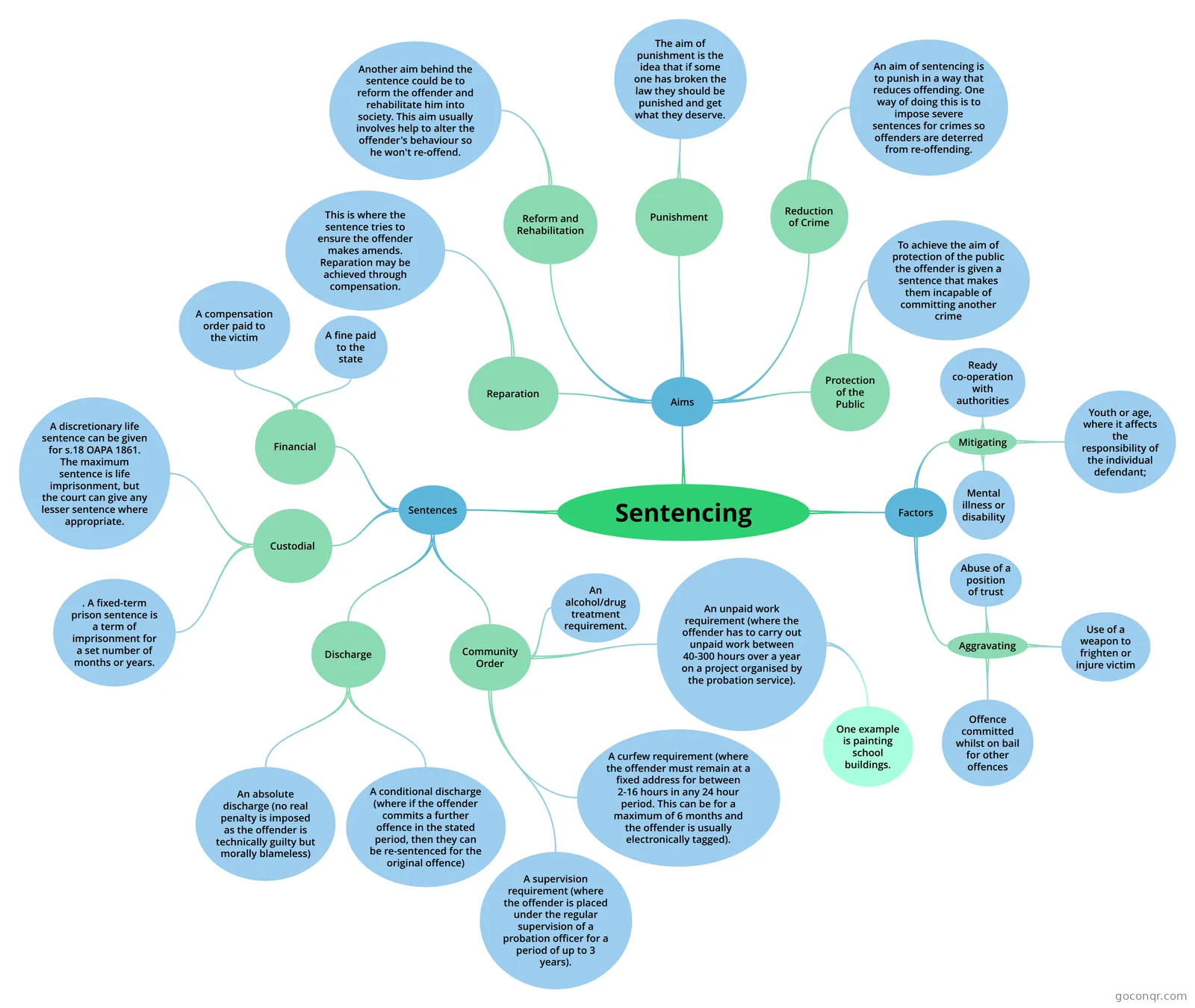 Mind map Sentencing SENTENCING MINDMAP
-
Mind map Custodial sentences in the Crown Court
-
36 cardsChpt 9
-
Mind map Penal Theory
-
119 cardsUntitled What is the role of the court in sentencing?
-
65 cardsDeathPenaltyFinal Where does the right to a jury come from?
-
39 cardsCorrectional Law Bell vs. Wolfish In a federal jail designed for one person per cell, prison was double bunking. Sued under ...
-
Mind map Penality
Quizzes
Mind maps
See all 64 mind mapsFlashcards
See all 35 flashcards-
36 cardsChpt 9
-
119 cardsUntitled What is the role of the court in sentencing?
-
65 cardsDeathPenaltyFinal Where does the right to a jury come from?
-
39 cardsCorrectional Law Bell vs. Wolfish In a federal jail designed for one person per cell, prison was double bunking. Sued under ...
-
22 cardssentencing practice sentences ought to be...
-
42 cardsChpt 10 jails
-
27 cardsUntitled what is the magistrates limitations in sentencing?
-
28 cardsCrime: 4) Sentencing and punishment What are judicial guidelines?
Notes
See all 11 notes-
Sentencing principles PURPOSES OF SENTENCING Court must have regard to the following while dealing with D: (s142(1) CJA 2003) Punishment of offenders Reduction of crime Reform and rehabilitation of Ds Protection of the public Making of rep...
-
Custodial Sentences
-
Non-custodial sentences FINES CC's powers to impose fines generally, CC can impose a fine on an offender either instead of, or in addition to, dealing with him in any other way sentences which CANNOT be combined with fine eg. hospital...
-
Sentences available to Youth Court Sentencing options available in respect of of youth includes: 1. Detention & training orders (DTO) [CUSTODIAL SENTENCE] available to YC and CC apply to Youth who has been convicted of an offence punishable with impris...
-
Dangerous offenders
-
Sentencing- Adult Offenders Sentencing Types: -custodial-Community-Fines-Discharges Magistrates: Maximum: 6 months / 12 months if second offence Crown: Maximum: Unlimited (must go along with sentencing guide lines) The Sentencing Council: -devel...
-
Sentencing Aims of sentencing Judges and magistrates look at the sentence available and what they are trying to achieve.Aims: UNDER THE CRIMINAL JUSTICE ACT 2003Retribution: Based on the idea that the offender deserves punishmen...
-
Aims of sentencing Aims of sentencing: Retribution/Punishment (Any crime) - Punishment imposed only the ground than an offence HAS been committed. (Tariff sentences, Sentence MUST be IN PROPORTION to the crime).Deterrence (London Riots)...
Slides
Topics in Sentencing and Punishment
More Criminal law topics
About Sentencing and Punishment
GoConqr OriginalWhat this unit covers
Most of the page is about how courts decide what happens to an offender. The aims come first: punishment, reduction of crime, reform and rehabilitation, protection of the public and reparation. The notes on sentencing principles link these to s142 of the Criminal Justice Act 2003. Later resources move on to the types of sentence a court can pass.
Where to start
Begin with the Sentencing mind map. It sets out the factors, the aims and the sentences in one view. Then open the Aims of Sentencing flashcards to fix the vocabulary: retribution, deterrence, incapacitation, rehabilitation and reparation. If you want theory, the Penal Theory mind map covers retributivism, deterrence, incapacitation, rehabilitation and restorative justice.
Sentences in practice
- Read the Non-Custodial Sentences mind map for discharges, fines and how fines are fixed and enforced.
- Move to the Custodial sentences in the Crown Court mind map, which covers release on licence after half of a sentence of 12 months or more, and licence conditions.
- Check the Seriousness & Sentencing mind map for the Sentencing Council and the duty to follow guidelines unless that would be contrary to the interests of justice.
- Finish with the notes on dangerous offenders and the notes on sentences available to the Youth Court.
Using maps and quizzes together
Read a map, close it, then try to rebuild it from memory. Use flashcards for definitions and short answers. The page also has two quizzes, so use them to see which areas still feel shaky, then go back to the matching map. The resources mention A-level Law, GCSE Law and HSC Legal Studies, so check which parts suit your course. A few decks come from other legal systems, such as the ones on correctional law and the death penalty, so treat those as extra reading.
Where it fits
This unit sits in the Courts, Trial and Sentencing strand of Criminal law. Choose one resource that matches what you are studying this week, and make your own flashcards or notes alongside it.
Frequently asked questions
Which resource should I open first?
Start with the Sentencing mind map. It brings together the factors, aims and types of sentence, so you get the whole picture quickly. After that, the Aims of Sentencing flashcards help you learn the key terms, and the Penal Theory mind map adds the theory behind them.
What do the mind maps cover?
There are over 60 mind maps. They cover the aims of sentencing, penal theory, seriousness and the Sentencing Council, custodial and non-custodial sentences, adult and youth sentencing, and factors that affect a sentence. Some repeat the same topic in different styles, so pick the one that reads best to you.
Are these resources free to use?
Yes. Every resource listed here is free to open, study and take, with no account needed. They were made by GoConqr users, not by GoConqr itself. A free account also saves your quiz scores and lets you create your own quizzes, mind maps, flashcards and notes.
Which exams and levels do they suit?
Most resources are pitched at secondary level, with a good share for university study and a few for professional candidates. The listed resources mention A-level Law, GCSE Law and HSC Legal Studies. Always check the content against your own course, as the contributors write for different courses.
Is there a quiz for this unit?
Yes, there are two quizzes on the page, CPL 410-430 and Week 6 Practice Quiz. Use them after reading a map or working through flashcards to see which areas need another look.
What if I can't find the topic I need?
Try the related maps and flashcards with different titles, since many cover the same ground under names like Sentence, Penality or Penal System. If a gap remains, you can make your own notes, maps or flashcards and keep them for revision.