
Mind map
Mozart - Symphony No. 40
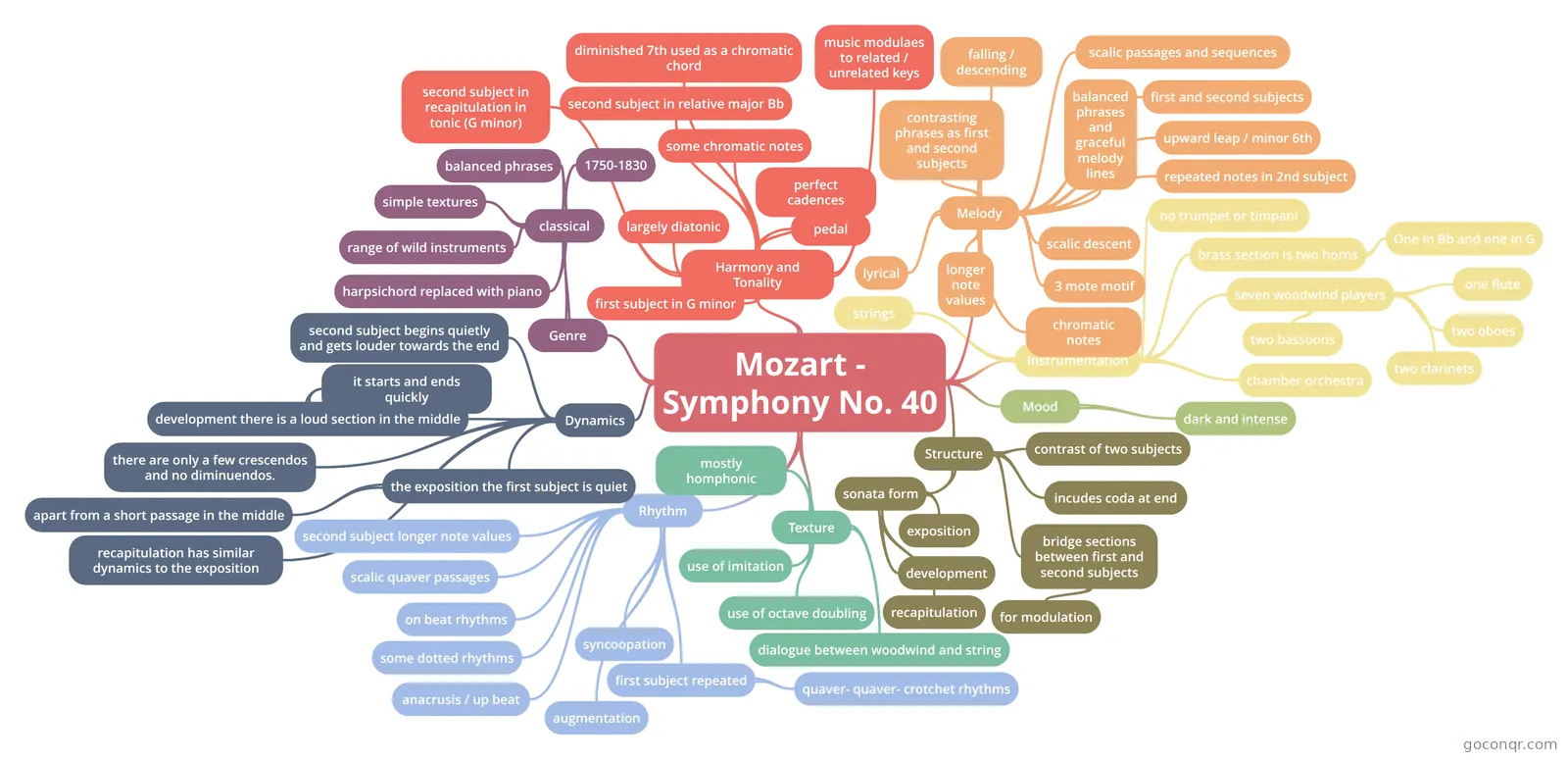
Mind map: Mozart Symphony No. 40
Map content
Mozart - Symphony No. 40
Harmony and Tonality
- largely diatonic
- some chromatic notes
- diminished 7th used as a chromatic chord
- perfect cadences
- pedal
- music modulaes to related / unrelated keys
- first subject in G minor
- second subject in relative major Bb
- second subject in recapitulation in tonic (G minor)
Instrumentation
- strings
- no trumpet or timpani
- brass section is two horns
- One in Bb and one in G
- seven woodwind players
- one flute
- two oboes
- two clarinets
- two bassoons
- chamber orchestra
Melody
- lyrical
- chromatic notes
- scalic passages and sequences
- falling / descending
- longer note values
- balanced phrases and graceful melody lines
- first and second subjects
- 3 mote motif
- scalic descent
- contrasting phrases as first and second subjects
- upward leap / minor 6th
- repeated notes in 2nd subject
Genre
- classical
- balanced phrases
- simple textures
- range of wild instruments
- harpsichord replaced with piano
- 1750-1830
- classical
Mood
- dark and intense
Structure
- sonata form
- exposition
- development
- recapitulation
- contrast of two subjects
- incudes coda at end
- bridge sections between first and second subjects
- for modulation
- sonata form
Texture
- mostly homphonic
- use of imitation
- use of octave doubling
- dialogue between woodwind and string
Dynamics
- the exposition the first subject is quiet
- apart from a short passage in the middle
- second subject begins quietly and gets louder towards the end
- development there is a loud section in the middle
- it starts and ends quickly
- recapitulation has similar dynamics to the exposition
- there are only a few crescendos and no diminuendos.
- the exposition the first subject is quiet
Rhythm
- first subject repeated
- quaver- quaver- crotchet rhythms
- on beat rhythms
- some dotted rhythms
- scalic quaver passages
- second subject longer note values
- syncoopation
- augmentation
- anacrusis / up beat
- first subject repeated
Information
- Description
- GCSE Music Mind Map on Mozart - Symphony No. 40, created by Alex Walmsley on 10/10/2016.
- Created by
- Alex Walmsley
- Views
- 0
- Rating