
Theatre Practitioners
85 resources created by 59 users
This Theatre Practitioners page on GoConqr gathers community-made mind maps, flashcards and notes on figures such as Brecht, Stanislavski, Artaud, Berkoff, Boal and Mary Overlie. It's built for school students revising a topic, university students and professional candidates filling gaps, and teachers after ready-made material. There are over 80 resources here, including more than 70 mind maps, with GCSE Drama among the exams mentioned. Pick a practitioner, open a map, then build your own flashcards.
Top Theatre Practitioners resources
Mind maps
See all 74 mind mapsFlashcards
-
8 cardsEpic Theatre Who wrote CCC
-
15 cardsPerforming Arts Practitioner Q's Give the Practitioner, Date, Main Themes, Features and Techniques of the Dance Green Table.
-
40 cardsActing Class Alexander Technique Recording
-
9 cardsSuzuki Methodology Tadashi Suzuki is a leading theatre director renowned for developing a technique of actor training known as?
-
3 cardsBrechtian Techniques Information about Brechtian Techniques
Notes
-
The six viewpoints - Mary Overlie Part 1: Definition By Mary Overli - All art functions through the arrangement of informationt specific logic systems. The six viewpoints can be seen and written about from the perspective of acting, directing, c...
-
Chekhov Chekhov returned to Lithuania in 1932, he had discovered a magical qaulity called "IT". He bought the question to the Lithuanian stage "Will something special happen in this room today?". He was on an intellectu...
-
Acting with our bodies: Grotowski Grotowski He suggested by listening to the wisdom of our bodiescan release ns,power and precision t on stage. Due to the paradoxical nature of acting, Grotowski suggested we needed courage to undertake it. It is not s...
-
Untitled BerkoffInfluences: Laurence Olivier - apparent from his one-man show ‘Shakespeare’s Villains’. Edmund Kean - admired as an actor and viewed as a role model, presenter of Shakespeare and combined passion with melodrama...
-
Strasberg part 2 The progression of the work Method works in three parts: Firstly, getting to trust the sensory work. Its really getting back to trusting yourself, your instincts and your realities. Then try sensory work in a mo...
Slides
Topics in Theatre Practitioners
More Performing arts (theatre, dance) topics
About Theatre Practitioners
GoConqr OriginalWhat this unit covers
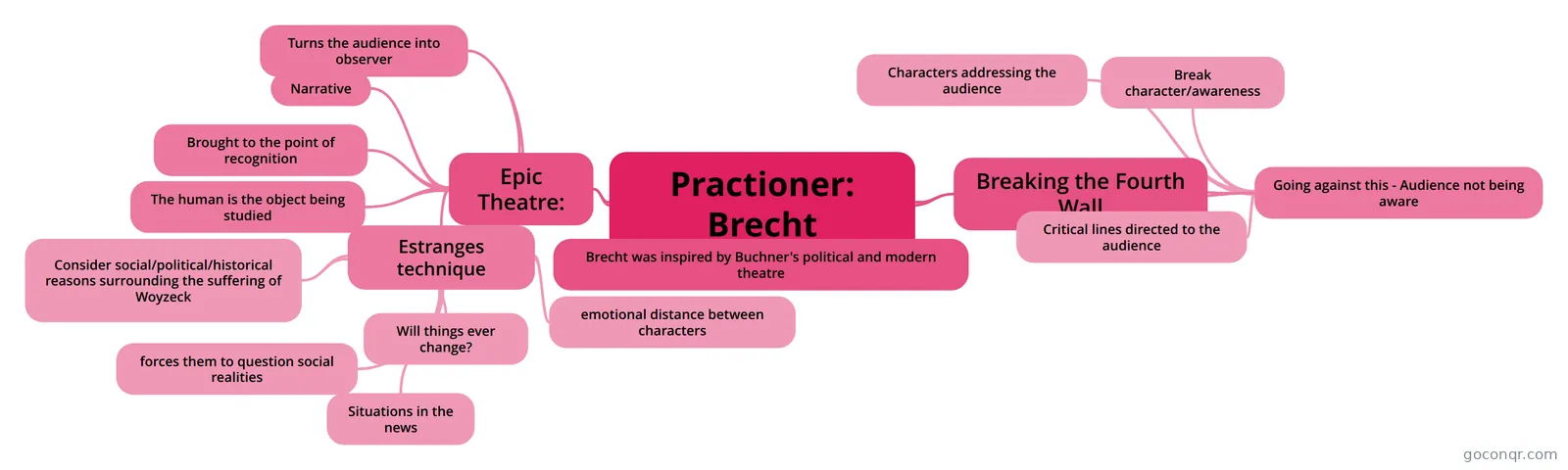
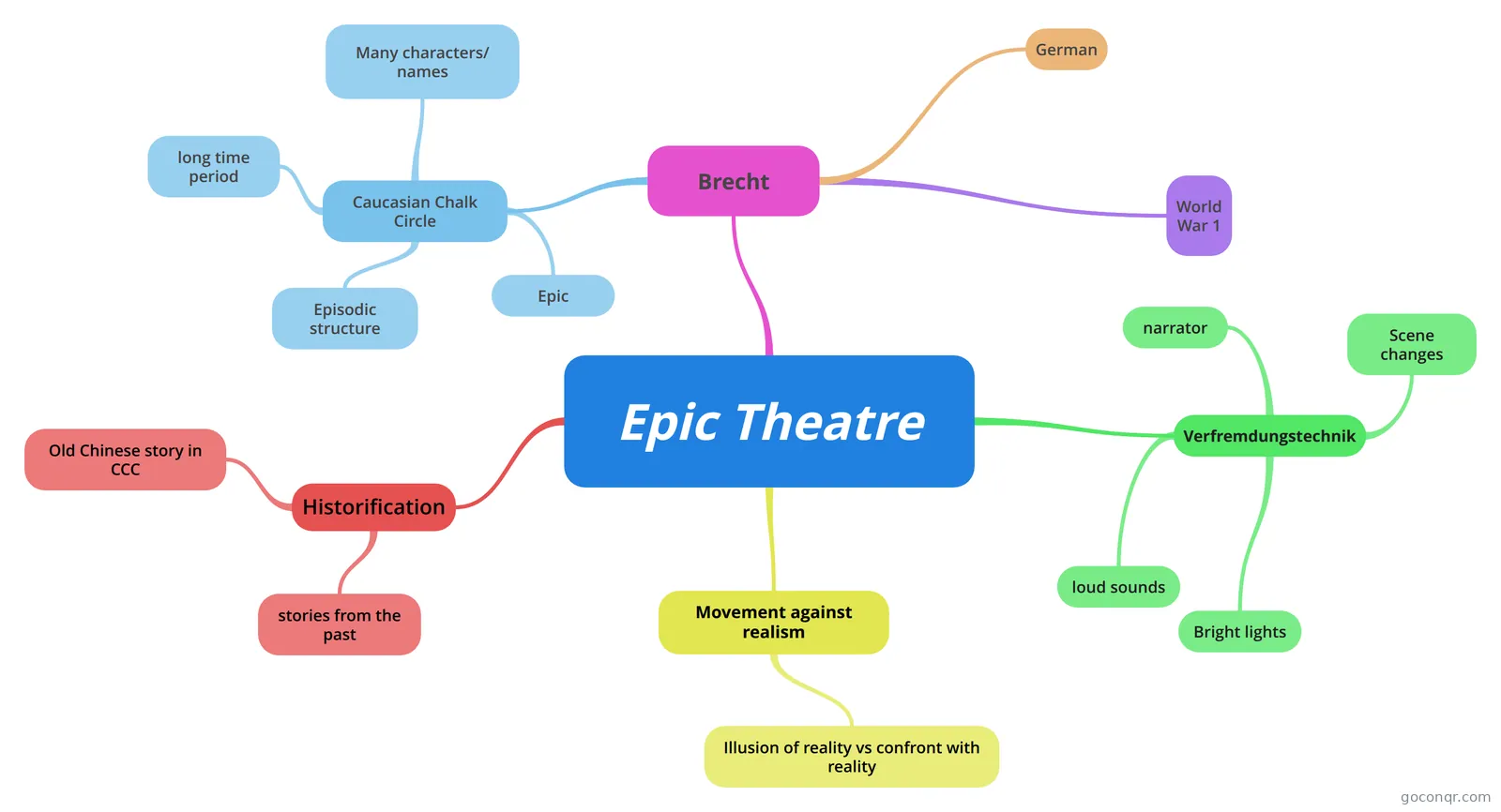
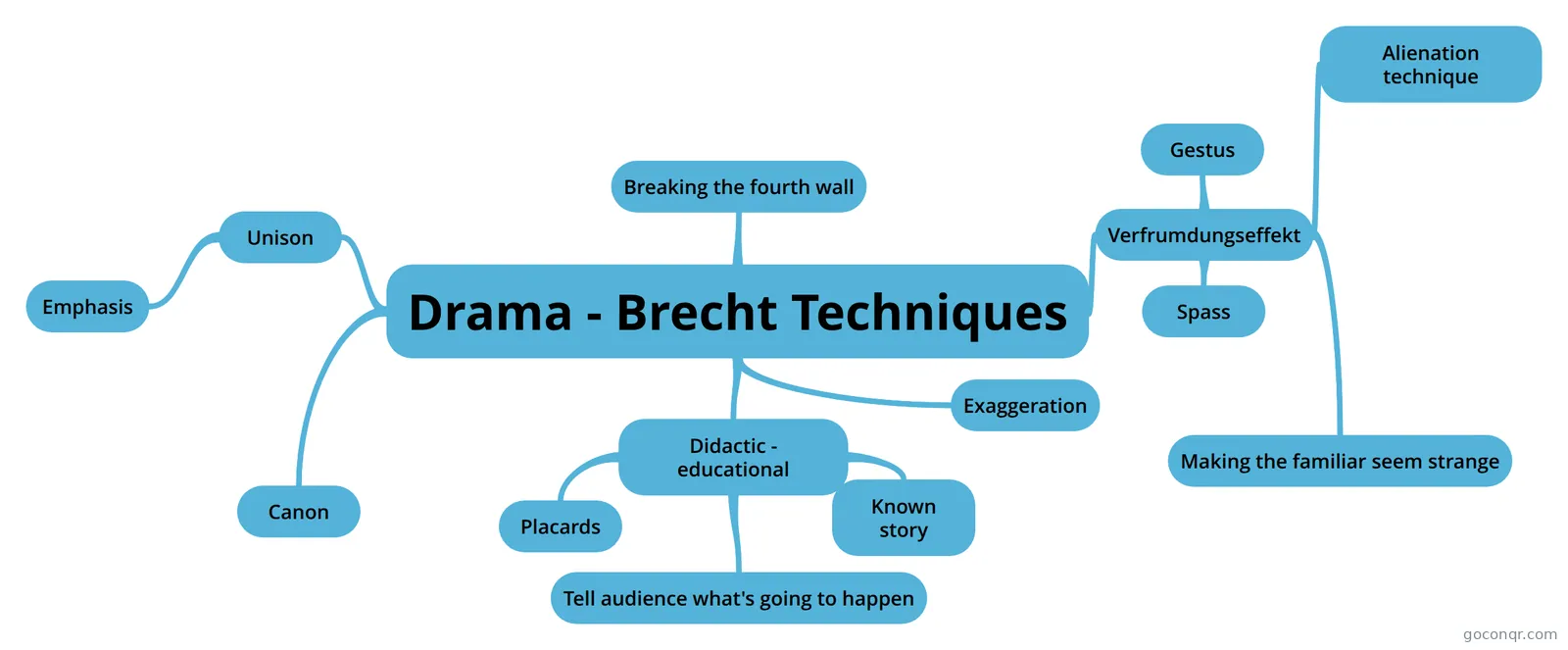
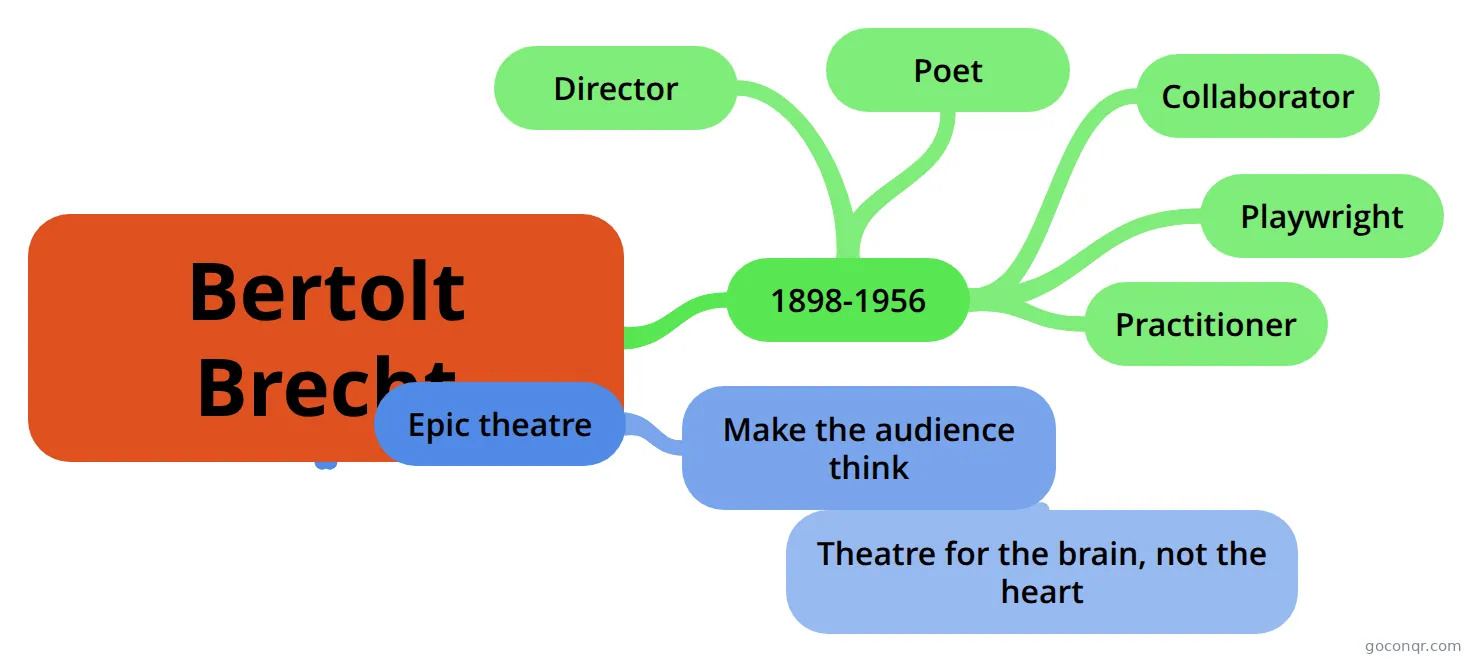
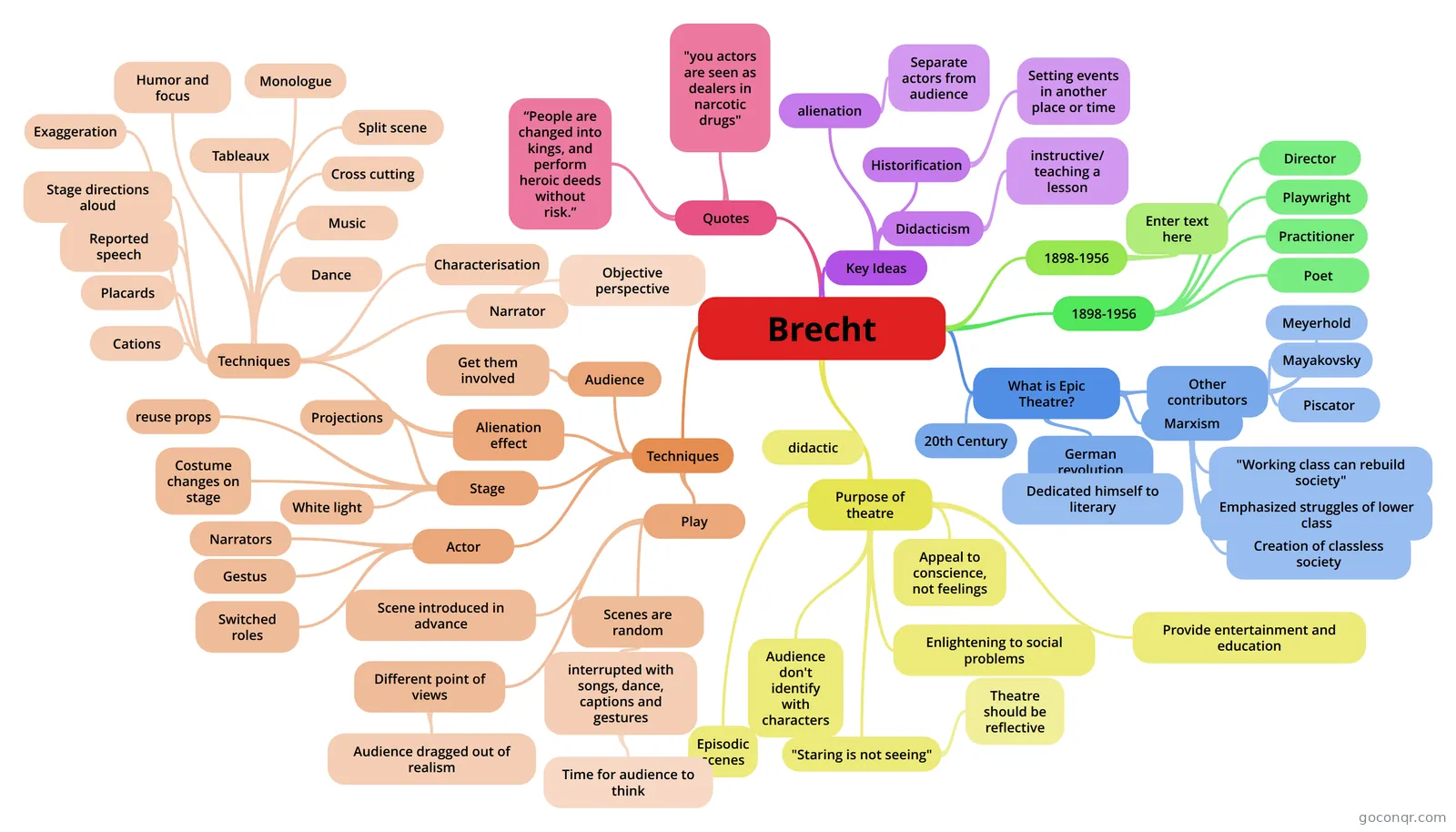
This unit collects revision material on theatre practitioners, and Brecht features most heavily. The maps on epic theatre and Brecht cover the movement against realism, Verfremdungstechnik, historification, narrators, placards, gestus and breaking the fourth wall. Several maps also look at his life, from 1898 to 1956, and at Brecht's Key Plays.
Beyond Brecht
Other maps cover a wide range of approaches:
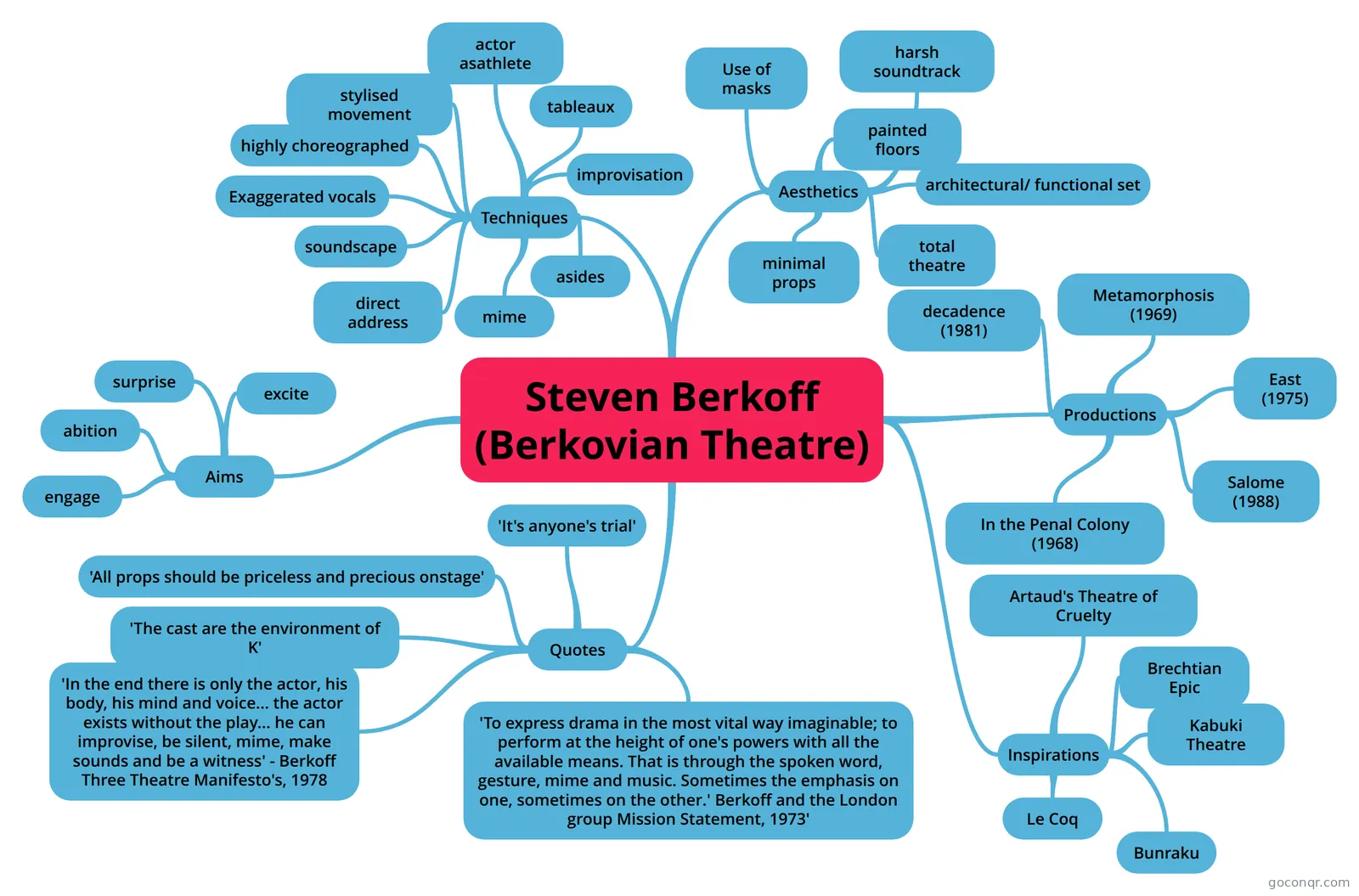
- Steven Berkoff and Berkoffian Theatre: mime, asides, direct address, stylised movement, masks and total theatre.
- VIEWPOINTS: Mary Overlie's categories and Anne Bogart's Six Viewpoints Training.
- John Godber, with his influences from Hull and from observing people.
- Stanislavski, including given circumstances and rehearsal techniques.
- Artaud, Theater of Cruelty, Forum Theatre, Frantic Assembly, Complicite, Katie Mitchell and Max Stafford-Clark.
There are also notes on Chekhov, Grotowski and Strasberg.
Where to start
- Open the Theatre Practitioners map for an overview.
- Read the Epic Theatre map, then Drama - Brecht Techniques, to learn the key terms.
- Test yourself with the Epic Theatre flashcards, which ask who wrote The Caucasian Chalk Circle, who Grusha is and how linear and episodic structures differ.
- Move on to one contrasting practitioner, such as Berkoff or Stanislavski.
Using maps and flashcards together
There are no quizzes on this page, so the flashcards do the testing. Read a map, cover it, and try to rebuild its branches from memory. Then run a deck such as Brechtian Techniques or Performing Arts Practitioner Q's to check what stuck. The Practitioners Lexicon map is handy for terms you keep forgetting.
Where it fits
This unit sits in the Theatre History and Practitioners strand of Performing arts (theatre, dance). Most material suits school students, including GCSE Drama, with some for university students and professional candidates. Pick one practitioner today and make a map or deck of your own to fill any gap.
Frequently asked questions
Which resource should I open first?
Start with the Theatre Practitioners mind map for an overview of the unit. Then open the Epic Theatre map and Drama - Brecht Techniques, which explain terms like Verfremdungseffekt, gestus and breaking the fourth wall. After that, choose another practitioner that interests you.
Which practitioners do the mind maps cover?
The maps cover Brecht most heavily, plus Stanislavski, Artaud, Steven Berkoff, John Godber, Augusto Boal, Katie Mitchell, Max Stafford-Clark, Frantic Assembly, Complicite and the Viewpoints of Mary Overlie and Anne Bogart. Some are short outlines, while others have detailed branches.
Are there quizzes on this page?
No, this page lists no quizzes. It has over 70 mind maps and some flashcard decks instead, including Epic Theatre, Brechtian Techniques and Suzuki Methodology. Use the flashcards to test yourself after reading a map, and check your answers against the map afterwards.
Which levels and exams do these resources suit?
Most resources suit school students, and GCSE Drama is the exam the listed resources mention. A smaller share is aimed at university students and professional candidates. Teachers can use the maps and decks as ready-made starting points for lessons or revision.
Are the resources free, and who made them?
Every resource here is free to open and study, with no account needed. They were made by GoConqr users, not by GoConqr. A free account also saves your scores and lets you make your own maps, flashcards and notes.
What if my practitioner is missing?
Check the other maps and notes first, as practitioners such as Chekhov, Grotowski and Strasberg appear in notes rather than maps. If yours is still absent, you can build your own mind map or flashcard deck on it.