
Fichas
attachment
Fichas del conjunto (80)
- 1What is meant by a bond?It is a set of feelings that ties one person to another for example a parent often feels strongly bonded with their new born babies.
- 2What is meant by an Attachment?It is an emotional reciprocal tie or relationship between two people shown in their behaviour for example an infant and their caregiver.An attachment takes longer to develop than a bond.
- 3Attachment Behaviours Seeking proximity:A young baby may watch their caregiver carefully and cry if they move too far away. An older baby may crawl after their attachment figure.
- 4Attachment Behaviours Separation distress:A young infant may show distress when the caregiver leaves the room even for a short period.
- 5Attachment Behaviours Joy on reunion:A baby may welcome back their attachment figure by clinging on to them.
- 6Attachment Behaviours Stranger anxiety:The baby will show a wariness of those not known to them.
- 7Attachment Behaviours General orientation towards the caregiver:The baby may direct their attention towards their caregiver who will reciprocate so engaging each other in activities and interaction.
- 8InteractionInteraction between a carer and infant helps to maintain and develop the attachment bond between them. Communication from the child may not necessarily occur via the use of language however communication occurs in a number of ways, which all help to fortify the attachment bond
- 9Interaction includes:Interactional synchrony
Reciprocity
Bodily contact - 10Interactional synchrony:When two people interact they tend to mirror what the other is doing in terms of their facial and body movements. This includes imitating emotions as well as behaviour. When the infant moves their body in tune with the rhythm of the carer this is known as synchrony.
- 11Reciprocity :The interaction that ocurs between the infant and the caregiver results in both parties responding to each other and eliciting a response from each other, therefore the interaction of similar behaviour patterns occurs between the infant and the carer.
- 12Bodily contact:physical interaction is partically important in the period immediately after birth and helps to form the attachment bond between the infant and the caregiver.
- 13Caregiver interactions in humans: strengthsResearch by Meltzoff & Moore looked at interactional synchrony in infants and found that as young as 2 or 3 week old infants imitated specific facial and hand gestures. Overall they found that there was an association between infants behaviour and thier adult models.
Klaus and Kennell (1976) investigated created an experimental group where mothers had an hour longer of skin-to-skin contact immediately after birth and then spent five hours longer with their babies over the next 3 days.They found that the experimental group formed closer bonds with their babies which produced noticeable differences in the degree of closeness between the child and the mother up to one year after birth. - 14Caregiver interactions in humans: weaknesses:Individual Differences – There is variation between infants interactional synchrony For example research by Isabella el at (1989) found that infant-caregiver pairs with stronger attachments demonstrated more interactional synchrony. So therefore a cause and effect can’t be established
Lack of consistent evidence- further research has failed to replicate the findings of Meltzoff and Moore, this challenges the reliability of interactional synchrony as a key aspect in securing the attachment. - 15The Formation of AttachmentsSchaffer and Emerson (1964) investigated the gradual development of attachments by studying 60 babies in Glasgow whom they visited monthly for their first year and again at 18 months. They used observation and interviews to conduct their research and used separation anxiety and stranger distress as their behavioural measurements.
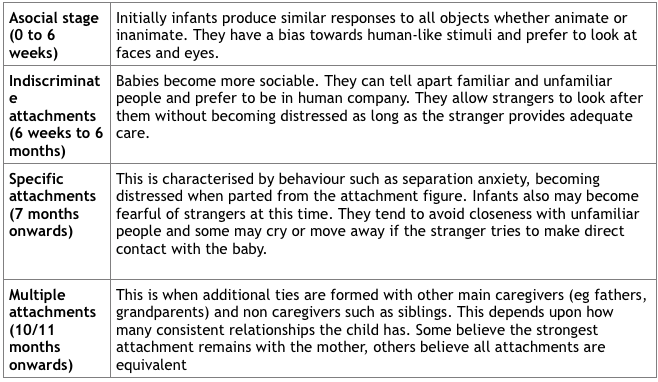
They found for 65% of babies, their first attachment figure was their mother and only 3% of babies formed their first relationship with their father. 27% formed joint attachments to mother and father at the same time. They did not necessarily form attachments with the person carrying out most of their basic care, in 40% of babies this was not their first attachment figure. - 16From their research Schaffer and Emerson concluded that attachment behaviours develop in stages which are loosely linked to age:
- 17The Formation of Attachments Evaluation:The methodology used was rich in detail and high in ecological validity as the babies were observed in their own homes and the mothers were asked about everyday situations. It may only reflect the 1960’s era however when mothers were less likely to work outside the home and fathers had a lesser role than today.
Others have challenged the accuracy of this stage account as very young infants have been found to be far more social than was originally thought. Carrying out research with very young infants is also highly problematic as it involves interpreting their responses and behaviour. - 18MULTIPLE ATTACHMENTSMost children form multiple attachments, which might include grand parent, sibling or childminder. Each of these attachments has a different purpose, for example, an attachment to mother is so they are provided with loving care where as an attachment to is because of excitable, unpredictable play. If a child has multiple attachments they will ben more likely to form and conduct social relationships and so therefore are at an advantage. In addition to this if they loose an attachment figure such as their father or mother they have severeal other attachment figures they can turn too .
- 19Schaffer and emerson demonstrated that children form multiple attachments between..... and what was the follow up research10 and 11 months
In follow up research, at the age of 18 months almost 31% of the children had multiple attachments to 5 or more attachments to a significant other such as, grandparents or siblings. Where as only 13% has a single attachment. - 20THE ROLE OF THE FATHEREvidently, fathers are having a much more significant role in parenting than before. Where as, traditionally they would go out to work to provide the resources for the family while mothers stayed at home to look after the children. As fathers are much more significant in their babies lives for example they are present at the birth and are involved in the rearing of the child on a equal basis with the mother, this has led to an interest in the role of the father and attachment. Fathers interact in very similar ways to the mother with their newborn for example ensuring they are warm (Christiansson, 1996).
- 21how do fathers behavioural roles differ to motherstheir behavioural style is different to the mothers as they are more involved in play which is more stimulating and unpredictable than the mothers. Mothers are more involved in the caretaking of the child and soothing them. Research has also demonstrated that mothers and fathers talk to their infants in different ways and about different things. For example, fathers structure talk around active play where as mothers’ talk is mainly emotional and designed to soothe the infant. Fathers are also more likely to encourage their infants to take risks and be brave during play (Paquette 2002). Grossman found that fathers play with infants was important for the quality of attachment in adolescence.
- 22THE ROLE OF THE FATHER strengths:Geiger (1996) support the notion that fathers are more like playmates and mothers are the caregivers as they found that fathers play interactions are more exciting and pleasurable than mothers, where as mothers are more nurturing and affectionate.
Fathers have a positive influence on developmental outcomes as children with secure attachments to their fathers go on to have better relationships with peers , display less problem behaviour and are more able to regulate their emotions. - 23THE ROLE OF THE FATHER Weaknesses:Contradictory evidence by Golombok (2004) found that children who grow up in single or same-sex parent families do not develop any differently from those in two-parent hetrosexual families. This suggests that the father roles as a secondary attachment figure is not important.
Hardy (1999) reported that fathers are less able to detect low level infant distress than mothers. This implies that males are less suitable as primary attachment figures. - 24ANIMAL STUDIES OF ATTACHMENT Lorenz (1935)divided fertile goose eggs randomly into two groups. Half were placed under the mother and allowed to hatch naturally and the remaining eggs were kept in an incubator. Lorenz made sure he was the first large, moving object to be seen by the incubator group. The goslings formed a rapid attachment to him and followed him around as if he were their mother. A short time after the geese had hatched Lorenz put all the goslings together in a container and then released them. They separated rapidly into two groups, each seeking their own “mother”. Lorenz called this formation of rapid attachments “imprinting”. Lorenz noted that imprinting was restricted to a very difinate period in the young animal’s life which is called the critical period. Therefore if exposure to a moving object doesn’t occur in the early stages of life within the critical period they will not imprint. Imprinting is a process like attachment which binds a young animal to its caregiver in a special relationship.
- 25ANIMAL STUDIES OF ATTACHMENT StrengthsSupporting research – Guiton (1966) found that chicks that were exposed to a rubber glove for feeding during the first few weeks, became imprinted on the glove.This supports the notion that young animals imprint during the critical period to a moving object which means its not innate.
The fact that imprinting only occurs within a brief, set time period influenced bowlbys idea of the critical period in human babies which is the specific time period within which an attachment between infants and carer must form. - 26ANIMAL STUDIES OF ATTACHMENT weaknesses:Generalising animal research to humans– as human behaviour is governed by conscious decisions and animals are not, application of animal research to humans is challenged. Therefore, confirmation from research on humans is needed before application from animal research is carried out.
As imprinting is irreversible, this suggests that it is biologically controlled as learned behaviours can be modified by experience - 27ANIMAL STUDIES OF ATTACHMENT Harlow and Harlow (1958) overviewdemonstrated that ‘contact comfort’ was more important than food in the formation of attachments amongst a group of rhesus monkeys, again questioning the principles of the learning explanation of attachment. Suggests the role of food is too simplistic.
- 28ANIMAL STUDIES OF ATTACHMENT Harlow and Harlow (1958) Procedure:Harlow created two wire monkeys that had different heads. One of the monkeys was covered in a soft cloth. Over a period of 165 days 8 rhesus monkeys were studied – for 4 of the monkeys the milk bottle was placed on the cloth –covered monkey and for the other 4 monkeys the milk bottle was placed on the wire mother monkey. Over the course of the study measurements regarding the amount of time spent on each of the monkeys was gathered. The infants response to being frightened by a mechanical teddy bear were observed.
- 29ANIMAL STUDIES OF ATTACHMENT Harlow and Harlow (1958) Findings:It was found that the 8 rhesus monkeys spent a majority of their time with the mother that was covered in cloth regardless of whether that mother had the milk bottle. The baby monkeys would return to the cloth-covered monkey after a short amount of time getting milk from the wire monkey. All the monkeys would cling to the cloth covered monkey when they frightened and for reassurance during play with new objects the baby monkeys would keep one foot on the cloth-covered monkey. The implications of this research is that attachment develops with the person that provides contact comfort and not the person who feeds them.
- 30Harlow and Harlow (1958) StrengthsLong-lasting effects: Continued research on the monkeys highlighted the consequences of early attachment experiences. The motherless monkeys developed abnormally, for example, they froze or fled when approached by other monkeys and didn’t cradle their own babies.
Unethical study justified – this research has clarified our understanding of attachment and has led to the assurance of better care for human infants. Therefore it could be argued that the benefits to society outweigh the costs to the monkeys involved. - 31Harlow and Harlow (1958)Confounding variables – the two mother monkeys varied in more ways than just being covered by cloth or not, they also had two different heads. It is possible that the reason the infant monkey preferred one mother to the other because the cloth covered monkey had a more attractive head. This means the implications of this study lack internal validity due to this confounding variable.
Ethical issues – the infant monkeys experienced long lasting emotional harm as the monkeys had difficulty forming peer relations. Therefore although the study can not be carried out on humans due to protection of participants its questionable whether it should have be carried out on monkeys. - 32LEARNING THEORY (also known as Behaviourism): Classical ConditioningThis theory argues attachment is learned through the processes of classical conditioning and operant conditioning. Classical conditioning is based on the principles derived from research by Pavlov on dogs. In attachment formation the stimulus of food (unconditioned stimulus) produces a response of pleasure (unconditioned response) in the baby. The person providing the food (usually the mother), who initially produces no response (neutral stimulus) overtime, becomes, associated with the food. Eventually the food-giver/mother becomes a conditioned stimulus, producing a conditioned response of pleasure, (even in the absence of food), meaning an attachment to the food-giver/mother is formed.
- 33LEARNING THEORY: Operant ConditioningAccording to the principles of operant conditioning, any behaviour that results in a reward (positive reinforcement) such as food will be repeated. Behaviours that “switch off” something unpleasant are also likely to be repeated (negative reinforcement).
In attachment formation, when a new born baby cries in response to discomfort (e.g. Pain/hunger), the carer will try to comfort the child by cuddling them or by providing food. This means the baby is likely to stop crying and settle down. This acts as negative reinforcement for the child as the cuddling/food “switched off” the unpleasant discomfort. Overtime the baby learns the carer can remove discomfort (e.g. pain/hunger), and as a result an attachment is formed to them. - 34Evaluation of Learning Theory StrengthsThere is a great deal of research evidence to support the processes of classical and operant conditioning, therefore it is valid to apply this theory to attachment formation also.
Dollard and Miller (1950) found babies are fed 2,000 times in their first year usually by their main caregiver. This provides great opportunity for an association between the caregiver and food/removal of hunger lending support for the processes of conditioning in attachment formation - 35Evaluation of Learning Theory WeaknessesSchaffer and Emerson (1964) found it was not always the person that fed the child that became the primary attachment, suggesting learning to form an association between food and the mother is unlikely to be the only reason for attachment formation. Other factors must be important too.
Harlow and Harlow (1958) demonstrated that ‘contact comfort’ was more important than food in the formation of attachments amongst a group of rhesus monkeys, again questioning the principles of the learning explanation of attachment. Suggests the role of food is too simplistic. - 36BOWLBY’S MONOTROPHIC THEORY OF ATTACHMENTBowlby was influenced by ethologists such as Lorenz’s ideas on “imprinting”.
- 37Bowlby generalised these ideas to humans and claimed:Infants display an innate tendency to become attached to one particular person (usually the mother).
Babies are genetically programmed to produce social releasers (such as crying) to attract the attention of the caregiver. These behaviours are adaptive as they promote survival.
The one particular or ‘special’ attachment is referred to as the monotropic bond.
This monotropic bond is qualitatively different from any attachments the child makes later and results in their “internal working model” of relationships.
The internal working model is a mental representation of what a relationship is like and forms the basis of what to expect from future relationships. Bowlby claimed the monotropic attachment is the basis for all later attachments – he called this the continuity hypothesis. - 38BOWLBY’S MONOTROPHIC THEORY OF ATTACHMENT StrengthsThere is research evidence to suggest security of attachment in infancy does affect later relationships (the continuity hypothesis and the internal working model) as Hazen & Shaver (1987) found there is a consistent relationship between early attachment type and later adult styles of romantic love. Black and Schutte (2006) provide further support with those recalling positive, loving, parental relationships being more trusting and open with their partners.
The developmental milestone of “crawling” occurs on average at 9 months. The fact that discriminate attachment is seen approximately one month prior to this may support the evolutionary argument as these attachment behaviours would enhance survival. - 39BOWLBY’S MONOTROPHIC THEORY OF ATTACHMENT WeaknessesThe theory does not explain why some children are able to cope better than others with poor early attachment experiences. It could be innate temperament rather than the internal working model affecting their subsequent ability to form healthy relationships.
The evolutionary argument cannot be proven. The behaviour may just be neutral rather than positive.
In many cultures children have equivalent relationships with many caregivers and still develop into healthy adults. Thomas (1998) claims in Caribbean cultures multiple attachments are the norm. - 40The Strange Situation:During the 1970’s Mary Ainsworth proposed a method for measuring the type of attachment relationship between an infant and its caregiver. The purpose of this method was to establish how securely attached the infants were, i.e. whether they felt safe enough to explore the environment around them when the caregiver was present or absent. In order to measure this Ainsworth used a structured observational method in the laboratory. This observation involved placing the infants (who were typically 12 – 18 months of age) in a comfortable room with toys, whilst trained observers hidden behind a one way mirror to record and classify their behaviour during the procedure.
- 41This method is called the strange situation as it involves placing infants in an unknown environment during which time 8 distinct episodes occur:
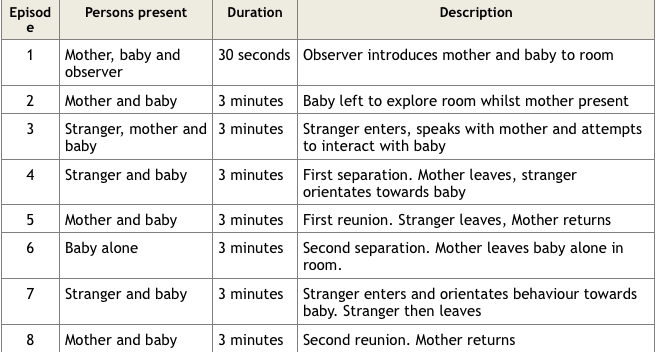
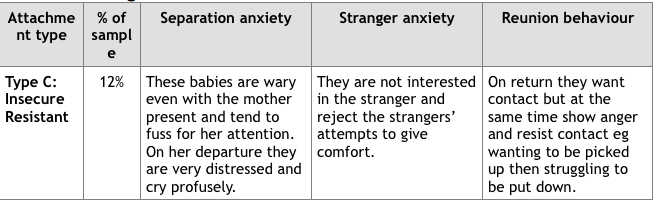
- 42During these 8 episodes the following key behaviours are assessed:Separation anxiety: this may occur when the mother is absent
Stranger anxiety: this may occur when the stranger is present
Reunion behaviour: this occurs during the reunion periods and is particularly important when assessing the quality of attachment between the infant and its mother/caregiver - 43Research findings: Type A: insecure avoidant
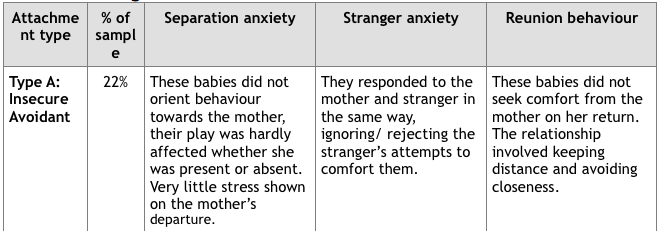
- 44Research findings: Type B: secure
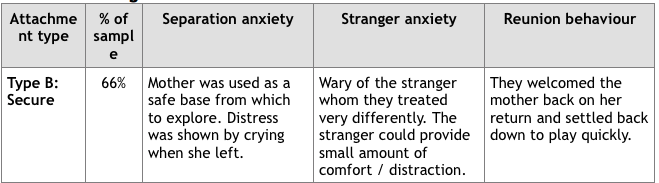
- 45Research findings: Type C: Insecure Resistant
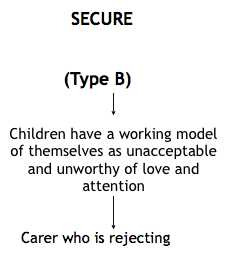
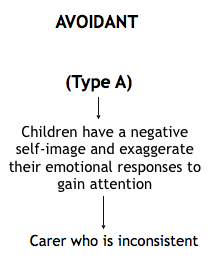
- 46It has been suggested that the attachment type depends on the sensitivity of the mother and this interacts in the following way: resistant
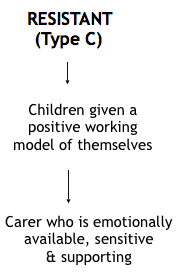
- 47It has been suggested that the attachment type depends on the sensitivity of the mother and this interacts in the following way: SECURE
- 48It has been suggested that the attachment type depends on the sensitivity of the mother and this interacts in the following way: AVOIDANT
- 49Evaluation of the Strange Situation StrengthsThe findings suggest that the strange situation is measuring something important and meaningful therefore it is a useful tool, giving a great deal of information in a short space of time.
The attachment classification system used (i.e. Type A, type B and type C) has been found to be reliable. For example, when living conditions remain the same an infants attachment type rarely changes over the long-term (Waters, 1978).
Secure infants have been rated by nursery school teachers as being less aggressive, more popular and having higher self-esteem. This suggest that secure attachment is correlated with more optimal (positive) types of behaviour. This also suggests that the strange situation procedure has predictive validity.
The use of a structured observation method helps control for extraneous variables and provides a technique which can be applied to all infants in the same way (standardized), therefore improving both validity and reliability. - 50Evaluation of the Strange Situation WeaknessesThe participant sample used by Ainsworth and Bell has been criticised for being unrepresentative, as they used only white middle class American babies. This sample does not reflect the entire American population or infants in other countries, meaning the results may not be cross-culturally valid.
The link between attachment type and later relationships is only correlational. It is not definite whether a type of attachment causes later behaviour as we cannot identify cause and effect.
Methodological criticisms: The ‘strange situation’ itself is artificial so may not reflect day to day life, meaning the attachment classifications maybe inaccurate. Also the categorisations allow for interpretation by observers which could introduce bias. Finally and some have criticised the study on ethics as children are put through distress. - 51CULTURAL VARIATIONS IN ATTACHMENTAttachment research has also been conducted in different cultures – as cultures adopt different child rearing practices it seems logical to assume that attachments may vary as well. N.B. Culture refers to the beliefs and customs that a group of people share, such as child rearing practices, not necessarily just a country.
- 52CULTURAL VARIATIONS IN ATTACHMENT Van Ijzendoorn & Kroonenberg (1988)carried out a meta-analysis of 32 different studies carried out in 8 different countries that used the strange situation methodology.
- 53CULTURAL VARIATIONS IN ATTACHMENT Van Ijzendoorn & Kroonenberg (1988) They examined over 2000 different strange sitautions. The results were as follows:Secure attachment was the most common form of attachment in all cultures studied.
Type A (Avoidant Attachment) was generally more common in western cultures than in non-western cultures.
The highest percentage of Type A attachments was in West Germany (35%).
Type C (Resistant Attachment) was generally more common in non-western cultures (such as Israel, China and Japan) than in western cultures. The highest percentage of Type C was in Israel (29%)
There was more variation within cultures (1.5 times greater variation) than across cultures - 54Fox (1977)studied child rearing practises in a kibbutz in Israel. Babies are placed in communal childcare when they are 4 days old and cared for primarily by a nurse known as a “metaplet”. The parents spend about 3 hours a day with their child after work, playing with them and cuddling them. When placed in the strange situation, they protested equally when either the mother or metaplet left but were more comforted by their mothers at reunion. Implications: Despite having multiple carers, the infants still had one special relationship. Also, the quality of the time spent together was more important than the amount of time, suggesting this is an important factor in attachment formation.
- 55Aviezer et al (1994)examined the kibbutzim sleeping arrangements where babies and young children sleep in large dormitories and concluded that the children were more likely to have insecure resistant attachments. Implications: practice is now changing so that children are cared for communally during the day but return to parents to sleep in the family house at night.
- 56Evaluation of cross-cultural researchThe Strange Situation methodology has received much criticism (see evaluations of the strange situation): Its use is based on the assumption that willingness to explore is a sin of secure attachment and separation anxiety means the same in all cultures which may not be true
Japanese children rarely leave their mother. Therefore, the anxiety could be due to this very unusual experience rather than because the infants were showing insecure resistant attachment. This means dependence rather than independence is a sign of secure attachment.
The use of the term “culture” is misleading – a culture often consists of various practices and behaviours that make up “sub-cultures” (eg different social classes). Van Ijzendoorn noted that the variation within cultures was nearly one and a half times the cross-cultural variation demonstrating the diversity in child rearing practices within a particular culture.
This suggests that to make generalisations about a culture is to oversimplify the relationships between caregivers and infants. - 57BOWLBY’S THEORY OF MATERNAL DEPRIVATION DEPRIVATION:occurs when a child has experienced substantial periods of separation, to the extent that the attachment bond is broken.
- 58BOWLBY’S THEORY OF MATERNAL DEPRIVATION The value of maternal care:Bowlby believed that children need a warm, intimate and continuous relationship with a mother to ensure continuing normal mental health. Therefore, ensuring that children are well fed, kept safe and warm enough. If this type of care is not provided for children due to frequent or prolonged separation they can become emotionally disturbed. However, this will only become a problem if it happens during the critical period which is before the age of two and a half or there is not a substitute mother available either male or female to avoid deprivation occurring. This is because deprivation has the potential to cause long-term harm such as emotional maladjustment or mental health issues.
- 59BOWLBY’S THEORY OF MATERNAL DEPRIVATION Key study: 44 Juvenile thieves procedureResearch into long term disruption of attachments was carried out by Bowlby (1944). He aimed to investigate whether frequent early separations led to behavioural and emotional disorders. While working in a child guidance clinic as a psychiatrist he examined 88 Participants aged 5-16yrs. 44 were referred for anti-social behaviours (‘thieves’) of which some were categorised as ‘Affectionless Psychopaths’. 44 were referred for emotional problems rather than antisocial behaviours of which none were Affectionless Psychopaths (lack affection, shame or sense of responsibility). The other half (44) were a control group.
- 60BOWLBY’S THEORY OF MATERNAL DEPRIVATION Key study: 44 Juvenile thieves findingsOf the ‘thieves’ who were Affectionless Psychopaths, 86% (12 out of the 14) had early & prolonged separations. Of the remaining ‘thieves’ 17% (5 out of the 30) had early & prolonged separations and only 4% of the control group had experienced early & prolonged separations.
- 61Implications:Early separations may be linked to juvenile delinquency/social maladjustment. In severe cases disruption of attachment causes emotional maladjustment
- 62Evaluation:- Only correlational data (can’t determine cause & effect) therefore other factors (eg family discord or poverty) may cause delinquent behaviour not prolonged separations.
- Inadequate control group used (emotional problems) and retrospective data. - 63Evaluation of Bowlbys theory of maternal deprivation strengthsSupport for long term effects – research suggests that maternal deprivation increases the likelihood of people experiencing mental health issues in late life. Antonia Bifulco et al (1992) found that 25% of women who had experience meternal deprivation due to maternal death or separation of more than a year, developed depression or an anxiety disorder. This was greater in those who had experienced separation before the age of 6 years, which supports Bowlbys critical period. Where as only 15% who has never experienced separation suffered with a mental health issue.
Real world application – Bowlbys theory has had a significant impact on child rearing practises and how children are looked after in hospital. For example, visiting children use to be discouraged or even forbidden. Children’s wards now encourage parental visits - 64Evaluation of Bowlbys theory of maternal deprivation weaknessesIndividual differences – Evidence suggests that not all children are affected by emotional disruption in the same way. Some children cope better due to being more securely attached and therefore more resilient where as insecurely attached children become distressed when separated (Barrett, 1997).
Research suggests other factors may influence the outcome of early maternal deprivation. Lewis (1954) found that prolonged early separation from the mother didn’t predict criminality or difficulty in forming close relationships. This study was a replication of bowlbys 44 theives research but on a larger scale. - 65ROMANIAN ORPHAN STUDIES:Unfortunately many Romanian parents were unable to afford to keep their children as the former president required woman to have five children. This meant that children ended up in orphanges which were of poor conditions. This tragedy has allowed the effects of deprivation/institutionalisation to be researched using orphan studies.
- 66InstitutionalisationInstitutionalisation is the behaviour patterns of children who have been raised in institutions such as orphanages or children’s homes. In the UK children are now likely to be placed with a foster family if their carers are unable to look after them however in other parts of the world they are regularly cared for in institutions.
- 67Rutter et al (2007)have been carrying out an ongoing longitudinal study for the past decade examining Romanian orphans who were adopted by UK families. They have been compared to a control group of UK born adoptees who were placed with families before the age of 6 months.
The Romanian orphans had been held in extremely poor institutional conditions. 58 of them had been adopted before 6 months old, 59 between 6 – 24 months of age and 48 between 2 – 4 years old who were classed as late adoptees. At the time of adoption over half the Romanians were malnourished, in the bottom third of the population for weight and head size. - 68Rutter et al (2007)Some were followed up at age 4, 6 and 11 using a range of measures eg interviews and observations. At 6 Rutter found evidence of disinhibited attachment, this was most common in the late adopted Romanian group with 25% showing this behaviour and was extremely rare in UK adoptees and early adoptees. Implications: Disinhibited attachments are most likely in children who have spent longer in institutions.
In 2007 some children were followed up aged 11. The disinhibited behaviour pattern was still evident in many adoptees. Of 83 Romanian children demonstrating this behaviour aged 6, 54% were still showing this 5 years later. Also some of this group were receiving special educational help and / or having input from mental health services. Implications: early intervention extremely important in reversing the effects of early childhood deprivation/privation. - 69Zeanah et al (2005) procedure :Attachment was assessed in 90 1-2.5 year old children of which 90% had spend most their life in institutional care. These children were compared to 50 children who had never lived in institutional care. They measured their attachment type using the strange situation and carers were asked whether any disinhibited attachment behaviour was displayed by the children such as clinginess or attention seeking behaviour directed inappropriately at adults (disinhibibited attachments)
- 70Zeanah et al (2005) findings:74% of the control group were found to be securely attached where as only 19% of the institutional group were securely attached in the strange situation. Of the institutionalised children 44% fitted the description of disinhibited attachment where as only 20% of the control group fitted this description.
- 71EFFECTS OF INSTITUTIONALISATION: Disinhibited Attachments:Children who have been raised in institutions such as orphanages or children’s homes show highly unusual behaviour, as they are equally affectionate to people they know well and people they have just met for the first time. This is evidence of disinhibited attachements as most children demonstrate stranger anxiety from an early age. This is supported by Rutter (2006) who suggested that DA is a result of living with multiple caregivers during the sensitive period of attachment formation, this is because children could have up to 50 caregivers.
- 72EFFECTS OF INSTITUTIONALISATION: Mental Retardation:Institutionalisation can cause damage to intellectual development as well as emotional development, however if adoption takes place before the age of 6 months development can be recovered. Rutter found that the Romanian children who came to Britain showed signs of mental retardation but recovered and caught up with the control group by the age of 4 if they were adopted by the age of 6 months.
- 73Evalutation of Romanian studies: strengthsReal life application – This research has resulted in improvements in the way children are cared for in institutions. Children who live in children homes now have a key worker and are looked after by a smaller amount of carers. This is because we have a better understanding of the effects of institutionalisation as a result of studying Romanian orphans and as a result can reduce the chances of them being disinhibited in their attachments.
Supporting evidence – research suggests rutters results are reliable. Similar findings were found with a group of Romanian Orphans adopted by Canadian adoptive parents (Morison and Elwood, 2005). - 74Evalutation of Romanian studies: weaknessesLacks Generalisability – Romanian orphanages provided a very low standard of care particularly when it came to forming relationships with the children and providing intellectual stimulation. Therefore, due to the situational variable within the Romanian orphan studies the results cant be applied to other orphanages and increase our understanding the impact of better quality institutional care.
Ethical Issues – In Zeanah’s research children were randomly allocated to institutional care or foster care to avoid the confounding variable of children being picked by parents because they were more sociable. - 75THE ROLE OF THE INTERNAL WORKING MODEL:Bowlby suggested tha children’s first relationship with their primary attachment figure forms a mental representation in which all future relationships are based on. This template will have a significant impact on the nature of their future relationships which means that children who have a bad experience in their first attachment will bring those bad experiences into future relationships for example display type A or C behaviour towards friends and partners. However, this also means that those who go on to have good experiences in future relationships will have had first experiences which consisted of a loving relationship and a reliable caregiver.
- 76Attachment and childhood relationships:Kerns (1994) found that securely attached infants tend to form the best quality childhood attachments and those who are insecurely attached have difficulties with friendships. Youngblade and Belsky (1992) found that 3-5 year olds who were securely attached got along better with other children and were more likely to form close relationships than insecurely attached children. Sroufe and Fleeson ( 1986) found that children who were insecurely attached were more dependent on teachers for emotional support and interactions.
- 77Attachment and adult relationships: Hazen and shaver (1987) procedurecarried out a love quiz to examine if attachment type in childhood is linked to love in adulthood. The quiz asked them about their current attachment experience and early childhood attachment to identify their attachment type for both. To assess their internal working model they asked them about attitude towards love. In total they analysed 620 responses from a cross section of the population. The sample consisted of 620 participants, 205 were males and 415 were females.
- 78Attachment and adult relationships: Hazen and shaver (1987) findingsWhen assessing the self-report questionnaires it was found that their current attachment style was similar to there infant attachment type – 565 were classified as secure, 255 avoidant and 195 resistant. There was a positive correlation between attachment type and love experiences. Adults who were securely attached described their love experiences in a positive way and their relationships were more enduring lasting on average of 10 years and were less likely to get divorced. Where as, those who were insecure in their attachment styles had relationships that were not as enduring, lasting between 5 and 6 years. There was also findings that those who were securely attached had positive internal working models. This supports the relationship between the concept of love (IWM) and attachment type.
- 79Evaluation of the influence of early attachment: StrengthsSupporting research by Belsky (1999) – found that women who were insecurely attached experienced more conflict with husbands on topics related to time spent together and house hold division of labour than securely attached women.
Support for the internal working models by McCarthy (1999) found that women who were insecure avoidant attachment types had less successful adult romantic relationships. Those who were insecure resistant had problems forming non-romantic adult friendships. - 80Evaluation of the influence of early attachment: weaknessesOverly deterministic – the implication is that early experiences of attachment will inevitability effect later adult relationships. This means that children who are insecurely attached are doomed to experience unsatisfactory/ overly emotional relationships in adulthood. However, various research has found that those who are insecurely attached have gone onto develop healthy adult relationships (Simpson et al, 2007)
The research that links the internal working model/ early attachment with later adult experiences is correlational but not experimental therefore a cause and effect between early attachment and later adult relationships cant be established. It needs to be considered that innate temperament affects both early and later attachments as they can influence the way the parent interacts with the child. This makes innate temperament an interfering variable.
Información
- Descripción
- (Paper 1) Psychology Fichas sobre attachment, creado por megan trent el 29/01/2019.
- Creado por
- megan trent
- Visitas
- 0
- Valoración