
Fichas
Cells And Cell Techniques - Flashcards (AQA AS-Level Biology)
Fichas del conjunto (47)
- 1What is a prokaryotic organism?A single-celled organism made up of a single prokaryotic cell.
- 2What is a eukaryotic organism?A multi-cellular organism made up of eukaryotic cells.
- 3What is found inside both eukaryotic cells and prokaryotic cells?Organelles.
- 4Which type of cell is more complex: prokaryotic or eukaryotic cells?Eukaryotic cells are more complex.
- 5Name 4 types of eukaryotic cell.Animal, plant, fungal and algal cells are eukaryotic cells.
- 6Name the 11 organelles found in a typical animal cell.Cell (or plasma) membrane, rough endoplasmic reticulum, smooth endoplasmic reticulum, nucleus, nucleolus, lysosome, ribosome, nuclear envelope, Golgi apparatus/body, cytoplasm, mitochondrion.
- 7Name the 3 organelles found in plant cells but not in animal cells.Cell wall made of cellulose with plasmodesmata, vacuole and chloroplasts.
- 8What is the function of chloroplasts?To facilitate photosynthesis.
- 9In a plant cell, what do plasmodesmata do?Allow exchange of substance between adjacent cells.
- 10What is the cell membrane and what is its function?Membrane made of lipids and protein
Regulates movement of substances in and out of the cell
Has receptor molecules on it - 11What is the nucleus and what is its function?Large organelle surrounded by nuclear envelope (double membrane) which is covered in pores
Nucleus contains chromosomes and one or more nucleoli
Nucleus controls the cell's activities by controlling the transcription of DNA
Pores in envelope allow substances (e.g. RNA) to move in and out of the nucleus
Nucleoli make ribosomes - 12What are mitochondria and what is their function?Small, oval-shaped organelles
Has a double membrane
Inner membrane is folded to form structures called cristae
Inside is the matrix which contains enzymes involved in respiration
Mitochondria are the site of aerobic respiration
Aerobic respiration produces ATP
Cells with high energy needs usually have lots of mitochondria - 13What is a chloroplast and what is its function?Small, flat structures filled with a liquid called stroma found in plant and algal cells
Surrounded by a double membrane
Contains membranes called thylakoid membranes
Thylakoid membranes are stacked up to form grant
Grana are linked together by lamellae, thin flat pieces of thylakoid membrane
The site of photosynthesis - takes place in the grana or the stroma - 14What is the Golgi apparatus/body and what is its function?A group of flat membrane-bound sacs of fluid
Vesicles are found near the edges of the sacs
Processes and packages new lipids and proteins
Also makes lysosomes - 15What is a Golgi vesicle and what is its function?Small fluid-filled sac
Found in the cytoplasm
Produced by the Golgi apparatus
Stores lipids and proteins made by the Golgi apparatus and transports them out of the cell - 16What is a lysosome and what is its function?Round organelle surrounded with a membrane
No clear internal structure
Type of Golgi vesicle
Contains digestive enzymes called lysosomes
Function is to digest invading cells or worn out cell components - 17What is a ribosome and what is its function?Very small organelle
Attached to rough ER or floating in cytoplasm
Made of proteins and RNA
Does not have a membrane
Function is to make proteins - 18What is a rough endoplasmic reticulum and what is its function?System of membranes filled with fluid
Surface covered in ribosomes
Function is to fold and process proteins made by the ribosomes - 19What is the singular of cristae?Crista
- 20What is the difference in structure between rough and smooth endoplasmic reticula?Smooth ER have no ribosomes
- 21What is the function of a smooth endoplasmic reticulum?To synthesise and process lipids
- 22What is a cell wall and what is its function?Rigid structure made of cellulose in plants and algae or chitin in fungi
Function is to support cells and prevent them from changing shape - 23What is a cell vacuole, what type of cell is it found in and what is its function?Membrane-bound organelle found in plant cells
Filled with cell sap (solution of sugar and salts)
Membrane is called the tonoplast
Function is to maintain pressure inside the cell and keep the cell rigid to stop the plant from wilting
Also isolates unwanted chemicals inside the cell - 24What type of cell are bacteria?Prokaryotes
- 25Do prokaryotic cells have a nucleus?No, they have a single long, loose piece of DNA. They also have plasmids, small loops of DNA that aren't part of the main piece of DNA that contain genes like antibiotic resistance. Not all prokaryotes have plasmids
- 26What is a flagellum?A long hair-like structure that rotates to move the cell
- 27What type of cell can have flagella?Prokaryotic
- 28What type of cell always has a cell wall - prokaryotic or eukaryotic?Prokaryotic
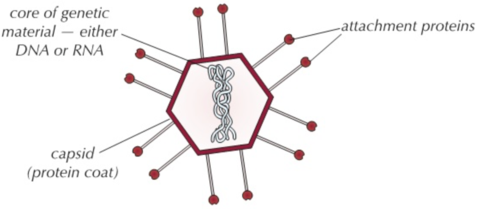
- 29Are viruses a type of cell?No. They are acellular
- 30What are viruses?DNA surrounded by protein
- 31Are viruses alive?No
- 32Draw the basic structure of a virus.
- 33What do attachment proteins do?Allow the virus to cling onto host cells
- 34Which is larger - bacteria or viruses?Bacteria
- 35How do you calculate magnification?Magnification = size of image / size of real object
- 36How many micrometers are in 1mm?1000
- 37How many nanometres are there in 1μm?1000
- 38How many nanometres are there in 1mm?1,000,000
- 39Define resolution.The minimum distance between two points or objects at which they can be seen as separated.
- 40Define magnification.The number of times bigger the image appears compared to its actual size.
- 41Which has the highest resolution - optical microscopes or electron microscopes? Why is this so?Electron microscope as the wavelength of an electron beam is less than that of a ray of light.
- 42Which has the highest magnification - optical or electron microscopes?Electron
- 43What is the maximum magnification of an optical microscope?1500x
- 44Name the two types of electron microscope.Transition and scanning (TEM and SEM)
- 45What are the pros and cons of TEMs?Pros: high resolution, allows you to see inside of cells
Cons: samples have to be very thin, can only be used on non-living samples - 46What are the pros and cons of SEMs?Pros: can be used on thick specimens, produces 3D images
Cons: lower resolution than TEMs, can only be used on non-living samples - 47How do you calculate the magnification of a microscope given the focal lengths of the objective and eyepiece lenses?Magnification = objective lens focal length * eyepiece lens focal length
Información
- Descripción
- Flashcards for the 'Cells and Cell Techniques' unit in the 2015 AQA AS Biology specification
- Creado por
- Henry Kitchen
- Visitas
- 2.392
- Etiquetas
- Valoración