
Fichas
Cognition and Emotion
Fichas del conjunto (48)
- 1Biological PreparednessEvolved to 'fear' phobic stimuli in the natural world. Emotional stimuli that elicit automatic responses are critical to survival/reproductive success.
- 2Winkielman et al.Strong effects of subliminally presented emotional faces on behaviour (consumption, willingness to pay and wanting more of a drink). BUT no effect on subjective moods or ratings of how much they liked the drink. Only present in thirsty pps.
- 3Unconscious priming behaviourExposure to unconcscious stimuli effects behaviour and decision-making. E.g. John Bargh found that people drive a harder bargain sitting on hard chairs vs soft chairs.
- 4Cognitive bias towards emotional stimuliTests demonstrate the influence of emotional stimuli on attention, memory and decision-making. Used to asses cognitive biases in disorders and possibly modify to treat.
- 5AttentionA process by which specific stimuli within the external and internal environment are selected for further processing
- 6Detection tasksA paradigm to assess attentional bias. If someone is prone to attending to specific stimulus, they should detect faster than distractors.
- 7Attentional biasSelective allocation of attention to disorder-related stimuli over neutral stimuli
- 8Visual search taskA paradigm to assess attentional bias. The pp is shown an array of stimuli and they must detect a target stimulus as quickly as possible. Selective attention measured as the extent to which the stimuli surrounding the target stimulus slow down the speed of detection.
- 9Emotional Stroop taskA paradigm to assess attentional bias. Say the colour of the word, not the word itself. Compare time when the word is neutral or related to a disorder. However hard to interpret as disorder relevant words may trigger rumination, induce an emotional reaction or produce cognitive avoidance slowing response.
- 10Dot probe taskA paradigm to assess attentional bias. Two cues presented simultaneously and must press response button when detect dot on the screen. Response time indicates preferential processing of on cue compared to the other. Look at degree of selective attention to emotional cues vs neutral.
- 11Modified attention probe taskA paradigm to assess attentional bias. Adapted to distinguish between engagement and disengagement biases. A cue stimulus is presented before and after pairs of target stimuli. Can assess whether pps are faster to move attention towards the location or slower to move attention away.
- 12Problem with the dot-probe paradigmGenerally gives a clear and unambiguous measure of attention. However, can't distinguish between engagement and disengagement. Responding faster to emotional locations could be due to either enhanced attentional engagement or greater difficulty disengaging attention from them. The index of attentional bias can't distinguish between them.
- 13Attentional bias in anxietyReliable evidence of a bias for Bias for threatening information for both for subliminal and supraliminal stimuli.
Eye-tracking suggests increased vigilance for threat and slower disengagement. - 14Attentional bias in depressionMeta-analysis suggests a bias and greater ‘lingering’ of attention on sad stimuli.
Eye-tracking shows maintenance of gaze on sad stimuli and less on positive stimuli. However, mixed evidence. General idea is difficulty disengaging from negative stimuli but no orienting bias. - 15Effect of emotional stimuli on the brainCause early neuronal responses prior to identification. Cause increased functional connectivity between the amygdala and visual cortex. Amygdala lesions abolish bias for emotional words.
- 16Key mechanisms of memoryEach stage (encoding, storage and retrieval) may be relevant to development of psychopathology. Many factors affect what's encoded and retrieved - stimulus salience, mood and environment.
- 17Weapon focus effectExamp of selective memory/attention. Reduced ability to recall other details from the environment and about the assailant.
- 18Flashbulb memoryA hghly detailed, exceptionally vivid 'snapshot' of the moment and circumstances in which a piece of surprising and consequential (or emotionally arousing) news was heard.
- 19Role of the amygdala in encodingPET scan study found an enhanced memory for emotional scenes vs neutral. The degree of enhancement positively correlated with amygdala activity.
Amygdala lesions reversed memory bias for emotional memories. - 20Altering memoriesWould be useful e.g. in PTSD. Suggested that memories could be modified by blocking reconsolidation which requires protein synthesis in the amygdala.
- 21Mood-congruent memoryThe selective encoding or retrieval that occurs while individuals are in a mood state consistent with the affective value of the material. E.g, in a sad mood it is easier to recall sad info. Could cause the maintenance of depression.
- 22Over-general memoryAutobiographical memory not as detailed and specific. May protect individuals from re-experiencing too many strong emotional responses associated with specific negative memories. Over-general autobiographical memory to negative prompts is a risk factor for depression in 10-18 year olds.
- 23Mood-state dependent memoryBetter free recall when in hte same mood at encoding and retrieval. Pps able to free-recall a map route better when put in the same mood (happy/sad music).
- 24Effect of antidepressants on memoryAfter 7 days on antidepressants, controls showed decreased recognition of negative emotional expressions and greater free recall of positive words. Increase positive bias in attention and memory.
- 25Summary of cognitive biases in anxietyAttentional = +++
Interpretive = ++
Memoey = + - 26Summary of cognitive biases in depressionAttentional = +
Interpretive = +
Memory = +++ - 27Attentional bias modificationPatients with anxiety and depression are trained to attend away from negative stimuli. This can lead to a reduction in symptoms.
- 28Cognitive bias modification in obesityTrain attention and responses away from unhealthy food to healthy food. A study showed intervention led to reduced brain reward and attention region responses to high-calorie food images.
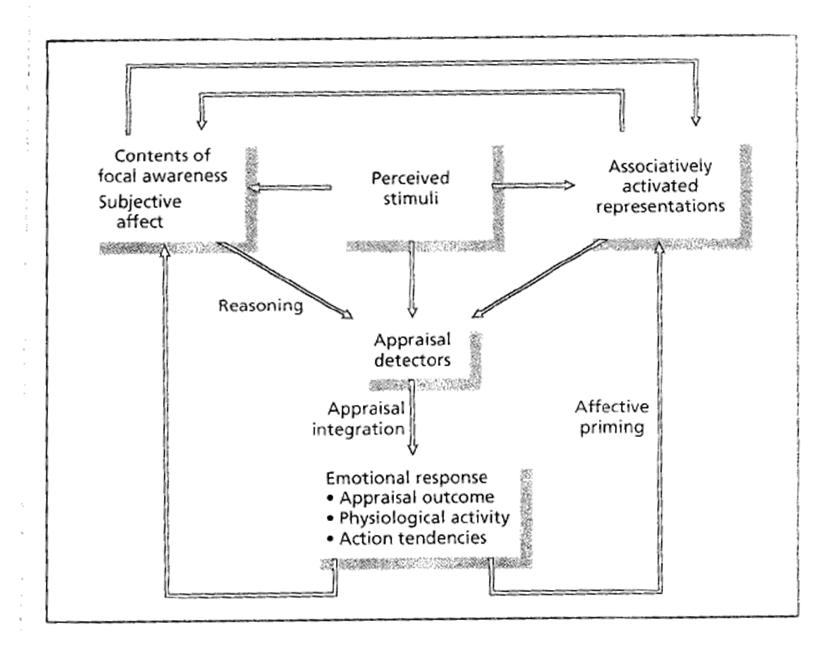
- 29Appraisal theoriesAppraisals start the emotion process. Can be conscious or auromatic. Different levels of appraisal.
- 30Primary appraisalEvaluate motivational relevance e.g. positive / negative / irrelevant to wellbeing
- 31Secondary appraisalEvaluation of resources and options for coping
- 32ReappraisalStimulus and coping strategies are monitored, with earlier appraisals being modified if necessary.
- 33Emotion regulationThe management and control of emotional states by various processes.
- 34Altering appraisalsA way of regulating emotion. E.g. a socially phobic individual could avoid stressful social situations, modify the situation by bringing a friend along, or by using attentional deployment. Some strategies are pro-active (e.g. Reappraisal) and others are reactive (e.g. Response suppression).
- 35Ochsner and Gross modelModel of emotion regulation.
1. Behavioural control (supressing emotional expression.
2. Attentional control (distraction)
3. Cognitive change (reappraisal)
Proactive strategies more effective (3) - 36Brain in emotion regulationNeuroimaging studies of emotion regulation show that many of the mechanisms are not unique to emotion regulation but are also involved in cognitive control. E.g. the dorsolateral prefrontal cortex plays an important role in working memory and emotion regulation.
- 37Distraction vs reappraisalMay work by occupying the limited capacity of working memory with information that ‘displaces’ negative emotional material. More demanding cognitive tasks reduces negative mood. fMRI found appeared to be related to increased DLPFC activation during complex arithmetic.
- 38Emotion regulation in depressionPps with depression showed sustained amygdala repsonse to the negative word that persisted thorugh the working memory part of the trial. Inverse relationship between DLPFC and amygdala response to negative words. Pps with depression didn't switch off in memory task.
- 39Selective attention in emotion regultaiionIn particular the ability to successfully ignore negative stimuli. The anterior cingulate is activated when people try to overcome interference or cognitive conflict in tasks. Studies suggest that a different part of the AC (‘affective division’) is involved in overcoming interference in the emotional Stroop to the part (‘cognitive division’) that is active during the non-emotional Stroop test.
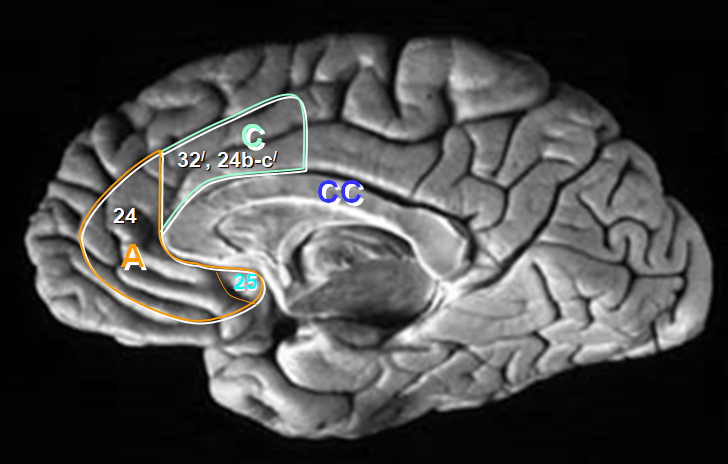
- 40Ventral anterior cingulateInvolved in the regulation of emotional states.
- 41Cognitive bias and the ACIn patients with depression, increased activation in the rostral anterior cingulate is positively associated with the level of Stroop interference from negative emotional words. Bias towards sad targets in depression linked to increased anterior cingulate response. Decreases in ventral anterior cingulate responses to increasing intensity sad faces correlated with antidepressant response
- 42Brain stimulation in depressionPET found that the ventral AC was involved in transient sadness in control and depressed mood. Successful treatment led to decreased blood flow. Simulating white matter in this region improved mood and reversed abnormal brain activity. Overlap in the involvement of the AC in sad mood, negative cognitive bias and depression.
- 43Brain training to improve emotion regulationGroups receive 20 days of emotional working memory or control training. Brain training activates working memory network and deactivates emotional regions (amygdala/insula). Task performance improves with training but also on untrained emotion regulation tasks.
- 44Ventromedial prefrontal cortexLesions cause impairment of emotional expression identification , impulsiveness, misinterpretation of other people’s moods and importantly impaired decision-making.
- 45Phineas GageCase study of previously kind man turned rude due to a frontal lobe injury.
- 46Iowa Gambling TaskPsychological task to imitate real-life decision making. Patients with ventromedial frontal lobe lesions are particularly impaired and people with substance use disorders also fail to show the adaptive learning pattern. Patients with lesions (amygdala and VMF) show less physiological arousal as no warning generated in response to risk.
- 47Somatic Marker HypothesisVersion of the James-Lange theory by Antoni Damasio. Peripheral feedback is essential to decision making. Somatic marker = the means by which an affective judgement comes to influence the decision making process. The set of events that led up to the experience of an emotion become associated with it through learning. A “somatic marker” is produced signalling the emotive consequences of the actions leading to such a decision when a similar situation is contemplated in future. The “somatic marker” is essentially the body state that corresponds to the peripheral arousal created by the emotion produced e.g. nausea with disgust. So it is the peripheral arousal which influences the decision-making process and biases it based on previous affective experience.
- 48Brain activation in risky vs safe choicesGreater activation in prefrontal cortex linked to better performance on Iowa Gambling Task (making more safe decisions).
Información
- Descripción
- Role of cognition in emotion and vice versa
- Creado por
- Chloe Davis
- Visitas
- 29
- Etiquetas
- Valoración