
Fichas
Personality Test Revision
Fichas del conjunto (64)
- 1Define Personality.An individuals unique and relatively consistent group of characteristics that determine patterns of thoughts, feelings and behaviors when alone and with others
- 2Define Character.One aspect of your personality on which others judge you as being right or wrong as an individual and a social being
- 3Define Temperament.Our tendency to emotionally respond or react to people and events. Is observable at birth and is assumed by some psychologists to be inherited
- 4Define Mood.An emotional state that colors our perceptions of the world and influences the way in which we interact with others
- 5What is a personality theory?An approach to describing and explaining the origins and development of personality, focusing on how people are similar, how they differ and why every individual is unique
- 6Why is a personality theory developed?to attempt to understand, explain and interpret the complicated patterns people's of thoughts, feelings and behaviours
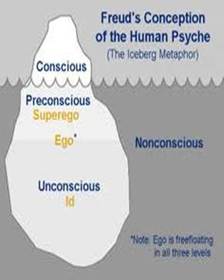
- 7What are Freud's 3 dimension that make up a persons behaviour?Unconscious, preconscious and conscious
- 8Describe unconsciousImages, thoughts and feelings being experienced right now
- 9Describe preconscious.memories and sensations that can easily be brought into consciousness at any moment
- 10Describe unconsciousDesires, impulses and wishes that would produce considerable anxiety if allowed into consciousness
- 11What is the most important level of the mind and why?The unconscious because our desires, impulses and wishes are thought to fuel our behaviours as they are what we are always striving to achieve
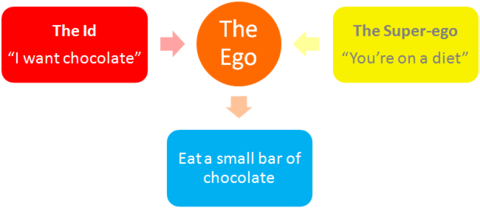
- 12What are Freud's 3 interrelating systems of personality?Id, Ego and Superego
- 13What are the two dimensions of Id?Eros: instincts that help preserve life
Thanatos: instincts potentially cause death - 14Describe Id and its operating principle.Primal desires/ basic natures and it operates on the pleasure principle (needs must be met to ensure pleasure and avoid pain)
- 15Describe ego and its operating principle.Reason and self control and it operates on the reality principle (applies logic to Id's demands)
- 16Describe ego and its operating principle.The quest for perfection and it runs on the Moral principle (informing our decisions of what is right and wrong)
- 17Define Defense Mechanisms.unconscious psychological process through which the ego defends and protects itself against anxiety arising from psychological conflicts.
- 18List 3 defense mechanisms.Denial, Repression and Reaction-Formation
- 19Define Denialrefusing to believe whatever it is that would cause anxiety
- 20Define Repression.preventing unacceptable thoughts and feelings from entering conscious awareness, therefor preventing anxiety
- 21Define Reaction-Formation.thinking, feeling or behaving in a manner which is opposite to how you really think, feel or behave
- 22Define Erogenous Zone.the area of the body where pleasure is obtained
- 23What causes a fixation?If a child experiences anxiety during a psychosexual development stage
- 24What are the 5 psychosexual stages?Oral, Anal, Phallic, Latent and Genital
- 25Where is pleasure obtained and what is the conflict during the oral stage?the mouth (sucking, biting, chewing) and the conflict is around the role of the mouth
- 26What are the 2 types of fixations for the oral stage?Oral Receptive: needy, swallow ideas take comfort from eating etc, passive and sensitive to rejection
Oral Aggressive: verbally abusive, mouth related aggression and hostile - 27Where is the pleasure centred and what is the conflict during the anal stage?Around the anus and passing stools and the conflict is in toilet training
- 28what are the 2 fixations from the anal stage?Anal Retentive: stingy, stubborn, perfectionist and OCD
Anal Expulsive: Lack of self control, messy and careless - 29what are the 2 fixations from the anal stage?Anal Retentive: stingy, stubborn, perfectionist and OCD
Anal Expulsive: Lack of self control, messy and careless - 30Where is the pleasure centred in the phallic stage and what is the conflict?the genitals and unconscious desires for parent develop. the conflict is between the boy and his father
- 31What does a fixation at the phallic stage cause?sexual deviancies (promiscuity or avoidance), problems with authority and weak or confused sexual identity
- 32What is the focus of the latency stage?On school and making friends and socialising, sexual energy is used for academic and social pursuits.
- 33Where is the focus in the genital stage and what is the conflict?still the genitals but sexual urges are directed onto opposite sex peers. Now the interest is also on the welfare of others, not just on the individual.
- 34What can a fixation at the genital stage cause?avoidance behaviour in relationships, reluctance to commit and childlike behaviour
- 35Define Type Theoriesdifferent personality types in terms of a group of characteristics that individuals have in common with others. Individuals with the same specified characteristics are said to be of the same personality type
- 36Who developed the Type A and Type B personalities?Friedman and Rosenman
- 37What are the characteristics of a Type A personality?ambitious, goal orientated, impatient. easily upset and hostile, impatient, successful, rarely satisfied,
- 38What are the characteristics of a Type B personality?easy going, can control anger, can relax, not incredibly driven, understand their emotions
- 39What is the relationship between personality and heart disease?Type A males are 2 times as likely to contract heart disease than Type B males
- 40What are the key characteristics of a Type C personality?strong need to conform, pessimistic, avoid and deny negative emotions
- 41What is the correlation between personality TYPE and the onset of cancer?Type C personalities are 16 times more likely to contract cancer as they suppress emotions and thus suppress their immune system
- 42What are some criticisms of the Empirical Approach (TYPE THEORY)?-Conflicting evidence from different studies
-Use of personality to explain links = inaccurate
-Classify only by most dominant characteristics
-Limited number of categories
-single label is to simplistic
-don't fit into one type perfectly
-narrow view of personality
-no personality development - 43Define Trait Theory.focus on measuring, describing and identifying individual differences in personality
- 44what are the 3 assumptions of trait theory?1. personality traits are stable and predictable over time
2. personality traits are stable across different situations
3. personality consists of a number of different traits and some people have more or less of each trait - 45Who developed the three dimensions of personalities?Eysenck
- 46What are the three dimensions of personality?introversion-extroversion, neuroticism-emotional stability, psychoticism
- 47What are the criticisms of trait theories?-Doesn't explain how traits change over time
-Small sample leads to oversimplification
-Doesn't count different traits for different personalities - 48Define Humanistic Theory.to understand a person properly, you need to understand the world as they do
- 49Who developed humanistic theory?Rogers (1961)
- 50Define Self-actualisation.Reaching full potential and it depends on how a person is treated and how they see themselves
- 51Define Self-conceptall perceptions and beliefs a person has about themselves. develops over time and childhood experiences are critical.
- 52what is an example of a well adjusted personality in rogers theories?Genuine, accepting and empathetic
- 53What are some of the criticisms of the humanistic approach?- simplistic, romantic and vague
- encourage self fulfillment
- unrealistic and unscientific - 54What are the 5 different ways of measuring personality?inventory, Myer-briggs type indicator, Hollands self directed search, Roschach inkblot and the TAT.
- 55Define Personality Inventories.a test which has a list of questions designed to assess aspects of personality
- 56What is an example of a personality inventory test?the Myer-Briggs type indicator
- 57What are the strengths of a personality indicator test?quick, uses computer scoring, can test multiple people at once, can measure traits simultaneously
- 58What are the limitations of a personality indicator test?cultural bias, can be manipulated, provide limited information
- 59Define Projective Test.person is shown visual material for which they provide an interpretation. eg. Roschach inkblot test
- 60What does a projective test do?attempts to uncover and individuals unconscious aspects of personality
- 61What are the strengths of projective tests?difficult to fake, provide information in persons own words
- 62What are the weaknesses of projective tests?difficult to interpret, subjective=open to errors, individuals may not have a response
- 63What does TAT test stand for?Thematic Apperception Test
- 64What 4 things does a TAT test ask?What has led up to the event shown
What is happening at the moment
What the characters are feeling or thinking
What the outcome of the story was
Información
- Descripción
- Year 10 (Personality) Psychology Fichas sobre Personality Test Revision, creado por alexandra.carr el 24/10/2014.
- Creado por
- alexandra.carr
- Visitas
- 162
- Etiquetas
- Valoración