
Fichas
C1 revision flash cards
Fichas del conjunto (19)
- 13 FACTS ABOUT FOSSIL FUELSThey are formed naturally
They are finite and non-renewable because they are used up much faster than new supplies can be formed
They are all easily extracted - 2WHERE IS CRUDE OIL FOUND AND HOW IS IT TRANSPORTED?Crude oil is found in the Earth's crust.
It is transported to refineries through pipelines or in oil tankers. - 3WHAT IS CRUDE OIL? DISADVANTAGES OF CRUDE OILCrude oil is a mixture of many hydrocarbons.
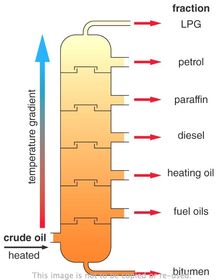
Accidents can cause oil spills . This can harm the wildlife (such as birds - their wings can get stuck together. and damage the beaches. - 4FRACTIONAL DISTILLATION: Different hydrocarbons have different boiling points. This means that crude oil can be separated into useful fractions that contain mixtures of hydrocarbons with similar boiling points.Fractions with low boiling points leave at the top
Fractions with high boiling points leave at the bottom. - 5CRACKING (WHAT IT IS AND WHY IT IS USED)Hydrocarbons can be described as alkanes or alkenes. Large alkane molecules can be broken down to create smaller, more useful alkane and alkene molecules.
Cracking is used to make more petrol. - 6FORCES BETWEEN MOLECULESIn a hydrocarbon molecule there are:
Strong covalent bonds between atoms in the molecule.
Weak intermolecular forces (forces of attraction between molecules). - 7COMBUSTIONCombustion is when fuels react with oxygen and they burn and release useful heat energy
Complete combustion of methane and air:
methane + oxygen->carbon dioxide+water - 8INCOMPLETE COMBUSTIONIncomplete combustion is when fuels burn without enough oxygen. Some heat energy is released but not as much as a complete combustion.
- 9WHAT DO YOU NEED TO THINK ABOUT WHEN CHOOSING A FUEL?Energy value
Availability
Cost
Ease of use
Pollution
Toxicity
Ease of storage - 10THE ATMOSPHEREAir today:
78% nitrogen, 21% oxygen, 1% other gases
The levels of gas in the atmosphere are maintained by respiration, combustion and photosynthesis. - 11HUMAN INFLUENCE ON THE ATMOSPHEREBurning fossil fuels is increasing the amount of CO2
Deforestation means the amount of photosynthesis is reduced so less CO2 is removed
Increase in world population - 12ALKANES AND ALKENESWhen a hydrocarbon chain has only single covalent bonds, it is called an alkane.
When a hydrocarbon chain has one or more double covalent bonds it's called alkene. - 13TEST FOR ALKENESA test to tell between alkenes and alkanes is to add bromine water:
Alkenes de-colourise bromine water
Alkanes have no effect on bromine water (it stays orange) - 14POLYMERS: Polythene: Light, flexible - plastic bags, moulded containers Polystyrene: Light, poor conductor of heat - insulation Polyester: Waterproof, tough - clothing, bottlesDISPOSING OF POLYMERS:
Landfill sites - plastics are non-biodegradable
Burning polymers - Produces air pollution
Recycling - Different types of plastic need to be recycled separately. - 15WHAT ARE THE DIFFERENT TYPES OF FOOD ADDITIVES?Antioxidants - stop food reacting with oxygen
Food colours - improve appearance
Flavour enhancers
Emulsifiers - help mix oil and water (mayonnaise) - 16PROPERTIES OF PERFUMEA perfume must smell nice and must:
evaporate easily
not be toxic
not irritate
not dissolve in water
not react with water - 17PAINT AND PIGMENTSPIGMENT - A substance that gives paint its colour
BINDING MEDIUM - an oil that sticks the pigment to the surface that its being painted onto
SOLVENT - thins the thick binding medium and makes it easier to coat the surface - 18WHAT IS NYLON?Nylon is lightweight, tough, waterproof and blocks UV light . But it doesn't let water vapour escape so it can be uncomfortable if you are hot.
- 19WHAT IS GORE-TEX?Gore-tex is a breathable material made from nylon. It is the same as nylon except it is treated with a material that allows sweat to escape whilst preventing rain from getting in.
Información
- Descripción
- facts from chemistry GCSE OCR revision guide
- Creado por
- cab.boyle13
- Visitas
- 28
- Etiquetas
- Valoración