
Fichas
C2-E
Fichas del conjunto (16)
- 1what is an exothermic reaction and give examples and usesAn exothermic reaction is one that transfers energy to the surroundings. Examples : combustion,
many oxidation reactions,
neutralisation.
Everyday uses : self-heating cans,
hand warmers. - 2what is an endothermic reaction and give examples and usesAn endothermic reaction is one that takes in energy from the surroundings.
Examples: thermal decompositions.
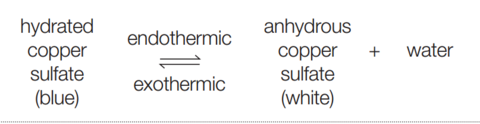
Uses: Some sports injury packs - 3Write the equation for the reversible reaction of hydrated copper sulfate to anhydrous copper sulfate indicating which directions are endo and exothermic and the colour change involved
- 4Soluble salts can be made by reacting acids with what 3 things ?1. metals – some are too reactive and others are not reactive enough
2. insoluble bases – the base is added to the acid until no more will react and the excess solid is filtered off
3. alkalis – an indicator can be used to show when the acid and alkali have completely reacted - 5Describe how nsoluble salts can be madeInsoluble salts can be made by mixing appropriate solutions of ions so that a precipitate is formed.
- 6Give an important use of a precipitation reactionPrecipitation can be used to remove unwanted ions from solutions, for example in treating water for drinking or in treating effluent.
- 7State 2 things that are bases. State something that is an alkalis.Metal oxides and hydroxides are bases.
Soluble hydroxides are called alkalis. - 8Describe what happens when you dissolve ammonia in water and give the importance of thisAmmonia dissolves in water to produce an
alkaline solution.
It is used to produce ammonium salts.
Ammonium salts are important as fertilisers. - 9State which ions make something acid and which make it alkalineHydrogen ions, H+(aq), make solutions acidic
Hydroxide ions, OH–(aq), make solutions alkaline. - 10what is the pH scale ?The pH scale is a measure of the acidity or
alkalinity of a solution. - 11Describe neutralisation in terms of the ions involvedIn neutralisation reactions, hydrogen ions react with hydroxide ions to produce water. This reaction can be represented by the equation:
H+(aq) + OH–(aq) ➞ H2O(l) - 12Give the equations for making the following soluble salts from soluble bases (alkalis) : sodium chloride from NaOH(aq) + HCl(aq) sodium sulphate from 2NaOH(aq) + H2SO4(aq) potassium sulphate from 2KOH(aq) + H2SO4(aq)NaOH(aq) + HCl(aq) ==> NaCl(aq) + H2O(l)
2NaOH(aq) + H2SO4(aq) ==> Na2SO4(aq) + 2H2O(l)
2KOH(aq) + H2SO4(aq) ==> K2SO4(aq) + 2H2O(l) - 13Give the equations for making the following soluble salts from soluble bases (alkalis) : sodium nitrate from NaOH(aq) + HNO3(aq) ammonium nitrate from NH3(aq) +HNO3(aq)NaOH(aq) + HNO3(aq) ==> NaNO3(aq) + 2H2O(l)
NH3(aq) + HNO3(aq) ==> NH4NO3(aq) - 14What is the general word equation for the reaction of an acid with a metalAcid + metal = salt (soluble) + hydrogen
- 15What is the general word equation for the reaction of an acid with an alkali or baseAcid + alkali/base = salt + water
- 16What is the general word equation for the reaction of an acid with a metal carbonateacid + metal carbonate = salt (soluble) + water + carbon dioxide
Información
- Descripción
- aqa science
- Creado por
- gfhgfhg gfhgfhg · nov 2015
- Actualizado
- 27 may 2016
- Visitas
- 139
- Etiquetas
- Valoración