
Fichas
AS: Approaches - Biopsychology
Fichas del conjunto (23)
- 1What is a neuron?A specialised cell that receives, processes and transmits information (signals) to other neurons as well as muscles and organs.
- 2There are 3 types of neurons...Sensory
Motor
Connector ( or relay) - 3Sensory neuron functions?Located in 'sense organs'.
Carry messages from sense organ to the CNS (central nervous system) - 4Motor neuron functions?These carry messages from the spinal cord and brain (CNS) to muscles.
- 5Relay neuronsOnly found in CNS.
Connect neurons with other neurons.
represent 95% of all neurons.
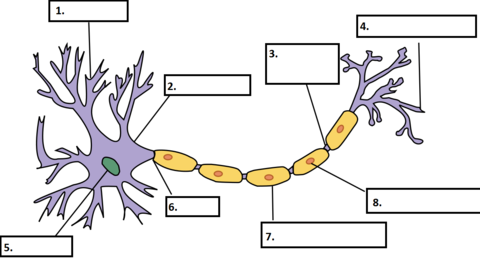
mostly located in the brain. - 6—1. Dendrite
2. Cell body
3. Node of Ranvier (indentations)
4. Axon terminal
5. Nucleus
6. Axon
7. Myelin Sheath
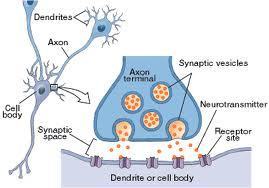
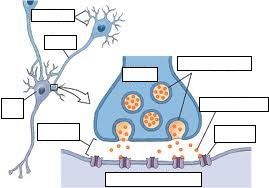
(8. Schwann cell) - 7Axon: A long extension from the cell body which nerve impulses are sent through. Myelin sheath: fatty material that surrounds, insulates and protects the axon.Axon terminal: End of the axon; releases neuro transmitters to communicate with other neurons.
Dendrites: Receive signals from adjacent neurons and process the information received. - 8Synaptic cleft: a gap between axon terminals and dendrites. Signals cross this gap in the form of neurotransmitters.Node of Ranvier: small indentions in the myelin sheath. speeds up the process of transmitting.
- 9Briefly describe synaptic transmission-Messages sent across axon as electrical impulses
-cross the synapse in the form of chemical neurotransmitters
-Each neurotransmitter then has ac specific receptor site on the other neuron / dendrites - 10—
- 11The nervous system has many divisions...
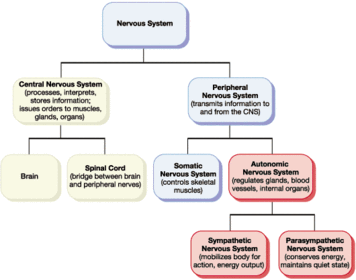
- 12the sympathetic and parasympathetic Ns's work in opposition... physiological changes due to sympathetic NS state....increased heart rate
increased breathing rate
dilated pupils
inhibited digestion/saliva production
contracted muscles - 13physiological aspects of parasympathetic ns state...decreased (normal) heart/breathing rate
constricted pupils
digestion/saliva production continues
muscles relax - 14Made up of glands that secretes chemicals called hormones into the blood stream.The endocrine system
- 15Examples: Pituitary gland Thyroid Adrenals Testes Ovaries-controls release of hormones from other -glands in the body
-Thyroxine
-adrenaline for 'fight or flight mode'
-testosterone
-oestrogen and progesterone - 16Briefly describe the process of 'fight or flight mode'...-stressful event
-autonomic NS changes it's normal state into the sympathetic state
-pituitary gland in the hypothalamus releases ACTH
-ACTH stimulate adrenals to produce adrenaline
-adrenaline triggers physiological changes of SNS state
(body is now ready for action) - 17Strengths of this approach-Objective
-Scientific
-Lab experiments = lots of control
-Has many applications in real life (drugs for mental illnesses as they're caused by chemical imbalances in the brain) - 18Weaknesses of this approach-Deterministic (what about free will? )
-Reductionist (behaviour = atoms? aren't we all unique??)
-Ethical issues - can we play with genetics?
-Ignores environmental factors/experiences (overly simplistic) - 19What are twin studies?To test whether a certain characteristic is caused by genetics twin studies are carried out that look for degrees of similarity.
- 20Monozygotic twins (identical) 100% shared genes same sex develop from one egg/embryo that splitsDizygotic twins (separate)
50% shared genes
Any sex combination
Two eggs released and developed - 21Twin studies are evaluated based on their concordance rates (%)Concordant if both twins develop the same studied trait/characteristic
Discordant if only one twin develops the trait/characteristic. - 22If Mz twins have a genetically hereditary trait that only one seems to have it could be caused by the environmental factors. why?Although 100% DNA is shared...
certain phenotypes will only be expressed under certain conditions - 23Phenylketonuria (PKU) this condition illustrates the importance of environmental factors (on the phenotype)affects 1 in 10,000
although a person can posses the genotype for the condition
it's possible to avoid it by not consuming a certain amino acid throughout the individuals life since birth.
Environment > biology (?)
Información
- Descripción
- A Levels Psychology Fichas sobre AS: Approaches - Biopsychology, creado por Julia Romanów el 19/03/2016.
- Creado por
- Julia Romanów
- Visitas
- 250
- Etiquetas
- Valoración