
Fichas
Biological Psychology: Audition and Non-Visual Systems
Fichas del conjunto (17)
- 1Sensation and Perception: Audition ObjectivesAuditory System - Ear to Brain
Why hair cells fire to 'transduce' air pressure changes into neural signals
Sound Localisation
Basic concepts relating to smell, taste, touch & kinaesthetic feedback
Cocktail party effect - auditory illusion - 2SoundSound is simply vibrating molecules of air that condense and rarefy.
Is measured in units called decibels (dB)
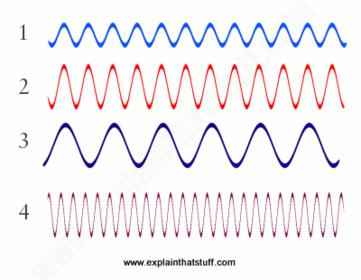
Tone is measure through Hertz - Hz - 3Waves of Moment-to-moment air pressure changes1. Low Amplitude
2. High Amplitude
3. Low Frequency
4. High Frequency - 4Human AuditionPitch: Psychological correlation of frequency - low pitch = low notes on piano, high pitch = high notes on P.
Loudness: Psychological correlation of intensity - the larger the vibrations of the displaced air particles - the louder the sound
Timbre: The quality of the sound - the complexity of sound eg. a conversation is made up of a complex range of sounds. Mixture of pitches determines complexity. - 5The EarExternal Ear
Middle Ear
Inner Ear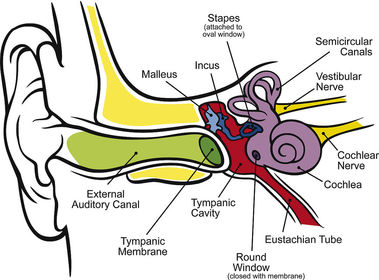
- 6External EarThe Pinna (the Earlobe) the the ear canal (2cm Long) takes on the air pressure changes)
Takes to sound to the middle ear (ME) - 7Middle EarTypanic Membrane (Ear Drum)
Malleus, Incus, Stapes - The Bones (vibrate against the ear drum, the stapes pumps in and out of the oval window, the round window. The Eustachian tube permits equalisation of pressure on each side of the E drum. - 8Inner Ear/ Cochlear- Cochlear is a 21/2 cm of coil made up of:
-Scala Vestibuli
- Scala Media
- Scala Tympani
- Basilar Membrane
- Cochlear Neuron
-Hair Cells - 9Basilar MembraneResponds to the travelling waves caused by movement of fluid, this causes the hair cells to more (sensory cells) - allowing for the detection of particular cells.
The tectorial membrane on the cilia of the basilar membrane causes a shearing action. - 10Basilar MembraneThe Basilar membrane is in a coil type shape, and has an apex (which is wide and 'floppy') and a base (which is narrow and stiff - base of the cochlear). This allows for a larger range of vibrations to be heard in terms of their pitch and frequency.
- 11Tectorial Membrane
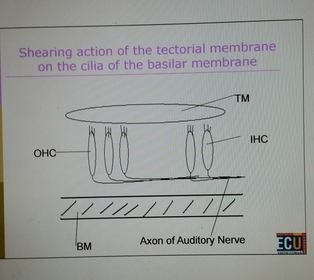
- 12Hair CellMovement of the tip links causes the ion channels to open, causing an action potential - as there is a change in the RMP.
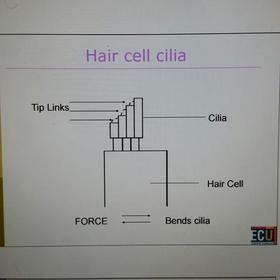
- 13Attentuation Reflex'Stiffens up' little bones, to stop them from moving so wildly when there is a sudden loud noise.
The tensor typani & stapedius muscle contract to stop the bone s from moving so wildly, mostly at low frequencies and when there is a lot of sound - 14Hearing Difficulties'Blue Ear'
Loss of language and communication - leading to depression as it limits connections with the social world
HL isn't noticed until 30% of hair cells are dead
Not using protection causes noise induced hearing loss
Speech in children - educational limits, job prospects
Tinnitus - 15Cochlear ImpantNothing will replace normal hearing, but it stimulates the nerves so that sound is heard.
- 16The Psychology of HearingCognition: Role of language in shaping our perceptions
Categorical Perception: Higher level - can hear across across boundaries - speech synthesis sounds (Pa vs. Ba) - PHonetic Boundary (hearing withing boundary - no perceptual changes, hearing across boundary - diff. phonemes are heard)
McGurk Effect - Auditory illusion (what we see overrides what we hear) - 17Sound LocalisationInteraural Intensity Difference: where the sound originated
Interaural Time Difference: How far away the sound is
Pinna Effect: Point to where the sound is coming from, softer in one ear than the other
Información
- Descripción
- An introduction and brief explanation of the auditory system and its biological functions in psychology.
- Creado por
- Hannah Shakeshaft
- Visitas
- 52
- Etiquetas
- Valoración