
Fichas
Core studies
Fichas del conjunto (198)
- 1Cognitive AreaThe mental processes we have, e.g. memory, attention, perception
Loftus and Palmer
Grant et al
Moray
Simons and Chabris - 2Loftus and PalmerReconstructive memory
- 3Aims1) Does the phrasing of a question about a car accident alter memory of an event?
2) Can leading questions change someone's memory of an event?
3) How good are witnesses at estimating the speed of vehicles? - 4Experiment 1How fast were the cars going when they _____________ each other?
- 5Sample45 students from University of Washington, divided into the 5 experimental groups.
- 6ProcedureShown 7 clips for an Seattle road safety video. 4 contained a crash. P's were asked to recall what they has seen and fill out a questionnaire on the crash. 'About how fast were the cars going when they ______ each other?' Bumped, hit, smashed, collided, contacted
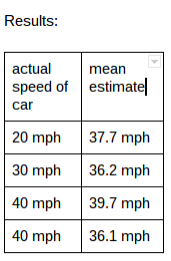
- 7Results Accuracy of speed estimates
- 8Results Comparison of speed estimates
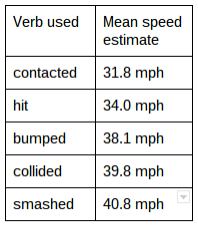
- 9Conclusions and explanation of resultsThe more severe the verb is the higher the mean speed estimate is
Participants are bad at estimating speeds
Response bias - responding to the situation, so in this case the verb
Memory altered - the language used has cause the memory to change - 10Experiment 2Did you see broken glass?
- 11Sample150 new students split into 3 groups
- 12ProcedureThe participants watched the same clips and filled in the same questionnaire with the verbs hit, smashed and one without a speed estimate question. A week later they completed a new questionnaire, 'did you see broken glass?'
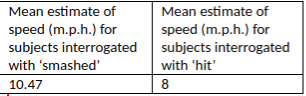
- 13Results Comparison of speed estimates
- 14Results Broken glass
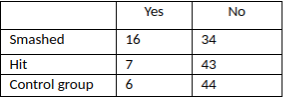
- 15Conclusion and explanation of resultsThe more violent the verb the more people thought there was broken glass
The more severe the verb the faster they remember the car travelling
Two elements to reconstruct memories:
1) own perception of original event
2) external influences supplied afterwards
These merge overtime and create false memories - 16Grant et alContext dependent memory
- 17Aims1) Is recall and recognition affected by the conditions in which we learn and remember information?
2) Is memory context-dependent?
3) Context dependent memory will not benefit recognition tasks - 18Sample8 researchers all recruited 5 participants but one was excluded, so 39 people aged between 17 and 56. Opportunity sampling as the researchers are not taking part, so not snowball.
- 19ProcedureParticipants were allocated to either a noisy or silent test condition, if they were in a noisy condition they listened to a recording from the university cafe through headphones. The silent condition also wore headphones but didn't listen to anything. They read a two-page article once, and were allowed to highlight and underline. They then had a 2 minute break
participants were then tested on recall and recognition, either in silence or listening to the same noisy recording. - 20Results mean reading time

- 21Results Correct answers out of 10 for recall

- 22Results Correct answers out of 16 for recognition

- 23ConclusionsContext dependent memory aids participants in both recall and recognition tasks.
Context dependent memory should be used to help students learn because in this study they were learning ‘meaningful prose’ and not just a list of words and it was shown to help. - 24Simons and ChabrisAuditory attention
- 25Aims1) Is inattentional blindness more likely if the unexpected event is similar to attended event?
2) Are unusual events more likely to be seen?
3) Would p's have trouble noticing the unexpected event when the task was hard?
4) To see if the same levels of blindness occur in a transparent and more realistic video - 26Sample228 observers, undergraduate students from Harvard Uni. Given a large candy bar, a single payment for this study and another or volunteered without reward.
- 27Procedure The video clipa recording of the same actors, on the same day, in the same location. It lasted 75 seconds and each had 6 people in two teams, three wearing white, three wearing black. The video was either transparent or opaque, had an umbrella woman or gorilla as the unexpected event, and the task was hard (number or areal and bounce passes) or easy (total passes)
- 28Procedure What they didThey were tested individually and were told to pay attention to the white or black team and make a mental not of the number of passes between players. They were then asked 'did you notice anything on the video?', followed by 'did you notice anything other than the 6 players?', and then 'did you see a gorilla/umbrella woman?' If they answered yes they were asked to provide details. They then fully debriefed the observer.
- 29Results Inattentional blindness Percentage of times they noticed the unexpected eventOverall level of inattentional blindness - 46%
Percent that did see unexpected event - 54%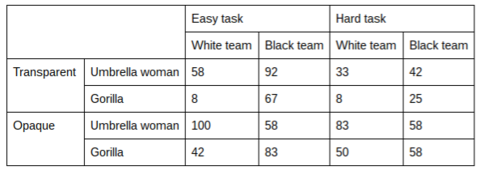
- 30ConclusionsInattentional blindness occurs in dynamic events that are sustained, lasting more then 5 seconds
Even in opaque clips p's missed the event
Objects can pass through our central field of vision and still not be seen if they aren't specifically attended to. So there is no conscious perception without attention. - 31MorayVisual attention
- 32AimsTo test Cherry's findings on attention more rigorously
- 33Pre-test4 trial shadowing tasks. Passage read by one male speaker at 150 words/minute. The loudness was approximately 60 decibels above the p's hearing threshold and matched in the two ear pieces.
- 34Experiment 1simple words
- 35SampleUndergraduate students and research workers of both genders at Oxford university
- 36ProcedureA short list of simple words was spoken 35 time as the rejected message in one ear as they shadowed a message in the other ear. At the end they were asked to recall all the words they could remember from the rejected message. Then after 30 seconds of completing that task they did a recognition task of 21 words. 7 from shadowed passage, 7 from rejected message, 7 similar but from neither
- 37Results
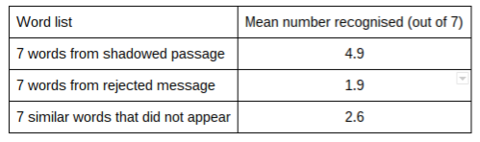
- 38ConclusionsWhen a subject directs his attention to the reception of a message from one ear and rejects the message from the other, almost none of the verbal content of the rejected message is able to penetrate the block
- 39Experiment 2Effective cues
- 40Sample12 students and research workers from Oxford university of both genders
- 41Procedure2 light fiction passages were read at once and they had to shadow one. Both had instructions at the start and within it. In all cases they were told to listen to the right ear and in 2 they were warned they would have to change ears. There were 3 passages with affective instructions and three with non-affective instructions. The rest had no instruction. P's were deemed to have heard the message if they reported hearing the instruction when asked about it or if they changed message throughout.
- 42Results
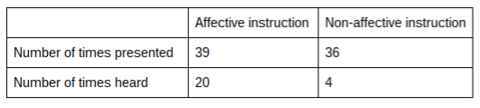
- 43ConclusionsThe persons own name is able to break the attentional block so they hear their name in the rejected message
- 44Experiment 3Digits
- 45Sample14 students and research workers at Oxford university
- 46ProcedureAsked to shadow a passage which for some people had digits put in towards the end. Sometimes numbers were in both passages, sometimes only in the shadowed, sometimes only in rejected. Some passages without numbers were also included.
- 47ResultsNo difference between the mean scored of digits recalled correctly between the rejected and attended messaged
- 48ConclusionsIt is very difficult to make 'neutral' material important enough to break through the block set up
- 49Developmental areaHow behaviour changes and develop
Bandura et al
Chaney et al
Kohlberg
Lee et al - 50Bandura et alSocial learning theory
- 51Aims1) Subjects exposed to aggressive models would reproduced aggressive acts
2) Observation of non-aggressive models would have an inhibiting effect on subjects
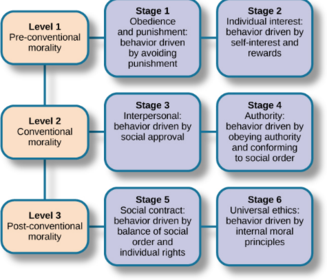
3) A same sex model would produce more imitative behaviour
4) Boys will be more pre-disposed towards imitating aggression than girls - 52SampleOpportunity sampling of 72 children from Stanford Nursery School aged between 37 and 69 months (average 52), 36 boys and 56 girls.
- 53Pre-testingEach child was assessed individually on four five point rating scaled by the experimenter and a nursery school teacher. The scales measured physical aggression, verbal aggression, aggression towards inanimate objects and aggressive inhibition.
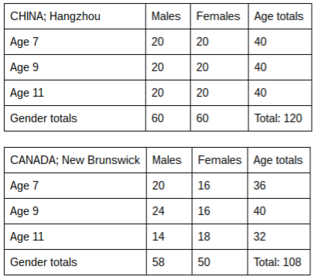
- 54Model conditionsAggressive female model
Aggressive male model
Non-aggressive female model
Non-aggressive male model
No model - 55Procedure Stage 1 (10 mins)Aggressive - the model began playing with the tinker toys but after a minute turned aggressively to the Bobo doll. there would be physical aggression, hitting the doll with a mallet, throwing it in the air, followed by verbal aggression, 'sock him in the nose'.
Non-aggressive - the model played with the tinker toys and ignored the Bobo doll
Control - no exposure to the adult model - 56Procedure Stage 2 (2 mins)the child was taken into a room to play with some attractive toys. Once they were settled the experimenter went in and told them they were her best toys and she decided to keep them for the other children.
- 57Procedure Stage 3 (20 mins)The 3rd room had a range of toys which included all the toys from the first room - Bobo dolls plus other violent toys e.g. guns, ball hanging from ceiling and nice toys e.g. tinker toys, tea set, crayons. For 20 minutes, the child was allowed to play in the room while being observed through a one-way mirror. Every 5 seconds a note was taken of their behaviour.
- 58Results Physical aggression
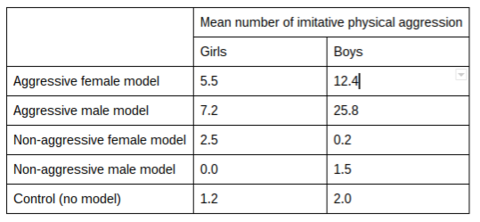
- 59Results Verbal aggression
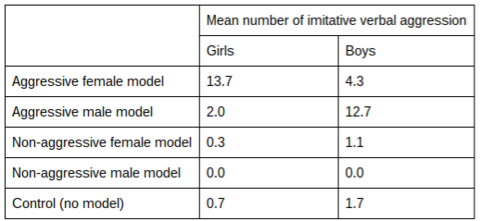
- 60ConclusionsShows that children learn through imitation and observation. For example children who watched an aggressive model tended to be more aggressive.
Boys tended to be more aggressive than girls - 61Chaney et alOperant conditioning
- 62AimsCan operant conditioning be used to encourage children to want to use their inhalers, and when they do - use it correctly?
- 63Sample32 children from Australia ages between 1.5 and 6 (75% over 3). 22 boys and 10 girls who have has asthma for an average of 2.2 years. They were recruited through their GP
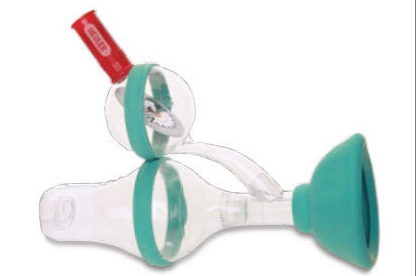
- 64Funhaler device
- 65ProcedureInitial data was collected about their current inhaler and attitudes towards it. During the two weeks parents were given funhalers with instructions on how to use it. They were contacted randomly and asked if they had used the funhaler that day. Afterwards there was a questionnaire to measure adherence and attitudes towards the funhaler.
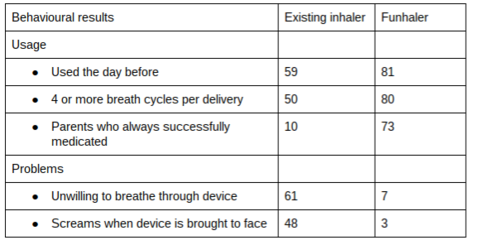
- 66Behavioural results
- 67Attitudinal results
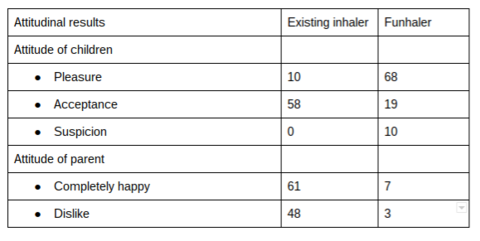
- 68ConclusionsThe funhaler lead to an increase in use, and correct use at 4 or more breaths per cycle. Parents also were less likely to give up and resort to a nebuliser if they were using the funhaler
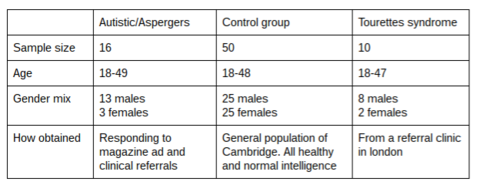
- 69KohlbergStages of moral development
- 70AimsTo provide evidence for theory of stages of moral development taking Piaget's research into child development, elements of behaviourism and psychodynamic psychology into account
- 71Sample75 American boys studies every 3 years. At the start they were between 10 to 16 and followed through to 22-28.
Also collected data in Britain, Canada, Taiwan, Mexico and Turkey.
Longitudinal and cross cultural study. - 72ProcedureThe boys were given hypothetical dilemmas (philosophical problems). Their answers and reasons for giving them were recorded and analysed.
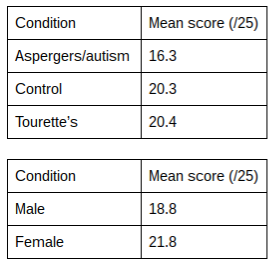
- 73FindingsThe results that Kohlberg collected from his participants allowed him to confirm his 3 stage theory of moral development
- 74ConclusionsThe stages come one at a time and always in the same order
All movement is forwards and no steps are skipped
The sequence is not significantly affected by varying social, cultural or religious conditions
Moral thought behaves like all other thought with each step being better organised cognitively - 75Lee et alLying and truth telling
- 76AimsTo see if Canadian and Chinese children would differ in how they rated pro-social and anti-social lie and truth telling
- 77Sample
- 78Story typesPro-social truth telling: when you do something good and tell the truth when asked about it
Pro-social lie telling: when you do something good but lie about it when asked
Anti-social truth telling: when you do something bad and tell the truth when asked
Anti-social lie telling: when you do something bad and lie when asked - 79ProcedureChildren were randomly assigned to the social story or the physical story condition. They were seen individually and the rating chart was explained to them. When they answered the questions they could use words, symbols or sometimes both. Each child listened to four stories, the good and naughty meanings were alternated so the researchers knew the child wasn't picking the first option.
- 80Results Pro-socialPro-social truth: no significant difference between cultures however Canadian children gave the same rating at each age but Chinese children rated truth telling less positively as age increases.
Pro-social lie: Canadian children rated lie telling negatively in the pro-social situation whereas Chinese children did not - 81Results Anti-socialAnti-social truth: no difference in culture but both rating truth telling very positively in the anti-social situation
Anti-social lie: the negative ratings increase with age irrespective of culture - 82Results QualitativeNearly half the Chinese children said they had given the pro-social truth telling response as the child was begging for praise. A third said you shouldn't leave your name after doing a good deed. They could not explain why they felt this was as it is a cultural norm
- 83ConclusionsMoral development is different in different cultures as a result of sociocultural norms and practices, not only as a result of cognitive development.
- 84Individual differences areaUnderstanding why the behaviours of different people are different
Freud
Baron-Cohen
Gould
Hancock et al - 85FreudOedipus complex
- 86AimsTo document the case of 'Little Hans'; a boy going through the phallic stage of development, and confirms if Freud's theories about the unconscious and Oedipus complex were true.
- 87Sample1 participant, Little Hans, a boy raised with minimal force. Volunteer sampling as Freud put out a call to friends and supporters and chose Hans as he was lively and cheerful. Reports lasted from 1906 until 1908
- 88ProcedureLetters were sent between Freud and Little Hans' dad. Hans' father would document behaviours and conversations and make his own interpretations which he would send to Freud
- 89Findings Giraffe daydreamHans said 'in the night there was a big giraffe and a crumpled one and the big one called out because I took the crumpled one away from it, it then stopped calling out and I sat on the crumpled one.' Freud interprets the dream as a manifestation of his Oedipus complex with the big giraffe being his father and the crumpled one representing his mother
- 90Findings Fear of bathAt about 3 1/2 around the time his sister was born he developed a fear of the bath. Freud suggested that Hans was hostile towards his sister as she takes away his mothers attention. When he watched his sister being bathed by his mother he wished his mother would drop her. This made him feel guilty and lead to anxiety that his mother would do this to him in the bath
- 91Findings Plumber fantasyHans tells his father about a fantasy with a plumber in which the plumber comes and takes away his behind with a pair of pincers and then he gave me another one and the same with his widdler. Freud says this shows that Hans was identifying with his father by wanting a larger behind and widdler, like his fathers
- 92ConclusionsFreud claims to 'have learnt nothing new from this analysis, nothing that he had not already been able to discover from other participants at a more advanced age.'
- 93Baron CohenTheory of mind
- 94Aims1) Would adults with autism and Asperger's be impaired on a theory of mind task designed specifically for adults?
2) Would females be better than males at mind reading? - 95Sample
- 96ProcedureTested on four tasks:
1) Eyes task (theory of mind)
2) Strange stories (concurrent validity of eyes task)
3) Gender recognition task (eyes again)
4) Basic emotion recognition task (whole face)
Tested individually at home or uni - 97Procedure Eyes task Done by all groupsShown 25 pictures of black and white eyes from magazines for 3 seconds each. They were of the eye region and the participants were asked 'which word best describes what this person is thinking or feeling?' and there were two mental state terms that they had to choose from. They were always opposites and the faces varied from male to female
- 98Procedure Strange stories Done by autism and tourette groupsEach aprticipnat is presented with 2 example from a selection of 12 story types. In each story a character says something that is not literally true and the participant is asked to explain why the character said what he/she did. Answers were scored as correct or incorrect
- 99Procedure Control tasks Done by autism group onlyGender recognition - shown same set of eyes as eyes task but they had to identify the gender of the person
Basic emotion recognition task - shown 6 whole faces which showed these basic emotions; happy, sad, angry, afraid, disgust and surprise and they had to identify which was which - 100Results
- 101ConclusionsPeople with Asperger's and high functioning autism have a lower theory of mind as they scored lower in the eyes task
In general females scored better on the eyes task than males showing they have a better theory of mind - 102GouldBias in IQ testing
- 103Aims1) To prove psychology can be as rigorous a science as physics, focusing on numbers and quantification
2) To develop the field of mental testing - 104Sample1.75 million men all recruits from the army in the first world war. Opportunity sampling as they signed up for the army themselved
- 105Design of the tests Army alphaWritten exam given to literate recruits. Included 8 parts and took less than an hour, could be given to large groups. It included number sequences, unscrambling sentences, analogies and multiple choice questions
- 106Design of the tests Army betaTest designed for illiterates and men who failed the army alpha. Included 7 parts and took less than an hour, could be given to large groups. Included maze running, cube counting, finding the next symbol, translating numbers into symbols. Failing the army beta they would be recalled for an individual examination
- 107Problems with the way they were designedAll tests were culturally biased towards Americans
It doesn't measure all types of intelligence
No rule on what counted as literate or illiterate
Some people may have never held a pencil before
In the interview they would immediately be judged on their race and speech - 108Administering the tests1) only given the beta test if you are illiterate
2) given a resit on Beta only if you fail alpha
3) given individual exam if failed beta test - 109Problems with administeringIn many camps protocols were not followed
Doesn't specify what literate is
If queues were too long for Beta they'd send them to Alpha
No chance to do beta if failed alpha as so much pressure on beta
Never bothered with individual exam - 110Findings1) The average mental age of white American adults was 13 (just above moron)
2) The darker people of southern Europe and the Slavs of eastern Europe were found to be less intelligent then the fair people of western and northern Europe. Russian-11.34, Italian-11.01,Pole-10.74
3)Black Americans lay at the bottom of the scale with a mental age of 10.41 - 111Problems with the interpretation of findingsBecause procedures were not followed correctly some people scored 0 on the Beta so would lower the average
It was ethnocentric against people outside of America
Some people would not have had a good education or lived in poverty which affected their results - 112How the findings were appliedHelped to inform a political policy to restrict immigration (The Immigration Restriction Act, 1924)
- 113Problems with applying the findingsMany Jewish migrants couldn't enter the US which lead to them dying at the hands of the Nazis.
6 million southern, central and eastern Europeans were barred between 1924 and 1939 - 114ConclusionsYerkes - intelligence is a hereditary quality and it is possible to grade individuals by the colour of their skin. Mental testing is a valid scientific technique
Gould - the mental tests were not accurate. Ideas can have consequences every bit as tragic as deliberate and direct attempts to do harm - 115Hancock et alLanguage of psychopaths
- 116Aims1) Psychopaths use cause and effect statements to achieve a pre-mediated external goal
2) Psychopaths language satisfies basic physiological and material needs more than high level needs
3) Psychopaths have a generalised deficit in their ability to experience emotions and recognise the emotions of others - 117Participants52 men in prison from Canada due to murder/manslaughter with a mean age of 28.9/ They all volunteered to take part
- 118Procedure Stage 1They were split into two groups; psychopaths and non-psychopaths using the PCL-R where they answered 20 questions scored from 0 to 2 for a maximum score of 20. 39 of the assessments were already done but 13 were completed by a researcher. The cut off point for clinical psychopathy is 30 however they used 25+ in this study
- 119Procedure Stage 2An interview was arranged with all 52 men lead by senior graduate students and one research student, all who were blind to the psychopathic sores of the offenders. The purpose of the study was explained verbally and then the participant was asked to describe their homicide in as much detail as possible. Interviews were taped and lasted around 25 minutes. After they were typed into transcripts.
- 120Procedure Stage 3Wmatrix: speech of all psychopaths brought together and analysed in comparison to the speech of the non-psychopaths. Two features were used, tagging language (e.g. verbs, adjectives) and analysing semantic concepts expressed as likelihood ratios.
Dictionary of affect in language (DAL): assessed the emotional properties of language. Each transcript was analysed and a score was given for the pleasantness and intensity of emotional language. - 121FindingsThe psychopaths produced significantly more subordinating conjunctions than non-psychopaths with 1.82% compared to 1.54%.
Psychopaths used more words connected to low level needs that the non-psychopaths who used more words connected to family and religion. - 122Findingsexamination of DAL showed no significant difference in the emotional content in each groups. However by their factor 1 score alone you can see that as their language increased in intensity their interpersonal deficits decreased.
Psychopaths used approximately 33% more disfluencies than non-psychopaths
Psychopaths used significantly higher percentage of verbs in the past tense whereas non-psychopaths used verbs in the present tense and articles. - 123ConclusionsThe language psychopaths use to describe emotional events is different from non-psychopaths
- 124Social areaHow other people and the environment influence behaviour and thought processes
Milgram
Bocchiaro
Piliavin et al
Levine et al - 125MilgramResponse to people in authority
- 126AimsTo investigate what level of obedience participants would go to when asked to deliver electric shocks to someone by an authority figure
- 127Participants40 males from New Haven area aged between 20 and 50, from a wide range of occupations but no university students. Volunteer sampling from an ad in a newspaper and one sent to random houses. Given $4.50 for taking part.
- 128ProcedureP's told they were investigating punishment and learning. They were always assigned the role of the teacher and saw the volunteer strapped into a chair. Told the volts were not harmful and given a sample shock of 45v. They were seated in a room adjacent to the 'learner' and read over the intercom word pairs. The learner would identify the correct answer from a choice of four by pressing switches.
- 129ProcedureIf correct - next question. If wrong - electric shock increasing by 15v each time. if teacher expressed discomfort experimenter gave prods like 'please continue'. The experiment ended at 450v or when the participant withdrew. They participant was debriefed and told the real nature and introduced to the learner again.
- 130Findings65% went to 450v (all the way)
100% went to 300v
5 refused after 300v
9 more stopped by 375v
Displayed signs of stress including sweating, trembling, nail biting, crying, stuttering, nervous laughing, lip biting, groaning and 3 participants had violent convulsions - 131ConclusionThe situation produces strong tenancies to obey
The situation caused emotional strain and tension - 132BocchiaroWhistle blowing
- 133Aims1) A higher percentage of participants will obey the experimenter than the the baseline condition
2) I predict a relatively lower level of whistle-blowing than disobedience
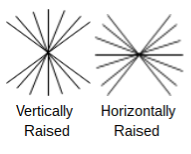
3) There will be a substantial overestimation in the tendency to disobey and whistle-blow
4) There will be weak effects for various participant variables due to the unethical situation - 134Sample149 undergraduate students from VU university in Amsterdam. 96 women and 53 men with a mean age of 20.8. Originally 160 but 11 were removed due to suspiciousness. They were recruited through fliers in campus cafeteria so volunteered and received €7 or course credit
- 135Procedure Room 1A male stern looking dutch experimenter formally dressed met them and asked them to provide names of other students that could take part. They were then presented with a cover story which was about a sensory deprivation task in Italy that was harmful to participants and how they wish to carry out the same thing in VU university. They were then asked to write a statement to convince the students they indicated earlier to participate in the study. The experimenter then left the room for 3 minutes so they could reflect on the decision about to be made
- 136Procedure Room 2They were taken into a room with a computer and encouraged to use two adjectives from 'exciting', 'incredible', 'great', 'superb' and not to mention the negative effects of sensory deprivation. Also in the room was a mailbox and a research committee form which they should sign if a piece of research violates ethics and post into the box. The experimenter left them for 7 minutes.
- 137Procedure Back to room 1Once back in the first room they had to complete the social value orientation test and HEXACO-PIR. They were then probed for suspiciousness, given a full debrief, asked not to discuss study with friends or colleagues. They also had to consent to their data being used and they were given an email address if they wanted to complain or ask questions
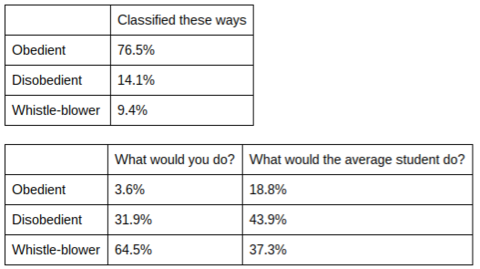
- 138Results
- 139Results Personal inventories QuotesReligious people tended to be more of the whistle-blowers than compared to people with no faith
'it was expected of me, that's why I continued'
'I disobeyed because I felt responsible towards my friends' - 140ConclusionsBehaving in a moral manner is challenging for people, even when this reaction appears to observers as the simplest path to follow
- 141Piliavin et alSubway Samaritan
- 142Aims1) Would it make a difference if he was ill/drunk?
2) Would it make a difference if he was black/white?
3) Would it make a difference in the helping behaviour of witnesses if someone 'modelled' helping behaviour?
4) Would their be a relationship between levels of helping behaviour and the number of people witnessing the emergency? - 143ParticipantsPassengers on the trains, 4450 men and women with 45% black and 55% white. Mean number of people in a carriage was around 43. Opportunity sampling
- 144Procedurenon-stop train journey of 7.5 minutes between 59th and 125th street on the New York 8th Avenue independent subway in either direction. 103 trials took place between April and June 1968, from 11am-3pm. They went out in teams of 4 (male victim, male model, 2 female observers) with 3 teams with a white victim and one with a black victim. All 4 board the train and 70 seconds in the victim would collapse and stare at the ceiling until helped.
- 145Procedure Layout of carriage
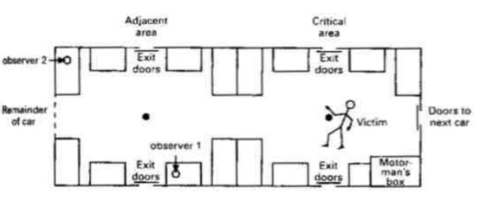
- 146Procedure Victim ModelVictim - always male between 26-35 years old wearing Eisenhouer jacket with trousers but no tie. In the critical area, 65 ill trials (with a cane) and 38 drunk trials (holding a brown paper bag smelling of alcohol)
Model - Male between 24-29 years old wearing informal clothing. Waited in the critical or adjacent area. Helped 'early' at 70secs or 'late' at 150secs. They raised them into a sitting position and stayed with them - 147Procedure ObserversBoth female and sat in adjacent area and sneakily noted comments and tried to get people to talk. The 1st one noted the race, sex and location of everyone in the critical area, the total number in the carriage and information and the number of people who offered help. The 2nd one noted the race, sex and location of everyone in the adjacent area, the time of the 1st helper and if they stepped in after the model
- 148Findings Quantitative62/65 spontaneously helped on ill trials with an average time of 5 seconds
19/38 spontaneously helped on drunk trials with an average time of 109 seconds
34 people left the critical area when help took a long time
Of the 81 trials where help was given;
90% of helpers were male
60% had more than one helper
Victims were helped quicker when 7+ males in the critical area
Slightly more same race helping when drunk - 149Findings Qualitative'I never saw this kind of thing before - I don't know where to look'
'It's for men to help him'
'You feel so bad you don't know what to do'
'I wish I could help him - I'm not strong enough' - 150ConclusionsSomeone who is ill is more likely to be helped than someone who is drunk
Men are more likely to help than women
There is a tenancy for same race helping, especially if they are drunk
Help comes quickest when there are more witnesses
The longer the person is not helped for the less impact the model has and people are more likely to leave the critical area - 151Levine et alCross-cultural altruism
- 152Aims1) To see if the tendecy of people in a city to give non-emergeny help to strangers was stable across different situations in which they needed help
2) To see if helping strangers varied across cultures
3) To identify the characteristics of those communities in which strangers are more likely to be helped - 153SampleThe selection of countries was aimed at obtaining the widest possible sample of regions and cultures of the world but was sometimes driven by convenience. They usually went to the largest city with a population or more than 230,000
- 154Procedure Dropped penAt a moderate pace confederates walked towards a solitary pedestrian passing in the opposite direction. When 10/15 feet away he would reach into his pocket and drop a pen behind him. A total of 214 men and 210 women were approached. Participants were recorded as giving help if they called out that he dropped his pen or picked it up and returned it to him.
- 155Procedure Hurt legWalking with a heavy limp and wearing a clearly visible leg brace, confederated would drop and struggle to pick up a pile of magazines as they came in 20 feet of a pedestrian. A total of 253 men and 240 women were approached. Helping was defined as offering to help and/or beginning to help without offering
- 156Procedure Blind person cross streetConfederated wearing dark glasses and holding a white cane would locate a city centre intersection which had a pedestrian crossing, traffic signals and moderate, steady pedestrian flow. Just before the lights turned green they would step up to the corner and wait for help. A total of 281 trials were conducted. participants were recorded as having helped if, at a minimum, they informed them the lights were green.
- 157Procedure Discarded tasksAsking for change - as there is a shortage of small value notes and coins in some places
Mislaid letters being picked up and passed on - being afraid to touch in case they contain explosives, lack of postboxes - 158ResultsNo significant relationship found between population size and helping amounts
Significant relationship found between purchasing power parity and helping, more help when lower levels of economic well being
No significant relationship between collectivist/individualistic countries and the amount of helping
Small relationship between pace of life and helping but not significant, faster pace of life less likely to help - 159ResultsThere was a large variance from 40% to 93% in the 23 countries
No difference found between the males and females on the level of helping (pen and leg trials only)
The 4 Latin American countries and Spain were above the mean in overall helping levels at 82.87% compared to 65.87% - 160ConclusionsOverall levels of helping across cultures are inversely related to a countries economic productivity. Also that countries with the cultural tradition of simpatia are on average more helpful than countries with no such tradition.
- 161Biological areaAll biological systems, e.g. the brain, the nervous system, genetic makeup
Sperry
Casey et al
Blakemore and Cooper
Maguire et al - 162SperryRole of the hemispheres
- 163Aims1) To use patents of split brain surgery to investigate the roles of the hemispheres
2) To study the functions of separated and independent hemispheres - 164Sample11 patients who previously had severe epilepsy and had undergone a commisurotomy (split brain surgery)
- 165Procedure, findings and conclusion Right visual fieldWhen an object was presented in the right visual field the information went to the left hemisphere. The participant could accurately verbalise what the object was so this tells us that the left hemisphere controls language
- 166Procedure, findings and conclusion Left visual fieldWhen an object was presented in the left visual field the information went to the right hemisphere. The participant could draw the object with their left hand and point at it however they could not verbalise what the object was. This shows that the right hemisphere does not control language.
- 167Procedure, findings and conclusion Simultaneously to both visual fields Apple in left, key in rightThe apple went to the right hemisphere and they could state they can't see it but would accurately draw an apple with their left hand
The key would go to the left hemisphere and they could accurately see and name it, however they could not draw it - 168Casey et alDelay of gratification
- 169Aims1) To see if low delayers at the age of 4 still struggle with resisting temptation in adulthood
2) to examine activity in areas of the brain thought to be associated with the ability to resist temptation - 170Experiment 1go/no-go task in own home
- 171Sample
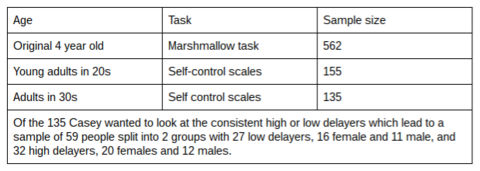
- 172Procedure Hot task Cool task
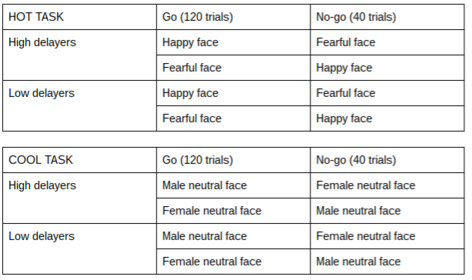
- 173Procedure Group sets
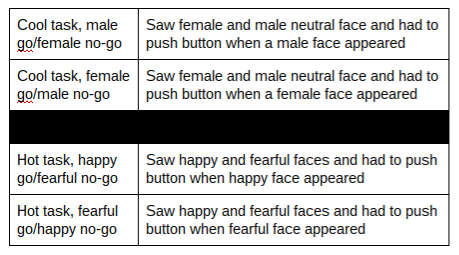
- 174ProcedureParticipants were sent a laptop to their house containing the photos of faces. The faces appeared for 0.5 seconds and there was a 1 second gap between them. Instructions appeared on the screen which told them the go stimulus and to push the button every time they saw the go face. They did 4 go/no-go tasks and 120/160 were always go faces. They were told to complete as quickly and accurately as possible.
- 175ResultsThe number of errors for the high delayers was similar for both hot and cool tasks however low delayers made significantly more errors on the hot task than the cool

- 176ResultsThere were no differences in the reaction times of the two groups.
Similar levels of accuracy were found between the low delayers and high delayers with it being very good.
Both groups made more errors on the no-go trials
Both groups made a similar number of errors on the cool task
On the hot task the low delayers performed worse than the high delayers but this was not statistically significant - 177ConclusionsThe low delayers at age 4 showed more difficulty suppressing responses to happy faces in their forties.
- 178Experiment 2Go/no-go tasks in MRI scanner
- 179Sample

- 180ProcedureThe participants took part in a the same two hot go/no-go task but the tasks were shorter and they were in a fMRI scanner which shows the increase activity in parts of the brain. They did a total of 96 trials.
- 181ResultsSimilar levels of accuracy between groups with it being higher on the go trials
Low delayers had less activity in the inferior frontal gyrus than the high delayers, so high delayers found it easier to resist temptation
Low delayers had more activity in the ventral striatum than the high delayers so low delayers are drawn to alluring stimuli and find it hard to resist. - 182ConclusionsResisting temptation if favour of long term goals is important for individual, social and economic functioning
- 183Overall conclusionsResisting temptation is a relatively stable trait
Evidence of 'hot' and 'cool' processing systems in the brain which affect self control - 184Blakemore and CooperImpact of early visual experience
- 185Aims1) To compare the behavioural consequences of raising kittens seeing only horizontal or vertical stripes
2) Investigate the neurophysical effect on neurones in kittens visual cortex (brain plasticity) - 186ParticipantsKittens from birth to one year old, unknown sample size, at least 2 kittens
- 187ProcedureThey spent the first two weeks in a completely dark room. After that they were placed in a cylinder with horizontal or vertical stripes for 5 hours a day and back in the dark when not in it. The cat was placed on a clear platform half way up the 2m cylinder with a diameter of 46cm. They wore a wide black collar to limit seeing their own body and a lid was placed on with a spot light.
- 188Behavioural results Initial reactionsShowed visual deficits
No startle response when a hand/object thrusted towards them
No visual placing e.g. putting feet out to meet a table
No fear response when reached the edge of tables/chairs - 189Behavioural results After 10 hours of exposure to well-lit surroundingsVisual deficits disappeared
Began to show visual placing, startle responses and would jump easily from objects to floor
Visual tracking of objects was clumsy
Tried to reach objects out of reach
Bumped into things while exploring - 190Behavioural results Horizontal and vertical differencesthe cat could not see vertical lines if raised horizontally and vice versa. A rod was shaken in front of them to see if they would catch/chase it. If it was presented horizontally to two kittens from different conditions only the one raised in the horizontal group would catch it. This was reversed vertically and the vertically raised cat would catch it
- 191Neurophysiological resultsA normal cat would have neurons for both horizontal and vertical orientations however kittens raised horizontally had no vertical neurones and kittens raised vertically had no horizontal neurones
- 192ConclusionsThe visual experience of these animals in early life has modified their brains, and there are profound perceptual consequences
The development of the brain, at least in the visual sense, responds to the environment that it has experienced. Cells that begun with a preferred 'vertical' orientation changed to a horizontal preference when the environment was only horizontal - 193Maguire et alTaxi drivers
- 194Aims1) To investigate the differences in the hippocampus in London taxi drivers to a control
2) To further investigate the functions of the hippocampus in spatial memory - 195Participants16 right handed, male, London taxi drivers, aged 32 to 62. All licensed for at least 1.5 years with a mean of 14.3. Average time on the knowledge was 2 years. All had healthy general medical, neurological and physiological profiles.
A control group was used of 50 right handed, males aged 32-62 who had been scanned for the MRI database at the Wellcome Department of Cognitive Neurology. - 196ProcedureScanned using MRI, structural to investigate the anatomy of the brain. The scans were analysed using Voxel-based morphometry - to measure the grey matter, and pixel counting - counting slices of the scan
- 197ResultsVBM showed an increase in grey matter in the left and right hippocampi of the taxi drivers. There was an increase of grey matter bilaterally in the posterior but a decrease in the anterior.
Pixel counting showed no difference in overall volume but in the anterior the non-taxi drivers had more volume in the right than left, in the body the taxi drivers showed no difference overall but the non-taxi drivers had more volume in the right and in the posterior taxi drivers had a higher volume than the non-taxi drivers.
There was a positive correlation found between the right posterior hippocampus and the time spent as a taxi driver - 198ConclusionsProvides evidence for regionally specific structural differences between the hippocampi of London taxi drivers and the control group.
Correlational analysis also confirmed that this difference was due to the environmental situation, the brain has changed as a response to the demands of being a taxi driver
Información
- Descripción
- AS level Psychology Fichas sobre Core studies, creado por Cerys Gill el 23/01/2017.
- Creado por
- Cerys Gill
- Visitas
- 70
- Etiquetas
- Valoración