
Fichas
AQA Psychology (AS level) -> Approaches
Fichas del conjunto (38)
- 1Wundt and Introspection What was it?Aim: Describe the nature of human consciousness in a lab - scientific and controlled
Attempted to study the mind by breaking up conscious awareness into basic structures of thoughts images and sensations
A metronome was played and participants were asked to record their thoughts at that time.
Helped establish psychology as a science
X - It could not be replicated because everyone would have different thoughts at different times - 2What is The Behaviourist Approach?- Behaviourism is concerned with studying behaviour that can be observed or measured and is a learning approach
- We are born with a blank slate and things are added over time
- Behaviour comes from the environment learning from classical and operant conditioning
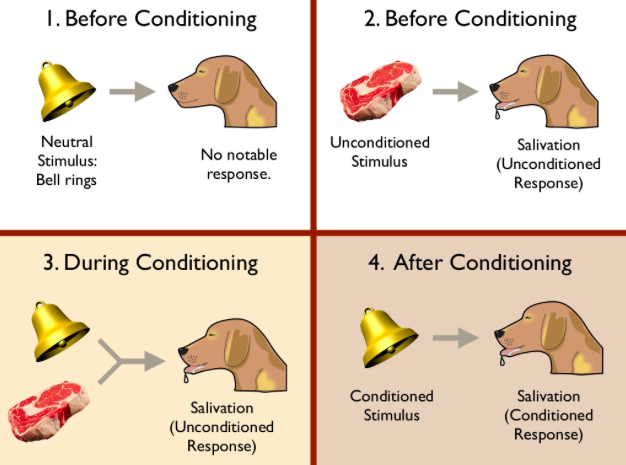
- Experiments are completed on animals and results are generalised to humans - 3Classical Conditioning Pavlovs salivating dogClassical -> Association
He noticed that whenever a dog was presented with food the dog began to salivate
He wanted to see whether he could make the dog salivate without actually providing the dog with food
Therefore he conditioned the dog to salivate to a bell - 4Classical Conditioning: The processPavlov showed that a neutral stimulus could bring about a new learned response (conditioned response)
- 5Concepts in Classical Conditioning EXTINCTIONIf a conditioned stimulus (the bell) is repeated many times without the unconditioned stimulus (the food), the conditioned response (salivating) disappears
- 6Concepts in classical Conditioning STIMULUS GENERALISATIONWhen a stimulus that is similar to the conditioned response can still bring about a response e.g. using a whistle instead of a bell
- 7Concepts in classical Conditioning SPONTANEOUS RECOVERYIf a conditioned response (salivation) has been lost and the conditioned stimulus (the bell) is later reintroduced, the conditioned response will reappear
- 8Concepts in classical Conditioning STIMULUS DISCRIMINATIONWhen a stimulus that is sufficiently different from the conditioned stimulus (the bell) will not bring about a response e.g. a snore.
- 9Operant Conditioning SKinner's RatsOperant -> Consequences
Behaviour is shaped and maintained by its consequences
Skinner placed a rat in a specially designed cage (Skinner box)
He tested the rats with a reward (food) and a punishment (electric shock) - 10Operant Conditioning; The ProcessCONDITION 1 - Whenever the rat pressed the lever the box rewarded it with a pellet of food.
CONDITION 2 - The rat was given an electric shock and when the rat pressed the lever the shock was removed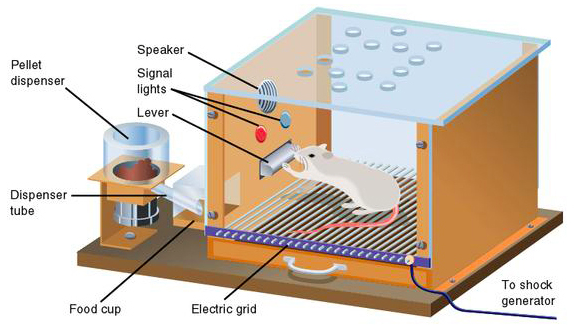
- 11Operant Conditioning The FindingsCondition 1 (food reward) -> This desirable consequence led to the behaviour being repeated
CONDITION 2 (electric shock) -> If pressing the lever relieved an electric shock the rat repeated the behaviour - 12Three types of consequences for behaviour POSITIVE REINFORCEMENTReceiving a reward for when a behaviour is performed
eg/ A child is misbehaving in a shop and is given some sweets to calm down - 13Three types of consequences for behaviour NEGATIVE REINFORCEMENTWhen an animal or human produces behaviour that avoids something unpleasant
eg/ When a parent gives their child a sweet to stop crying - 14Three types of consequences for behaviour PUNISHMENTAn unpleasant consequence of behaviour
- 15EVALUATION+ It has useful applications such as treating phobias
+ Its scientific and can be replicated
- Ethical issue of using the animals in experiments because they are put through stressful and aversive conditions
- Is not concerned with mental processes
- Deterministic -> 'slaves' to the environment and lack free choice in our behaviour - 16What is the Social Learning Theory?- Based on observational learning
- Bridge between cognitive and behaviourism
- Believes the mind and environment cause our behaviour - takes into account cognitive processes
- Behaviour takes place through observation and imitation of others. - 17Learning related to consequences of behaviour VICARIOUS REINFORCEMENTBandura -> VICARIOUS REINFORCEMENT:
Children and adults observe other people behaviour and take note of its consequences. They are likely to copy behaviour that is rewarded and not punished. - 18Mediational Processes (COGNITIVE) in learningATTENTION -> Whether behaviour is noticed/has an influence on anyone
RETENTION -> Whether behaviour observed is remembered in order to imitate it
MOTOR REPRODUCTION -> Being able to imitate the behaviour shown by the model
MOTIVATION -> Considering the pros and cons of imitating, whether to follow it or not - 19How does IDENTIFICATION make an impact on the behaviour we display?People are more likely to intimidate the behaviour of people with whom they identify (role models) as they are either similar or want to be like them
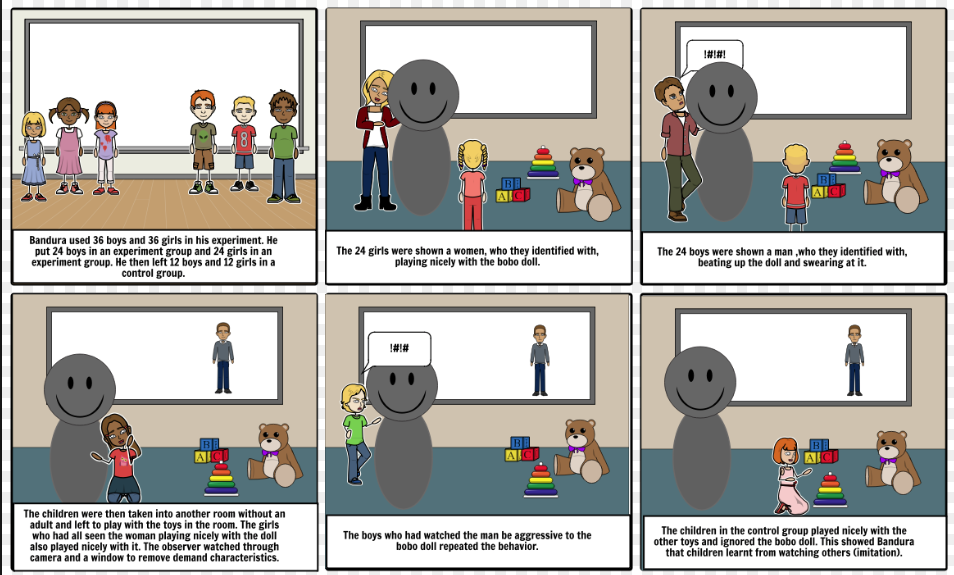
Role models tend to be attractive, successful and have high status. - 20BANDURA'S DOLLS RESEARCH 1 Stanford UniversityChildren witnessed:
- An adult acting agressively towards the Bobo doll
or
-An adult behaving in a non-aggressive way towards the Bobo doll
=When the children were left in the room alone with the dol, the children who saw the agression were much more aggressive to the doll. - 21BANDURA'S DOLLS - The Process
- 22BANDURA'S DOLLS RESEARCH 2 Stanford UniversityThe children saw an adult who was:
1- REWARDED
2- PUNISHED
3- NO CONSEQUENCE
1 -> Those who saw the adult being praised for their agression were being more aggressive themselves
2 -> These children showed little/no aggression towards the doll
3 -> Some continued to show aggression and some others did not - 23What did the study show?The Bobo doll studies show children are more likely to model acts of violence if they observe and adult figure doing this
Modelling aggressive behaviour is also more likely if the behaviour is seen to be reward (vicarious reinforcement) - 24EVALUATION of the SLT+ Takes into account the cognitive processes involved in learning
+ Flexible research methods
- Underestimates the influence of biological factors such as levels of hormones -> testosterone higher in boys which is linked to aggressive behaviour
- Observations took place in lab settings which raises the problem of demand charateristics and therefore the children may have acted in a way they thought was expected
- iGNORES INDIVIDUAL DIFFERENCES - 25What is the Cognitive Approach?- Focuses on how mental processes affect our behaviour
- Dominant approach in modern psychology
- Concerned with different aspects of how we think
- Explains how emotions effect our behaviour
-Humans are like computers
- Study in a outwardly objective way - 26How do cognitive psychologists study mental processes?Because thoughts are private and cannot be observed, mental processes are studied indirectly by making inferences (assumptions) about what is going on inside people heads on the basis of their behaviour
- 27Internal processes are studied by theoretical models. What is one of the theoretcal models they use?Information processing approach -> Information flows through the cognitive system in a sequence of stages that include INPUT, STORAGE and RETRIEVAL as in the multi-store model
- 28Cognitive psychologists believe in the 'computer analogy', what is it?Psychologists compere the human mind to a computer as there are similarities in how they both process information"
The use of a central processor (the brain), chnaging of information into a useable code (coding) and the use of 'stores' to hold the information - 29The idea of schemasSCHEMAS -> little packages of information that are developed through experience
They act as a 'mental framework' for the interpretation of incoming information received by the cognitive system e.g. you have a schema for a chair (has legs and you can sit on it)
Babies are born with SIMPLE MOTOR SCHEMA for INNATE behaviours such as grasping and sucking
As we get older and more experienced they become more detailed and sophisticated - 30Types of enquiry: COGNITIVE NEUROPSYCHOLOGYCOGNITIVE NEUROPSYCHOLOGY -> The study of cognitive processes in people who have suffered different types of brain damage
Therefore its the study of diferent brain structures on mental processes
Includes research linking semantic and episodic memories to opposite sides of the prefrontal cortex
Scanning techniques have enabled to establish the neurological basis of some disorders such as OCD - 31Types of enquiry: COGNITIVE SCIENCECOGNITIVE SCIENCE -> Theories and theoretical development and whether we process information once at a time (serial processing) or whether the human brain can process more than one piece at a time (parallel processing)
- 32Types of enquiry: EXPERIMENTAL COGNITIVE PSYCHOLOGYEXPERIMENTAL COGNITIVE PSYCHOLOGY -> Investigates mental prcesses in normal healthy people
- 33EVALUATION+ Application to everyday life -> understanding will enable us to revolutionise how we live in the future
+ Dominant approach in psychology
+ Less deterministic than other approaches as it recognise we can only operate within certain limits butare free to think before responsing to a stimulus
- Based on research which lacks external validity -> artificial stimuli used such as recall of word lists which does not represent everyday experiences
- Only provides a mechanical view of behaviour and ignores the role of the environment and our biological makeup
- Based on machine reductionism -> computer analogy does not show anything about emotion or motivation which is proven to affect accuracy of recall - 34What is the biological approach?- The belief that biological structures are the cause of behaviour e.g./ genes, neurochemistry and the nervous system
- The mind lives in the brain
- Behaviour has a genetic (inheritance) and neurochemical basis (hormones) e.g./low levels of serotonin in OCD - 35Twin Studies What did it prove?The study was used to determine the likelihood that certain traits have a genetic basis
Concordance rates were calculated - The extent to which twins share the same characteristics.
There were higher concordance rates among the identical twins compared to the non-identical twins
This is because identical twins share 100% of the same genes where as 50% is shared with non-identical twins
e.g./ 68% of Itwins have OCD compared to 31% of NItwins - 36GenotypeThe particular set of a genes a person possesses (their genetic make-up)
- 37PhenotypeThe characteristics of an individual determined by their genes and the environment
It is the way the genes are expressed through behavioural, physical and psychological characteristics - 38An example of the difference between genotype and phenotypePKU is a rare disease and illustrates how children can be born with a specific gene which causes them to have this condition
Información
- Descripción
- - Behaviourism - Social Learning - Cognitive - Biological
- Creado por
- Jadzia Allen
- Visitas
- 91
- Valoración