
Mapa mental
Physical education
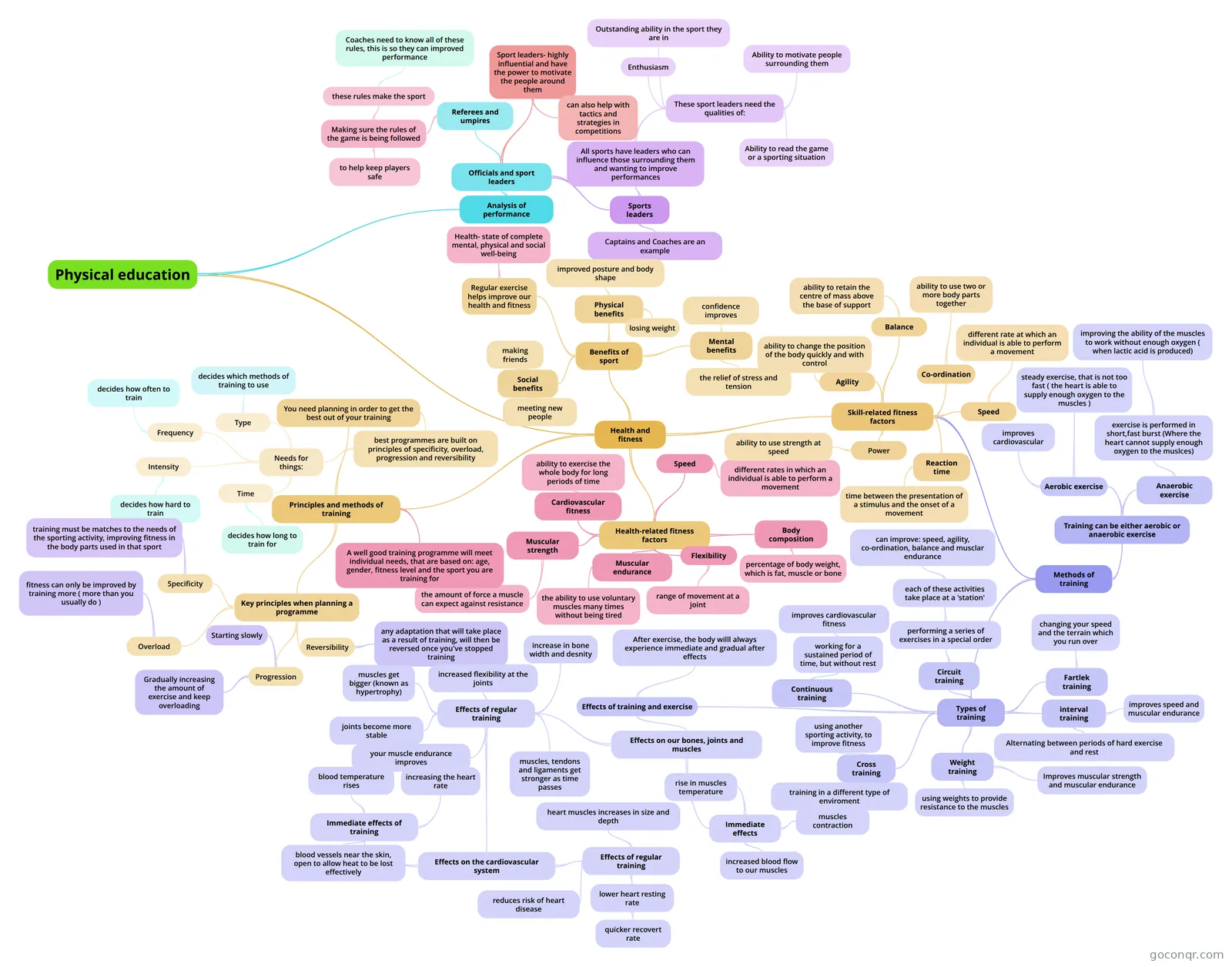
Mind map: Physical education
Contenido del mapa
Physical education
Analysis of performance
- Officials and sport leaders
- Sport leaders- highly influential and have the power to motivate the people around them
- can also help with tactics and strategies in competitions
- Referees and umpires
- Making sure the rules of the game is being followed
- these rules make the sport
- Coaches need to know all of these rules, this is so they can improved performance
- to help keep players safe
- these rules make the sport
- Making sure the rules of the game is being followed
- Sports leaders
- All sports have leaders who can influence those surrounding them and wanting to improve performances
- These sport leaders need the qualities of:
- Enthusiasm
- Outstanding ability in the sport they are in
- Ability to motivate people surrounding them
- Ability to read the game or a sporting situation
- These sport leaders need the qualities of:
- Captains and Coaches are an example
- All sports have leaders who can influence those surrounding them and wanting to improve performances
- Sport leaders- highly influential and have the power to motivate the people around them
- Officials and sport leaders
Health and fitness
- Benefits of sport
- Regular exercise helps improve our health and fitness
- Health- state of complete mental, physical and social well-being
- Mental benefits
- confidence improves
- the relief of stress and tension
- Physical benefits
- losing weight
- improved posture and body shape
- Social benefits
- making friends
- meeting new people
- Regular exercise helps improve our health and fitness
- Health-related fitness factors
- Cardiovascular fitness
- ability to exercise the whole body for long periods of time
- Muscular strength
- the amount of force a muscle can expect against resistance
- Muscular endurance
- the ability to use voluntary muscles many times without being tired
- Flexibility
- range of movement at a joint
- Body composition
- percentage of body weight, which is fat, muscle or bone
- Speed
- different rates in which an individual is able to perform a movement
- Cardiovascular fitness
- Skill-related fitness factors
- Agility
- ability to change the position of the body quickly and with control
- Balance
- ability to retain the centre of mass above the base of support
- Co-ordination
- ability to use two or more body parts together
- Power
- ability to use strength at speed
- Reaction time
- time between the presentation of a stimulus and the onset of a movement
- Speed
- different rate at which an individual is able to perform a movement
- Methods of training
- Training can be either aerobic or anaerobic exercise
- Aerobic exercise
- steady exercise, that is not too fast ( the heart is able to supply enough oxygen to the muscles )
- improves cardiovascular
- Anaerobic exercise
- exercise is performed in short,fast burst (Where the heart cannot supply enough oxygen to the muslces)
- improving the ability of the muscles to work without enough oxygen ( when lactic acid is produced)
- exercise is performed in short,fast burst (Where the heart cannot supply enough oxygen to the muslces)
- Aerobic exercise
- Types of training
- Circuit training
- performing a series of exercises in a special order
- each of these activities take place at a 'station'
- can improve: speed, agility, co-ordination, balance and musclar endurance
- each of these activities take place at a 'station'
- performing a series of exercises in a special order
- Continuous training
- working for a sustained period of time, but without rest
- improves cardiovascular fitness
- working for a sustained period of time, but without rest
- Cross training
- using another sporting activity, to improve fitness
- training in a different type of enviroment
- Fartlek training
- changing your speed and the terrain which you run over
- interval training
- Alternating between periods of hard exercise and rest
- improves speed and muscular endurance
- Weight training
- using weights to provide resistance to the muscles
- Improves muscular strength and muscular endurance
- Effects of training and exercise
- After exercise, the body willl always experience immediate and gradual after effects
- Effects on our bones, joints and muscles
- Immediate effects
- muscles contraction
- increased blood flow to our muscles
- rise in muscles temperature
- Effects of regular training
- increase in bone width and desnity
- muscles, tendons and ligaments get stronger as time passes
- joints become more stable
- increased flexibility at the joints
- muscles get bigger (known as hypertrophy)
- your muscle endurance improves
- Effects on the cardiovascular system
- Immediate effects of training
- increasing the heart rate
- blood temperature rises
- blood vessels near the skin, open to allow heat to be lost effectively
- Effects of regular training
- heart muscles increases in size and depth
- lower heart resting rate
- quicker recovert rate
- reduces risk of heart disease
- Immediate effects of training
- Immediate effects
- Circuit training
- Training can be either aerobic or anaerobic exercise
- Agility
- Principles and methods of training
- You need planning in order to get the best out of your training
- best programmes are built on principles of specificity, overload, progression and reversibility
- Needs for things:
- Frequency
- decides how often to train
- Intensity
- decides how hard to train
- Time
- decides how long to train for
- Type
- decides which methods of training to use
- Frequency
- Needs for things:
- best programmes are built on principles of specificity, overload, progression and reversibility
- A well good training programme will meet individual needs, that are based on: age, gender, fitness level and the sport you are training for
- Key principles when planning a programme
- Specificity
- training must be matches to the needs of the sporting activity, improving fitness in the body parts used in that sport
- Overload
- fitness can only be improved by training more ( more than you usually do )
- Progression
- Starting slowly
- Gradually increasing the amount of exercise and keep overloading
- Reversibility
- any adaptation that will take place as a result of training, will then be reversed once you've stopped training
- Specificity
- You need planning in order to get the best out of your training
- Benefits of sport
Información
- Descripción
- GCSE GCSE EDEXCEL PE Mapa Mental sobre Physical education, creado por plumlovesoreos el 30/06/2014.
- Creado por
- plumlovesoreos
- Visitas
- 382
- Etiquetas
- Valoración