
Mapa mental
Cell division
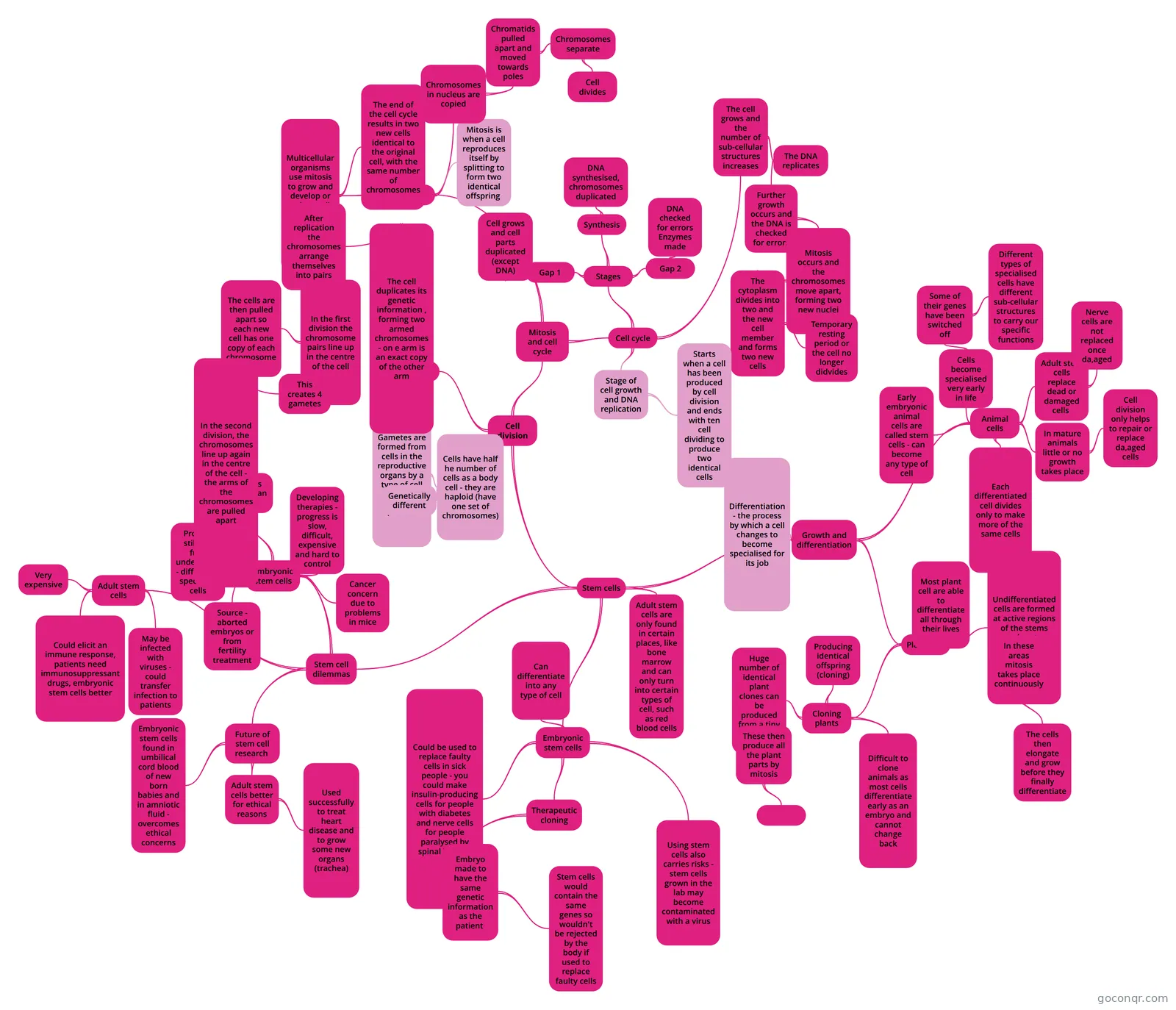
Mind map: Cell division
Contenido del mapa
Cell division
Stem cells
- Growth and differentiation
- Differentiation - the process by which a cell changes to become specialised for its job
- Animal cells
- Early embryonic animal cells are called stem cells - can become any type of cell
- Cells become specialised very early in life
- Some of their genes have been switched off
- Different types of specialised cells have different sub-cellular structures to carry our specific functions
- Some of their genes have been switched off
- Adult stem cells replace dead or damaged cells
- Nerve cells are not replaced once da,aged
- In mature animals little or no growth takes place
- Cell division only helps to repair or replace da,aged cells
- Each differentiated cell divides only to make more of the same cells
- Plant cells
- Most plant cell are able to differentiate all through their lives
- Undifferentiated cells are formed at active regions of the stems and roots, known and meristems
- In these areas mitosis takes place continuously
- The cells then elongate and grow before they finally differentiate
- In these areas mitosis takes place continuously
- Cloning plants
- Producing identical offspring (cloning)
- Huge number of identical plant clones can be produced from a tiny piece of leaf tissue
- These then produce all the plant parts by mitosis
- These then produce all the plant parts by mitosis
- Difficult to clone animals as most cells differentiate early as an embryo and cannot change back
- Embryonic stem cells
- Can differentiate into any type of cell
- Could be used to replace faulty cells in sick people - you could make insulin-producing cells for people with diabetes and nerve cells for people paralysed by spinal injuries
- Therapeutic cloning
- Embryo made to have the same genetic information as the patient
- Stem cells would contain the same genes so wouldn't be rejected by the body if used to replace faulty cells
- Embryo made to have the same genetic information as the patient
- Using stem cells also carries risks - stem cells grown in the lab may become contaminated with a virus
- Adult stem cells are only found in certain places, like bone marrow and can only turn into certain types of cell, such as red blood cells
- Stem cell dilemmas
- Embryonic stem cells
- Source - aborted embryos or from fertility treatment
- Embryos and human rights
- Developing therapies - progress is slow, difficult, expensive and hard to control
- Process still not fully understood - difficult to specialise cells
- Cancer concern due to problems in mice
- Adult stem cells
- May be infected with viruses - could transfer infection to patients
- Could elicit an immune response, patients need immunosuppressant drugs, embryonic stem cells better
- Very expensive
- Future of stem cell research
- Embryonic stem cells found in umbilical cord blood of new born babies and in amniotic fluid - overcomes ethical concerns
- Adult stem cells better for ethical reasons
- Used successfully to treat heart disease and to grow some new organs (trachea)
- Embryonic stem cells
- Growth and differentiation
Mitosis and cell cycle
- Mitosis
- Mitosis is when a cell reproduces itself by splitting to form two identical offspring
- Multicellular organisms use mitosis to grow and develop or replace cells that have been damaged
- The end of the cell cycle results in two new cells identical to the original cell, with the same number of chromosomes
- Chromosomes in nucleus are copied
- Chromatids pulled apart and moved towards poles
- Chromosomes separate
- Cell divides
- Chromosomes separate
- Chromatids pulled apart and moved towards poles
- Cell cycle
- Stages
- Gap 1
- Cell grows and cell parts duplicated (except DNA)
- Synthesis
- DNA synthesised, chromosomes duplicated
- Gap 2
- DNA checked for errors Enzymes made
- Gap 1
- The cell grows and the number of sub-cellular structures increases
- The DNA replicates
- Further growth occurs and the DNA is checked for errors
- Mitosis occurs and the chromosomes move apart, forming two new nuclei
- The cytoplasm divides into two and the new cell member and forms two new cells
- Temporary resting period or the cell no longer didvides
- The cytoplasm divides into two and the new cell member and forms two new cells
- Mitosis occurs and the chromosomes move apart, forming two new nuclei
- Further growth occurs and the DNA is checked for errors
- The DNA replicates
- Stage of cell growth and DNA replication
- Starts when a cell has been produced by cell division and ends with ten cell dividing to produce two identical cells
- Stages
- Mitosis
Meiosis
- Gametes are formed from cells in the reproductive organs by a type of cell division called meiosis
- Cells have half he number of cells as a body cell - they are haploid (have one set of chromosomes)
- Genetically different
- Cells have half he number of cells as a body cell - they are haploid (have one set of chromosomes)
- The cell duplicates its genetic information , forming two armed chromosomes - on e arm is an exact copy of the other arm
- After replication the chromosomes arrange themselves into pairs
- In the first division the chromosome pairs line up in the centre of the cell
- The cells are then pulled apart so each new cell has one copy of each chromosome
- In the second division, the chromosomes line up again in the centre of the cell - the arms of the chromosomes are pulled apart
- This creates 4 gametes
- In the second division, the chromosomes line up again in the centre of the cell - the arms of the chromosomes are pulled apart
- The cells are then pulled apart so each new cell has one copy of each chromosome
- In the first division the chromosome pairs line up in the centre of the cell
- After replication the chromosomes arrange themselves into pairs
- Gametes are formed from cells in the reproductive organs by a type of cell division called meiosis
Información
- Descripción
- (Biology) Yr 10 mocks Mapa Mental sobre Cell division, creado por Emily H el 27/09/2017.
- Creado por
- Emily H
- Visitas
- 0
- Valoración
Más sobre Cell Cycle and Division