
Mapa mental
B1.8 Evolution
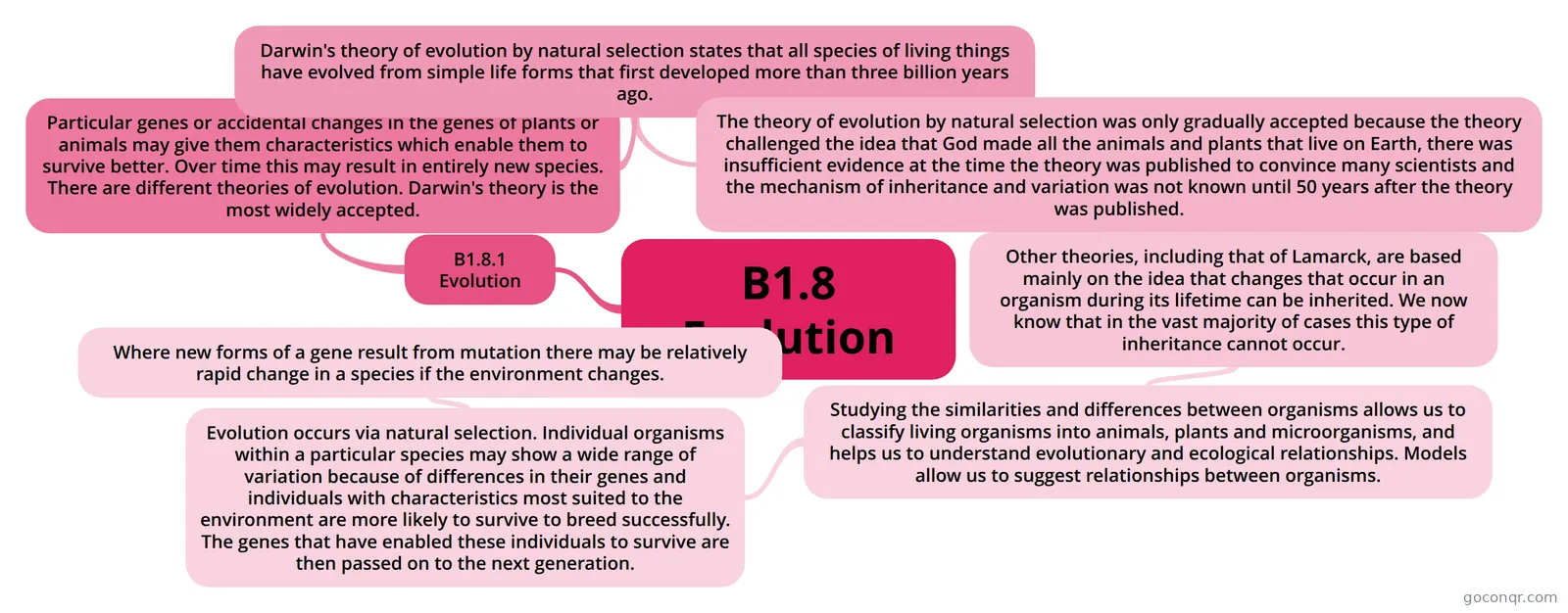
Mind map: Evolution
Contenido del mapa
B1.8 Evolution
B1.8.1 Evolution
- Particular genes or accidental changes in the genes of plants or animals may give them characteristics which enable them to survive better. Over time this may result in entirely new species. There are different theories of evolution. Darwin's theory is the most widely accepted.
- Darwin's theory of evolution by natural selection states that all species of living things have evolved from simple life forms that first developed more than three billion years ago.
- The theory of evolution by natural selection was only gradually accepted because the theory challenged the idea that God made all the animals and plants that live on Earth, there was insufficient evidence at the time the theory was published to convince many scientists and the mechanism of inheritance and variation was not known until 50 years after the theory was published.
- Other theories, including that of Lamarck, are based mainly on the idea that changes that occur in an organism during its lifetime can be inherited. We now know that in the vast majority of cases this type of inheritance cannot occur.
- Studying the similarities and differences between organisms allows us to classify living organisms into animals, plants and microorganisms, and helps us to understand evolutionary and ecological relationships. Models allow us to suggest relationships between organisms.
- Evolution occurs via natural selection. Individual organisms within a particular species may show a wide range of variation because of differences in their genes and individuals with characteristics most suited to the environment are more likely to survive to breed successfully. The genes that have enabled these individuals to survive are then passed on to the next generation.
- Where new forms of a gene result from mutation there may be relatively rapid change in a species if the environment changes.
- Evolution occurs via natural selection. Individual organisms within a particular species may show a wide range of variation because of differences in their genes and individuals with characteristics most suited to the environment are more likely to survive to breed successfully. The genes that have enabled these individuals to survive are then passed on to the next generation.
- Studying the similarities and differences between organisms allows us to classify living organisms into animals, plants and microorganisms, and helps us to understand evolutionary and ecological relationships. Models allow us to suggest relationships between organisms.
- Other theories, including that of Lamarck, are based mainly on the idea that changes that occur in an organism during its lifetime can be inherited. We now know that in the vast majority of cases this type of inheritance cannot occur.
- The theory of evolution by natural selection was only gradually accepted because the theory challenged the idea that God made all the animals and plants that live on Earth, there was insufficient evidence at the time the theory was published to convince many scientists and the mechanism of inheritance and variation was not known until 50 years after the theory was published.
- Darwin's theory of evolution by natural selection states that all species of living things have evolved from simple life forms that first developed more than three billion years ago.
- Particular genes or accidental changes in the genes of plants or animals may give them characteristics which enable them to survive better. Over time this may result in entirely new species. There are different theories of evolution. Darwin's theory is the most widely accepted.
Información
- Descripción
- GCSE (B1) Biology Mapa Mental sobre B1.8 Evolution, creado por killthemoment el 02/08/2014.
- Creado por
- killthemoment
- Visitas
- 51
- Etiquetas
- Valoración