
Mapa mental
Nucleic Acids
Contenido del mapa
Nucleic Acids
Structure of RNA and DNA
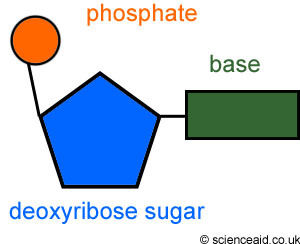
- Nucleotide Structure
- made up of 3 components
- a pentose sugar
- a phosphate group
- a nitrogen containing organic base
- A/T/C/G/U
- A is complementary to T and C is complementary to G
- A/T/C/G/U
- the pentose sugar, organic base and phosphate group are joined by a condensation reaction
- forms a mononucleotide
- bond between two mononucleotides is a phosphodiester bond
- dinucleotide
- made up of 3 components
- RNA - ribonucleic acid
- polymer made up of nucleotides
- single relatively short polynucleotide chain
- pentose sugar is always ribose. Organic bases are A,G,C,U.
- one type of RNA transfers genetic info. Another is involved in protein synthesis. Ribosomes are made of another type
- DNA structure
- pentose sugar is deoxyribose. Organic bases are A,T,C,G
- DNA is made of 2 strands of nucleotides
- they are both very long and joined by hydrogen bonds.
- double helix forms a structural backbone
- DNA stability
- the phosphodiester backbone protects the more chemically reactive bases
- hydrogen bonds link the bases
- C-G = 3 A-T = 2
- DNA function
- hereditary material responsible for passing genetic information from cell to cell and generation to generation
- almost infinite variety of sequences of bases
- leading to increased genetic variation
- rarely mutates and very stable
- two strands joined by hydrogen bonds meaning it can separate during replication
- large molecule and carries lots of genetic information
- genetic information is protected from chemical and physical forces becuause it is located within the phosphodiester backbone
- Nucleotide Structure
DNA replication
- cell division occurs in two ways
- nuclear division = nucleus divides (mitosis/meiosis)
- cytokinesis = follows nuclear division and the whole cell divides
- semi-conservative replication
- needs... the nucleotide bases, both strands of DNA to act as a template, DNA polymerase, source of chemical energy
- 1. DNA helicase breaks the hydrogen bonds
- 2. helix unwinds and separates into two strands
- 3. each exposed polynucleotide chain acts as a template
- 4. nucleotides are joined together in condensation reactions by DNA polymerse
- 5. each new DNA molecule has one original strand and one new one
- 4. nucleotides are joined together in condensation reactions by DNA polymerse
- 3. each exposed polynucleotide chain acts as a template
- 2. helix unwinds and separates into two strands
- cell division occurs in two ways
Energy and ATP
- Structure = adenine, ribose and phosphates
- ATP has 3 phosphate groups
- the bonds between them are unstable and lave low activation energy
- they are easily broken and release lots of energy when they do
- usually only the terminal phosphate is removed
- ATP + H2O -> ADP + Pi + E
- water is used to convert AP to ADP, this is known as hydrolysis. The reaction is catalysed by ATP hydrolase
- this is a reversible reaction. That is a condensation reaction and is catalysed by ATP synthatse
- this can occur in three ways
- photophosphorylation
- oxidative phosphorylation
- substrate-level phosphorylation
- this can occur in three ways
- this is a reversible reaction. That is a condensation reaction and is catalysed by ATP synthatse
- water is used to convert AP to ADP, this is known as hydrolysis. The reaction is catalysed by ATP hydrolase
- ATP + H2O -> ADP + Pi + E
- usually only the terminal phosphate is removed
- they are easily broken and release lots of energy when they do
- the bonds between them are unstable and lave low activation energy
- ATP is a good immediate energy source because it is instable
- ATP is a better immediate energy source than glucose because the amount of energy released is more manageable and the hydrolysis of ADP to ATP is a single reaction
- ATP is involved in energy-requiring processes in cells
- metabolic processes - provides the energy needed to build up macromolecules from their basic sub-units
- movement - provides energy for muscle contraction and the energy for filaments to slide past one another
- active transport - energy to change the shape of carrier proteins
- secretion - needed to form lysosomes
- activation of molecules - Pi released during hydrolysis can be used to phosphorylate other compounds to make them more reactive
Water
- Dipolar
- oxygen atoms are slightly negative and hydrogen slightly positive, so the molecule has positive and negative poles
- Hydrogen bonding
- opposite poles attract and the attractive forces between them is a hydrogen bond
- individually the bonds are weak
- SHC
- water molecules bond together meaning it takes more energy to break the bonds
- latent heat of vaporisation
- hydrogen bonding between water molecules means that it requires a lot of energy to evaporate 1 gram of water
- cohesion and surface tension
- the tendency of molecules to stick together is known as cohesion.
- with its hydrogen bonding, water has large cohesive forces and these allow it to be pulled through a tube, such as a xylem vessel
- water in metabolism
- used to break down complex molecules by hydrolysis
- produced in condensation reactions
- chemical reactions take place in aqueous medium
- major raw material in photosynthesis
- solvent
- water readily dissolves other substances such as gases, wastes, inorganic ions and enzymes
- important features
- evaporation cools organisms
- not easily compressed so provides support
- transparent so aquatic plants can photosynthesise
- not easily compressed so provides support
- inorganic ions (iron, phosphate ions, hydrogen ions, sodium ions)
- evaporation cools organisms
- Dipolar
Imágenes y archivos del mapa
Información
- Descripción
- A level (Section 1) Biology Mapa Mental sobre Nucleic Acids, creado por Orlagh Bonser el 25/01/2018.
- Creado por
- Orlagh Bonser
- Visitas
- 93
- Etiquetas
- Valoración