
Mapa mental
Evolution
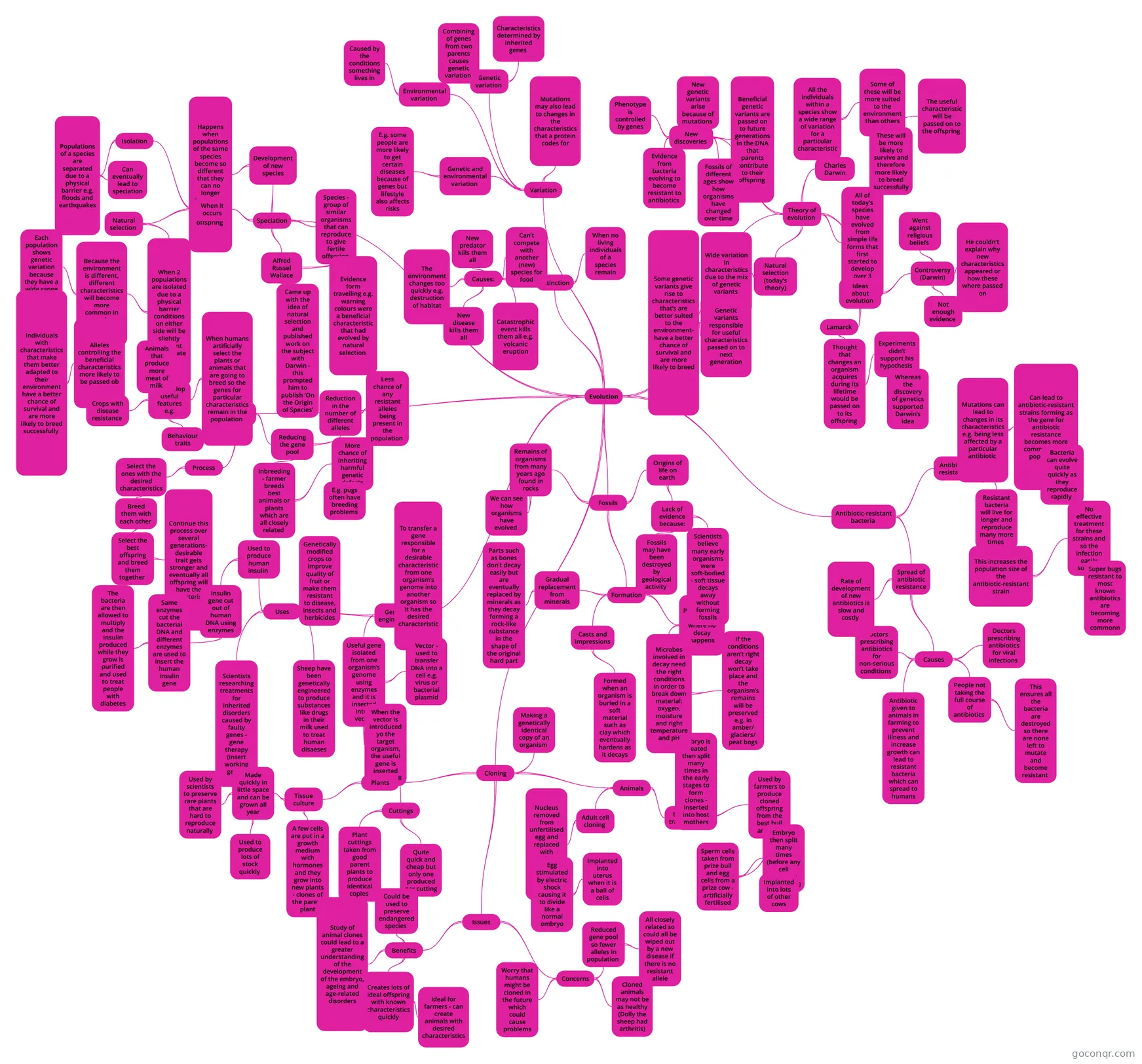
Mind map: Evolution
Contenido del mapa
Evolution
Variation
- Genetic variation
- Characteristics determined by inherited genes
- Combining of genes from two parents causes genetic variation
- Environmental variation
- Caused by the conditions something lives in
- Genetic and environmental variation
- E.g. some people are more likely to get certain diseases because of genes but lifestyle also affects risks
- Mutations may also lead to changes in the characteristics that a protein codes for
- Genetic variation
Theory of evolution
- All of today’s species have evolved from simple life forms that first started to develop over 3 billion years ago
- Charles Darwin
- All the individuals within a species show a wide range of variation for a particular characteristic
- Some of these will be more suited to the environment than others
- These will be more likely to survive and therefore more likely to breed successfully
- The useful characteristic will be passed on to the offspring
- These will be more likely to survive and therefore more likely to breed successfully
- Some of these will be more suited to the environment than others
- All the individuals within a species show a wide range of variation for a particular characteristic
- New discoveries
- Phenotype is controlled by genes
- New genetic variants arise because of mutations
- Beneficial genetic variants are passed on to future generations in the DNA that parents contribute to their offspring
- Fossils of different ages show how organisms have changed over time
- Evidence from bacteria evolving to become resistant to antibiotics
- Natural selection (today’s theory)
- Wide variation in characteristics due to the mix of genetic variants
- Some genetic variants give rise to characteristics that’s are better suited to the environment- have a better chance of survival and are more likely to breed
- Genetic variants responsible for useful characteristics passed on to next generation
- Some genetic variants give rise to characteristics that’s are better suited to the environment- have a better chance of survival and are more likely to breed
- Wide variation in characteristics due to the mix of genetic variants
- Ideas about evolution
- Controversy (Darwin)
- Went against religious beliefs
- He couldn’t explain why new characteristics appeared or how these where passed on
- Not enough evidence
- Lamarck
- Thought that changes an organism acquires during its lifetime would be passed on to its offspring
- Experiments didn’t support his hypothesis
- Whereas the discovery of genetics supported Darwin’s idea
- Experiments didn’t support his hypothesis
- Thought that changes an organism acquires during its lifetime would be passed on to its offspring
- Controversy (Darwin)
Speciation
- Development of new species
- Happens when populations of the same species become so different that they can no longer interbreed to produce fertile offspring
- Species - group of similar organisms that can reproduce to give fertile offspring
- When it occurs
- Isolation
- Populations of a species are separated due to a physical barrier e.g. floods and earthquakes
- Can eventually lead to speciation
- Populations of a species are separated due to a physical barrier e.g. floods and earthquakes
- Natural selection
- When 2 populations are isolated due to a physical barrier conditions on either side will be slightly different e.g. climate
- Because the environment is different, different characteristics will become more common in each population
- Each population shows genetic variation because they have a wide range of alleles
- Individuals with characteristics that make them better adapted to their environment have a better chance of survival and are more likely to breed successfully
- Alleles controlling the beneficial characteristics more likely to be passed ob
- Individuals with characteristics that make them better adapted to their environment have a better chance of survival and are more likely to breed successfully
- Each population shows genetic variation because they have a wide range of alleles
- Because the environment is different, different characteristics will become more common in each population
- When 2 populations are isolated due to a physical barrier conditions on either side will be slightly different e.g. climate
- Isolation
- Alfred Russel Wallace
- Came up with the idea of natural selection and published work on the subject with Darwin - this prompted him to publish ‘On the Origin of Species’
- Evidence form travelling e.g. warning colours were a beneficial characteristic that had evolved by natural selection
- Development of new species
Extinction
- When no living individuals of a species remain
- Causes:
- The environment changes too quickly e.g. destruction of habitat
- New predator kills them all
- New disease kills them all
- Can’t compete with another (new) species for food
- Catastrophic event kills them all e.g. volcanic eruption
Selective breeding
- When humans artificially select the plants or animals that are going to breed so the genes for particular characteristics remain in the population
- To develop useful features e.g.
- Animals that produce more meat of milk
- Crops with disease resistance
- Behaviour traits
- To develop useful features e.g.
- Process
- Select the ones with the desired characteristics
- Breed them with each other
- Select the best offspring and breed them together
- Continue this process over several generations- desirable trait gets stronger and eventually all offspring will have the characteristic
- Select the best offspring and breed them together
- Breed them with each other
- Select the ones with the desired characteristics
- Reducing the gene pool
- Inbreeding - farmer breeds best animals or plants which are all closely related
- More chance of inheriting harmful genetic defects
- E.g. pugs often have breeding problems
- More chance of inheriting harmful genetic defects
- Reduction in the number of different alleles
- Less chance of any resistant alleles being present in the population
- Inbreeding - farmer breeds best animals or plants which are all closely related
- When humans artificially select the plants or animals that are going to breed so the genes for particular characteristics remain in the population
Genetic engineering
- To transfer a gene responsible for a desirable characteristic from one organism’s genome into another organism so it has the desired characteristic
- Useful gene isolated from one organism’s genome using enzymes and it is inserted into a vector
- Vector - used to transfer DNA into a cell e.g. virus or bacterial plasmid
- When the vector is introduced yo the target organism, the useful gene is inserted into its cell
- Uses
- Used to produce human insulin
- Insulin gene cut out of human DNA using enzymes
- Same enzymes cut the bacterial DNA and different enzymes are used to insert the human insulin gene
- The bacteria are then allowed to multiply and the insulin produced while they grow is purified and used to treat people with diabetes
- Same enzymes cut the bacterial DNA and different enzymes are used to insert the human insulin gene
- Insulin gene cut out of human DNA using enzymes
- Genetically modified crops to improve quality of fruit or make them resistant to disease, insects and herbicides
- Sheep have been genetically engineered to produce substances like drugs in their milk used to treat human disaeses
- Scientists researching treatments for inherited disorders caused by faulty genes - gene therapy (insert working genes)
- Used to produce human insulin
Cloning
- Making a genetically identical copy of an organism
- Plants
- Tissue culture
- A few cells are put in a growth medium with hormones and they grow into new plants - clones of the parent plant
- Made quickly in little space and can be grown all year
- Used by scientists to preserve rare plants that are hard to reproduce naturally
- Used to produce lots of stock quickly
- Cuttings
- Plant cuttings taken from good parent plants to produce identical copies
- Quite quick and cheap but only one produced per cutting
- Tissue culture
- Animals
- Embryo transplant
- Embryo is created then split many times in the early stages to form clones - inserted into host mothers
- Used by farmers to produce cloned offspring from the best bull and cow
- Sperm cells taken from prize bull and egg cells from a prize cow - artificially fertilised
- Embryo then split many times (before any cell becomes specialised)
- Implanted into lots of other cows
- Embryo then split many times (before any cell becomes specialised)
- Sperm cells taken from prize bull and egg cells from a prize cow - artificially fertilised
- Adult cell cloning
- Nucleus removed from unfertilised egg and replaced with nucleus removed from adult body cell
- Egg stimulated by electric shock causing it to divide like a normal embryo
- Implanted into uterus when it is a ball of cells
- Egg stimulated by electric shock causing it to divide like a normal embryo
- Nucleus removed from unfertilised egg and replaced with nucleus removed from adult body cell
- Embryo transplant
- Issues
- Benefits
- Creates lots of ideal offspring with known characteristics quickly
- Ideal for farmers - can create animals with desired characteristics
- Study of animal clones could lead to a greater understanding of the development of the embryo, ageing and age-related disorders
- Could be used to preserve endangered species
- Creates lots of ideal offspring with known characteristics quickly
- Concerns
- Reduced gene pool so fewer alleles in population
- All closely related so could all be wiped out by a new disease if there is no resistant allele
- Cloned animals may not be as healthy (Dolly the sheep had arthritis)
- Worry that humans might be cloned in the future which could cause problems
- Reduced gene pool so fewer alleles in population
- Benefits
Fossils
- Remains of organisms from many years ago found in rocks
- We can see how organisms have evolved
- Formation
- Gradual replacement from minerals
- Parts such as bones don’t decay easily but are eventually replaced by minerals as they decay forming a rock-like substance in the shape of the original hard part
- Casts and impressions
- Formed when an organism is buried in a soft material such as clay which eventually hardens as it decays
- Preservation in places where no decay happens
- Microbes involved in decay need the right conditions in order to break down material: oxygen, moisture and right temperature and pH
- If the conditions aren’t right decay won’t take place and the organism’s remains will be preserved e.g. in amber/ glaciers/ peat bogs
- Microbes involved in decay need the right conditions in order to break down material: oxygen, moisture and right temperature and pH
- Gradual replacement from minerals
- Origins of life on earth
- Lack of evidence because:
- Scientists believe many early organisms were soft-bodied - soft tissue decays away without forming fossils
- Fossils may have been destroyed by geological activity
- Lack of evidence because:
- Remains of organisms from many years ago found in rocks
Antibiotic-resistant bacteria
- Antibiotic resistance
- Mutations can lead to changes in its characteristics e.g. being less affected by a particular antibiotic
- Can lead to antibiotic-resistant strains forming as the gene for antibiotic resistance becomes more common in the population
- Bacteria can evolve quite quickly as they reproduce rapidly
- Can lead to antibiotic-resistant strains forming as the gene for antibiotic resistance becomes more common in the population
- Resistant bacteria will live for longer and reproduce many more times
- This increases the population size of the antibiotic-resistant strain
- No effective treatment for these strains and so the infection easily soreads
- Super bugs resistant to most known antibiotics are becoming more commonn
- No effective treatment for these strains and so the infection easily soreads
- This increases the population size of the antibiotic-resistant strain
- Mutations can lead to changes in its characteristics e.g. being less affected by a particular antibiotic
- Spread of antibiotic resistance
- Causes
- Doctors prescribing antibiotics for non-serious conditions
- Doctors prescribing antibiotics for viral infections
- People not taking the full course of antibiotics
- This ensures all the bacteria are destroyed so there are none left to mutate and become resistant
- Antibiotic given to animals in farming to prevent illness and increase growth can lead to resistant bacteria which can spread to humans
- Rate of development of new antibiotics is slow and costly
- Causes
- Antibiotic resistance
Información
- Descripción
- - XGCSE Mapa Mental sobre Evolution, creado por Emily H el 07/02/2018.
- Creado por
- Emily H
- Visitas
- 0
- Valoración