
Mapa mental
Evolution
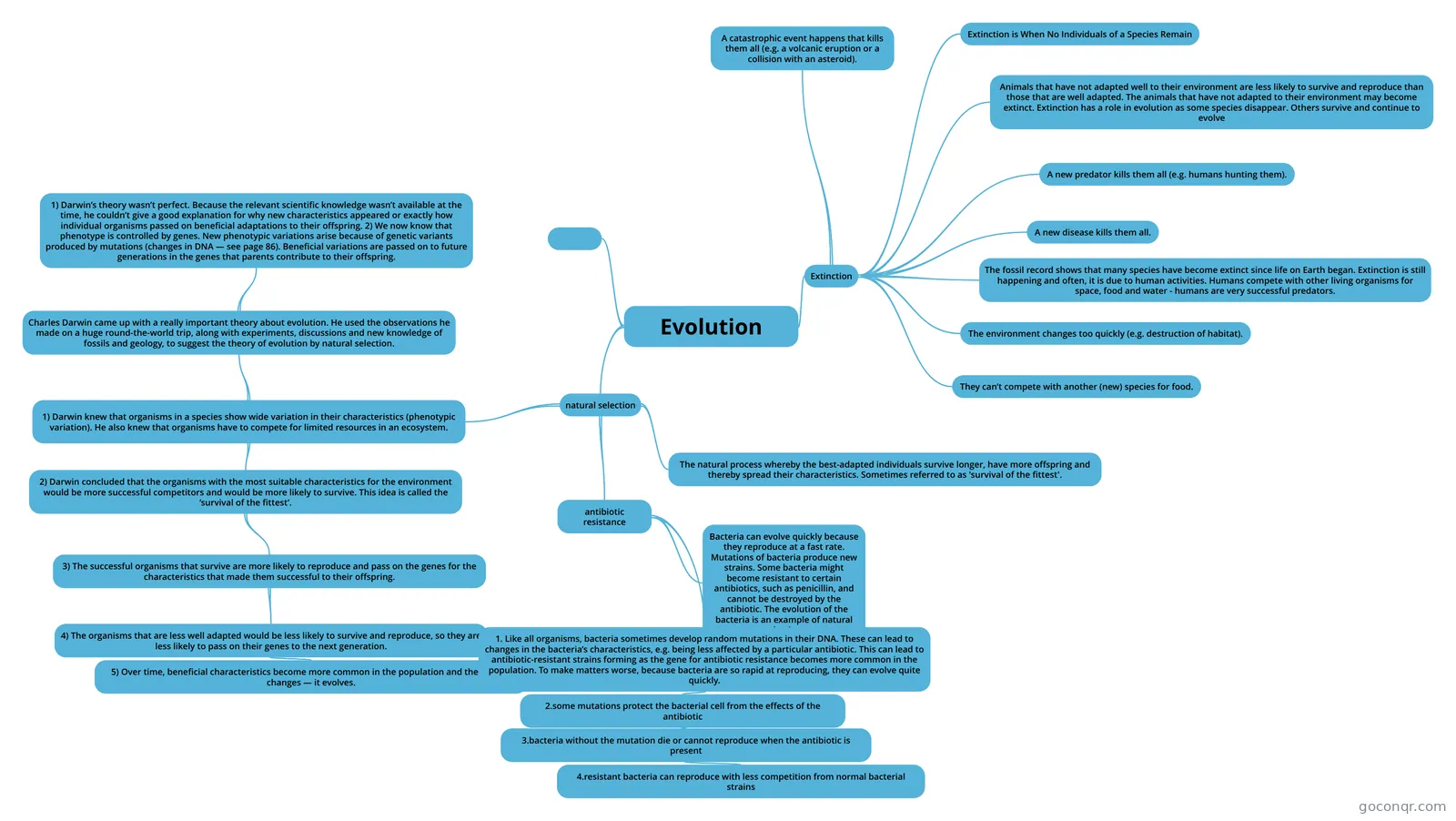
Mind map: Evolution
Contenido del mapa
Evolution
natural selection
- The natural process whereby the best-adapted individuals survive longer, have more offspring and thereby spread their characteristics. Sometimes referred to as 'survival of the fittest'.
- 1) Darwin knew that organisms in a species show wide variation in their characteristics (phenotypic variation). He also knew that organisms have to compete for limited resources in an ecosystem.
- Charles Darwin came up with a really important theory about evolution. He used the observations he made on a huge round-the-world trip, along with experiments, discussions and new knowledge of fossils and geology, to suggest the theory of evolution by natural selection.
- 1) Darwin’s theory wasn’t perfect. Because the relevant scientific knowledge wasn’t available at the time, he couldn’t give a good explanation for why new characteristics appeared or exactly how individual organisms passed on beneficial adaptations to their offspring. 2) We now know that phenotype is controlled by genes. New phenotypic variations arise because of genetic variants produced by mutations (changes in DNA — see page 86). Beneficial variations are passed on to future generations in the genes that parents contribute to their offspring.
- 2) Darwin concluded that the organisms with the most suitable characteristics for the environment would be more successful competitors and would be more likely to survive. This idea is called the ‘survival of the fittest’.
- 3) The successful organisms that survive are more likely to reproduce and pass on the genes for the characteristics that made them successful to their offspring.
- 4) The organisms that are less well adapted would be less likely to survive and reproduce, so they are less likely to pass on their genes to the next generation.
- 5) Over time, beneficial characteristics become more common in the population and the species changes — it evolves.
- 4) The organisms that are less well adapted would be less likely to survive and reproduce, so they are less likely to pass on their genes to the next generation.
- 3) The successful organisms that survive are more likely to reproduce and pass on the genes for the characteristics that made them successful to their offspring.
- Charles Darwin came up with a really important theory about evolution. He used the observations he made on a huge round-the-world trip, along with experiments, discussions and new knowledge of fossils and geology, to suggest the theory of evolution by natural selection.
- antibiotic resistance
- Bacteria can evolve quickly because they reproduce at a fast rate. Mutations of bacteria produce new strains. Some bacteria might become resistant to certain antibiotics, such as penicillin, and cannot be destroyed by the antibiotic. The evolution of the bacteria is an example of natural selection.
- 1. Like all organisms, bacteria sometimes develop random mutations in their DNA. These can lead to changes in the bacteria’s characteristics, e.g. being less affected by a particular antibiotic. This can lead to antibiotic-resistant strains forming as the gene for antibiotic resistance becomes more common in the population. To make matters worse, because bacteria are so rapid at reproducing, they can evolve quite quickly.
- 2.some mutations protect the bacterial cell from the effects of the antibiotic
- 3.bacteria without the mutation die or cannot reproduce when the antibiotic is present
- 4.resistant bacteria can reproduce with less competition from normal bacterial strains
- 3.bacteria without the mutation die or cannot reproduce when the antibiotic is present
- 2.some mutations protect the bacterial cell from the effects of the antibiotic
Extinction
- Extinction is When No Individuals of a Species Remain
- The environment changes too quickly (e.g. destruction of habitat).
- A new predator kills them all (e.g. humans hunting them).
- A new disease kills them all.
- They can’t compete with another (new) species for food.
- A catastrophic event happens that kills them all (e.g. a volcanic eruption or a collision with an asteroid).
- Animals that have not adapted well to their environment are less likely to survive and reproduce than those that are well adapted. The animals that have not adapted to their environment may become extinct. Extinction has a role in evolution as some species disappear. Others survive and continue to evolve
- The fossil record shows that many species have become extinct since life on Earth began. Extinction is still happening and often, it is due to human activities. Humans compete with other living organisms for space, food and water - humans are very successful predators.
Información
- Descripción
- Mapa Mental sobre Evolution, creado por shruthi nagarajan el 11/03/2018.
- Creado por
- shruthi nagarajan
- Visitas
- 0
- Valoración