
Mapa mental
Functionalism
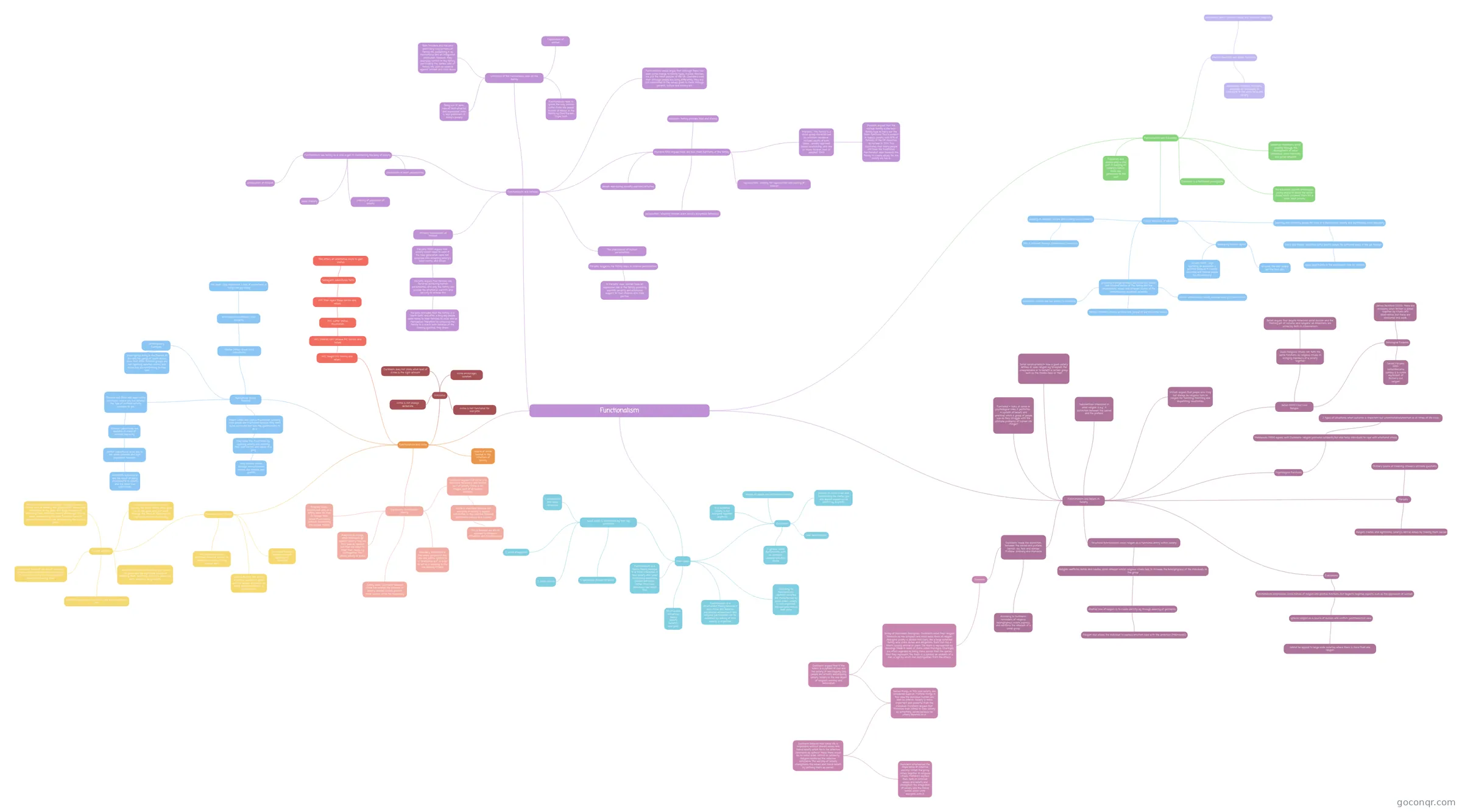
Mind map: Functionalism sociology
Contenido del mapa
Functionalism
Main Ideas:
- Structuralist, consensus theory: society benefits everyone
- Functionalism is a macro theory because it is more interested in how society and social institutions determine peoples behaviour rather than how individuals feel about this.
- Functionalism is a structuralist theory because it says crime and deviance, educational achievement, and religious participation can be explained by looking at how society is organised
- According to functionalists, capitalist societies are characterised by social order- society is well organised and everyone knows their place
- Social order is maintained by four key processes
- 1. socialisation into value consensus
- 2. social integration
- 3. social control
- 4. specialised division of labour
- Evaluation
- over deterministic
- implies all people are conformist citizens
- focuses on social order and maintaining the status quo and doesn't explain social conflict eg. boycotts
- it ignores social dysfunctions such as domestic violence and child abuse
- it is outdated: society is not everyone together anymore
Functionalism and Education
- 4 basic functions of education
- passing on societies culture and building social solidarity
- this is achieved through hidden/overt curriculum
- providing a bridge between particularistic values and ascribed status of the family and the universalistic values and achieved status of the contemporary advanced socieities
- Durkheim- schools are like society in minature
- family- children's status ascribed and judged on particularistic values
- school- universalistic values because society is meritocratic
- developing human capital
- Schultz (1971) - high spending on education is justified because it creates educated and trained people for the economy
- ensures the best people get the best jobs
- selecting and allocating people for roles in a meritocratic society and legitimising social inequality
- Davis and Moore- education sifts/ selects people for different levels in the job market
- equal opportunity in the educational race for success
- Davis and Moore- education sifts/ selects people for different levels in the job market
- passing on societies culture and building social solidarity
- The education system encourages young people to share the same values which prepares them for a wider adult society
- Education is a functional prerequisite
- Education and schools play a vital part in passing on society's culture from one generation to the next
- education maintains social stability through the development of value consensus, social harmony and social cohesion
- Merton: manifest and latent functions
- education's manifest functions: empower all individuals to contribute to the work force and society
- education's latent function: create and maintain inequality
- 4 basic functions of education
Functionalism and families
- Functionalists see family as a vital organ in maintaining the body of society
- socialisation of children
- social stability
- stability of population of society
- stablisation of adult personalities
- Murdock 1949 argued there are four main functions of the family
- sexual- expressing sexually approved activities
- socialisation- whereby children learn socially acceptable behaviour
- reproduction- stability for reproduction and rearing of children
- economic- family provides food and shelter
- Murdock " The family is a social group characterised by common residence... includes adults of both sexes.... socially approved sexual relationship, and one or more children, own or adopted." 1949
- Murdock argued that the nuclear family is the best family type to carry out the main functions. This is evident in today's society with 67% of families in the UK classified as nuclear in 2014. This illustrates that many people still have the traditional, functionalist view towards the family to create values for the society we live in.
- The stabilization of human personalities
- Parsons suggests the family helps to stablize personalities
- In Parsons' view, women have an expressive role in the family, providing warmth security and emotional support to their children and male partner
- Parsons suggests the family helps to stablize personalities
- Primary Socialisation of children
- Parsons (1951) argues that society would cease to exist if the new generation were not socialised into accepting society's basic norms and values
- Parsons argues that families are factories producing human personalities, and only the family can provide the emotional warmth and security to achieve this
- Parsons concluded that the family is a 'warm bath' and after a long day people went home to their families to relax and be themselves. Therefore he compared the family to a warm bath because of the relaxing qualities they share
- Parsons argues that families are factories producing human personalities, and only the family can provide the emotional warmth and security to achieve this
- Parsons (1951) argues that society would cease to exist if the new generation were not socialised into accepting society's basic norms and values
- Functionalists would argue that although there has been some change to family types, nuclear families are still the most popular in the UK. Chambers said that although people are living differently, they are still committed to the values given to them through parents, culture and history etc.
- Criticisms of the functionalist view on the family
- Functionalists tend to ignore the way women suffer from the sexual division of labour in the family e.g Dual Burden, Triple Shift
- Exploitation of women
- Both Murdock and Parsons paint very rosy pictures of family life, presenting it as harmonious and an integrated institution. However, they downplay conflict in the family, particularly the 'darker side' of family life, such as violence against women and child abuse
- Being out of date- view of 'instrumental' and 'expressive' roles is less prominent in today's society
- Functionalists see family as a vital organ in maintaining the body of society
Functionalism and crime
- source of crime located in the structure of society
- Durkheim's functionalist theory:
- Durkheim argued that crime is a inevitable, necessary, and normal part of society: 'crime is an integral part of all healthy societies'
- Crime is inevitable because not everyone in society is equally committed to the collective (shared) sentiments (values and morals)
- This is because we are all exposed to different influences and circumstances
- Crime is inevitable because not everyone in society is equally committed to the collective (shared) sentiments (values and morals)
- Boundary maintenance: the whole purpose of the law and justice system is to "dramatise evil" in order to act as a warning to the law abiding citizens
- Adaption to change: when individuals go against society they are first seen as deviant but then we adapt to meet their needs e.g suffragettes. This allows society to evolve
- Kingsley Davis- prostitution acts as a safety valve for men to release their sexual frustrations without threatening the nuclear family
- Safety valve- Durkheim believed crime can release the stresses in society, smaller crimes prevent more serious crime for happening
- Durkheim argued that crime is a inevitable, necessary, and normal part of society: 'crime is an integral part of all healthy societies'
- Merton's Strain Theory
- Structural Factors: societies unequal opportunity structure
- Culture Factors: the strong emphasis success on goals and the weaker emphasis on using legitimate means to achieve them
- The American Dream: promised material success to everyone in society if they worked hard
- Deviant adaption
- conformity: those at the top of the social structure could conform both to the goals of American society and the legitimate means of achieving them
- innovation: working class adapt through innovation, crimes such as robbery and gangsterism, where they conformed to the goals, but illegal methods of achieving them. American society encouraged this by under emphasising the need the importance of legitimate means, and over emphasising the cultural goals
- ritualism: members of society, typically the lower middle class, gave up on the goals, and just went through the ritual of following the legitimate means of achieving
- retreatism: members of society gave up on the goals and the legitimate means of achieving them, becoming drop outs, down and outs, alcoholics, drug addicts
- rebellion: replace previous norms and values with new ones
- Subcultural Strain Theories
- Albert Cohen and status frustration: working class people are frustrated because they want to be successful but lack the qualifications to do s
- they solve this frustration by rejecting society and creating their own norms and values in a gang
- they achieve status through non-utilitarian crimes like violence and graffiti
- they solve this frustration by rejecting society and creating their own norms and values in a gang
- Cloward and Ohlin and opportunity structures: where you live dictates the type of criminal activity available to you
- criminal subcultures are available in areas of criminal hierarchy
- conflict subcultures arise due to low social cohesion and high population turnover
- retreatists subcultures are the result of being unsuccessful in society and the other two subcultures
- conflict subcultures arise due to low social cohesion and high population turnover
- criminal subcultures are available in areas of criminal hierarchy
- Contemporary Examples
- street gangs living in the Favelas of Rio and the gangs of South Africa show that often criminal groups are not rejecting societies norms and values but are conforming to their own
- Walter Miller- lower class subcultures
- each class has different focal concerns
- the lower class experience a lack of excitement in things like joy riding
- each class has different focal concerns
- Albert Cohen and status frustration: working class people are frustrated because they want to be successful but lack the qualifications to do s
- W.C taught M.C norms and values
- W.C children can't achieve M.C norms and values
- W.C suffer status frustration
- W.C then reject these norms and values
- Delinquent subcultures form
- This offers an alternative route to gain status
- Delinquent subcultures form
- W.C then reject these norms and values
- W.C suffer status frustration
- W.C children can't achieve M.C norms and values
- criticisms
- crime is not functional for everyone
- crime encourages isolation
- Durkheim does not state what level of crime is the right amount
- crime is not always deliberate
Functionalism and Beliefs in Society
- Functional = looks at social or psychological roles it performs- ' A system of beliefs and practices which a group of people use as they struggle with the ultimate problems of human life' (Yinger)
- Substantive= interested in what religion is e.g ' A distinction between the sacred and the profane'
- Social constructionist= how a given society defines or uses religion e.g to explain the unexplainable or to benefit a certain group such as the middle class or men
- Durkheim: made the distinction between the sacred and profane. Sacred- aw, fear and wonder. Profane- ordinary and mundane
- Totenism
- Group of Australian Aborigines- Durkheim called their religion Totenism as the simplest and most basic form of religion. Aborigine society is divided into clans, like a large extended family who share duties and obligations. Each clan has a totem, usually animal or plant. The them is represented by drawings made in wood or stone, called churingas. Churingas are often regarded as being more sacred than the species that they represent. The them is a symbol, an emblem of a clan, a sign by which clan distinguishes from the others.
- Durkheim argued that if the totem is a symbol of God and the society, in worshipping God, people are actually worshipping society. Society is the real object of religious worship and admiration
- Sacred things, in this case society, are considered superior. Profane things, in this case the individual human are seen as inferior. Society is more important and powerful than the individual. Durkheim argued that 'Primitive man comes to view society as something sacred because he utterly depends on it'
- Durkheim believed that social life is impossible without shared values and moral beliefs which form the collective conscience as without these there would be no social order, control or solidarity. Religion reinforces the collective conscience. The worship of society strengthens the values and moral beliefs by defining them as sacred.
- Durkheim emphasised the importance of collective worship. When the group comes together in religious rituals, members express their faith in common values and beliefs and strengthen the integration of society and the moral bonds which unite everyone with it.
- Durkheim believed that social life is impossible without shared values and moral beliefs which form the collective conscience as without these there would be no social order, control or solidarity. Religion reinforces the collective conscience. The worship of society strengthens the values and moral beliefs by defining them as sacred.
- Sacred things, in this case society, are considered superior. Profane things, in this case the individual human are seen as inferior. Society is more important and powerful than the individual. Durkheim argued that 'Primitive man comes to view society as something sacred because he utterly depends on it'
- Durkheim argued that if the totem is a symbol of God and the society, in worshipping God, people are actually worshipping society. Society is the real object of religious worship and admiration
- Group of Australian Aborigines- Durkheim called their religion Totenism as the simplest and most basic form of religion. Aborigine society is divided into clans, like a large extended family who share duties and obligations. Each clan has a totem, usually animal or plant. The them is represented by drawings made in wood or stone, called churingas. Churingas are often regarded as being more sacred than the species that they represent. The them is a symbol, an emblem of a clan, a sign by which clan distinguishes from the others.
- According to Durkheim, reminders of religious belongingness create, express, and reinforce the cohesion of a social group
- Totenism
- Structural functionalism views religion as a functional entity within society.
- Religion reaffirms bonds and creates social cohesion whilst religious rituals help to increase the belongingness of the individuals to the group
- Another role of religion is to create identity: eg through wearing of garments
- Religion also allows the individual to express emotion: cope with the uncertain (Malinowski)
- Another role of religion is to create identity: eg through wearing of garments
- Religion reaffirms bonds and creates social cohesion whilst religious rituals help to increase the belongingness of the individuals to the group
- Wilson argues that people who may not always be religious turn to religion for 'hatching, matching and dispatching' ceremonies
- Bellah (1970) Civil/ Civic Religion
- Quasi Religious rituals can fulfil the same functions as religious rituals in bringing members of a society together
- Bellah argues that despite American social division and the 'melting pot of cultures and religions' all Americans are united by faith in Americanism
- Sociological Evidence
- Gerald Parsons 2002- rememberance sunday is a visible expression of Britain's civil religion
- James Beckford (2003)- there are occasions when Britain is joined together by rituals and observances but these are occasional and weak
- Quasi Religious rituals can fulfil the same functions as religious rituals in bringing members of a society together
- Psychological Functions
- Malinowski (1954) agrees with Durkheim- religion promotes solidarity but also helps individuals to cope with emotional stress
- 2 types of situations: when outcome is important but uncontrollable/uncertain or at times of life crisis
- Malinowski (1954) agrees with Durkheim- religion promotes solidarity but also helps individuals to cope with emotional stress
- Parsons
- Religion creates and legitimates society's central values by making them sacred
- Primary source of meaning: answers ultimate questions
- Evaluations
- functionalism emphasises social nature of religion and positive functions, but neglects negative aspects, such as the oppression of women
- ignores religion as a source of division and conflict- postmodernist view
- cannot be applied to large-scale societies where there is more than one religion
- ignores religion as a source of division and conflict- postmodernist view
- functionalism emphasises social nature of religion and positive functions, but neglects negative aspects, such as the oppression of women
Información
- Descripción
- AS level Sociology Mapa Mental sobre Functionalism, creado por daisy jones el 16/03/2018.
- Creado por
- daisy jones
- Visitas
- 0
- Valoración