
Mapa mental
Second Sociology Test
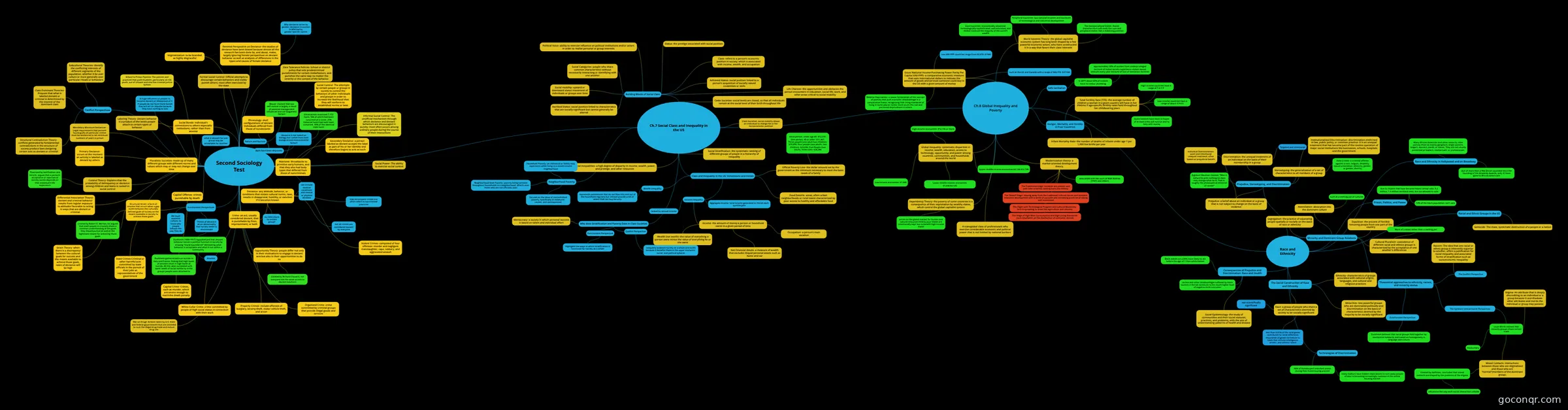
Mind map: Sociological Perspectives on Deviance and Crime
Contenido del mapa
Second Sociology Test
Deviance- any attitude, behavior, or conditions that violate cultural norms, laws, results in disapproval, hostility, or sanction if it becomes known
- may encompass crimes but often refers to noncriminal practices
- not all crimes are considered deviant by everyone
- no restrictions to certain groups
- can include medical conditions and mental or physical illnesses
- Crime- an act, usually considered deviant, that is punishable by fines, imprisonment, or both
Pluralistic Societies- made up of many different groups with different norms and values which may or may not change over time
- what is deviant for one group may be acceptable for another
Capital Offense- crimes punishable by death
- Capital Crime- Crimes, such as murder, which are severe enough to merit the death penalty
Phrenology- skull configurations of deviant individuals differed from those of nondeviants
- Both have been disproven
- deviance is not based on biology but comes from both biological and environmental factors
- Christiansen examined 7,172 twins, 926 of which had been convicted of a crime. 21% fraternal twins had both been convicted, 35% of the identical male twins
- Nature and Nurture
- Beaver claimed that low self-control is largely a result of parental management influences and not biogenetic factors
- deviance is not based on biology but comes from both biological and environmental factors
- Both have been disproven
Atavisms- throwbacks to primitive early humans, and that they also had body types that differed from those of noncriminals
Functionalist Perspectives
- We must examine culture, to know why people behave the way they do
- Thinks of deviance as an abnormality that society seeks to eliminimate
- Durkheim (1858-1917) hypothesized that deviant behavior serves a positive function in society by drawing “moral boundaries” delineating what behavior is acceptable and what is not within a community
- Anomie
- Durkheim gathered data on suicide in Italy and France, finding that high levels of anomie result in high levels of suicide, All the rates correlated with lower levels of social solidarity in the groups people were attached to
- Durkheim (1858-1917) hypothesized that deviant behavior serves a positive function in society by drawing “moral boundaries” delineating what behavior is acceptable and what is not within a community
- Structural Strain- a form of anomie that occurs when a gap exists between the culturally defined goals of society an the means available in society to achieve those goals
- created by Robert K. Merton, he argued that most people in a society share a common understanding of the goals they should pursue as well as the legitimate means for achieving those goals
- Strain Theory- when there is a discrepancy between the cultural goals for success and the means available to achieve those goals, rates of deviance will be high
Opportunity Theory- people differ not only in their motivations to engage in deviant acts but also in their opportunities to do so
- Created by Richard Cloward, not everyone has the same access to deviant solutions
Control Theory- Explains that the probability of delinquency or deviance among children and teens is rooted in social control
- Theorized by Gottfredson and Hirschi, argues that a person's acceptance or rejection of society norms depends on that individual's life experience
Social Bonds- individual's connections to others especially institutions, rather than from anomie
- A huge influence on people to become deviant or disapprove of it. If people do not form these bonds they will act on impulse because they have nothing to lose
Feminist Perspective on Deviance- the studies of deviance have been biased because almost all the research has been done by, and about, males, largely ignoring female perspectives on deviant behavior as well as analyses of differences in the types and causes of female deviance
- Why deviance varies by gender, deviance in women is affected by gender-specific norms
Stigmatization- to be branded as highly disgraceful
Labeling Theory- deviant behavior is a product of the lavels people attach to certain types of behavior
Primary Deviance- occurs at the moment an activity is labeled as deviant by others
Secondary Deviance- a person labeled as deviant accepts the label as part of his or her identity and therefore begins to acts as such
Differential Association Theory- deviant and criminal behavior results from regular exposure to attitudes favorable to acting in ways that are deviant or criminal.
Violent Crimes- composed of four offenses: murder and negligent manslaughter, rape, robbery, and aggravated assault
Property Crimes- include offenses of burglary, larceny-theft, motor vehicle theft, and arson
Organized Crime- crime committed by criminal groups that provide illegal goods and services
White-Collar Crime- crime committed by people of high social status in connection with their work
State Crimes-Criminal or other harmful acts committed by state officials in the pursuit of their jobs as representatives of the government
Social Control- The attempts by certain people or groups in society to control the behaviors of other individuals and groups in order to increase the likelihood that they will conform to established norms or laws
Social Power- The ability to exercise social control
Informal Social Control- The unofficial mechanism through which deviance and deviant behaviors are discouraged in society; most often occurs among ordinary people during the course of their interactions
Formal Social Control- Official attempts to discourage certain behaviors and visibly punish others; most often exercised by the state
School to Prison Pipeline- The policies and practices that push students, particularly at-risk youth, out of schools and into the criminal justice system
Zero Tolerance Policies- School or district policy that sets predetermined punishments for certain misbehaviors, and punishes the same way no matter the severity or the context of the behavior
Mandatory Minimum Sentances- Legal requirements that persons found guilty of particular crimes must be sentenced to set minimum numbers of years in prison
War on Drugs- Actions taken by U.S. state and federal governments that are intended to curb the illegal drug trade and reduce drug use
Conflict Perspectives
- Class-Dominant Theories- Propose that what is labeled deviant or criminal is determined by the interest of the dominant class
- Subcultural Theories- identify the conflicting interests of different segments of the population, whether it be over culture or more generally over particular rituals or behaviors
- Structural Contradiction Theory- conflicts generated by fundamental contradictions in the structure of society produce laws designing certain acts as deviant or criminal
Ch.7 Social Class and Inequality in the US
- Social Inequalities- a high degree of disparity in income, wealth, power, and prestige, and other resources
- Social Stratification- the systematic ranking of different groups of people in a hierarchy of inequality
- Caste Societies- social levels are closed, so that all individuals remain at the social level of their birth throughout life
- Class Societies- social mobility allows an individual to change his or her socioeconomic position
- Building Blocks of Social Class
- Social Categories- people who share common characteristics without necessarily interacting or identifying with one another
- Achieved Status- social position linked to a person’s acquisition of socially valued credentials or skills
- Ascribed Status- social position linked to characteristics that are socially significant but cannot generally be altered
- Class- refers to a person’s economic position in society, which is associated with income, wealth, and occupation
- Life Chances- the opportunities and obstacles the person encounters in education, social life, work, and other areas critical to social mobility
- Social mobility- upward or downward status movement of individuals or groups over time
- Status- the prestige associated with social position
- Political Voice- ability to exercise influence on political institutions and/or actors in order to realize personal or group interests
- Class and Inequality in the US: Dimensions and trends
- Income Inequality
- ranked by annual income
- Aggregate Income- total income generated in the US each quintile gets
- Income- the amount of money a person or household earns in a given period of time
- Wealth (net worth)- the value of everything a person owns minus the value of everything he or she owns
- Net Financial Assets- a measure of wealth that excludes illiquid personal assets such as home and car
- Occupation- a person’s main vocation
- Wealth Inequality
- represents possessions that do not flow into and out of the household regularly but instead provide a set of assets that can buy security
- Food Deserts- areas, often urban neighborhoods or rural towns characterized by poor access to healthy and affordable food
- Official Poverty Line- the dollar amount set by the government as the minimum necessary to meet the basic needs of a family
- Once person, under age 65- $12,331; One person, 65 or older- $11,367; Three people (one adult two children)- $19,096; Four people (two adults, two children)- $24,036; Five People (two adults, three kids)- $28,286
- Income Inequality
- Neighborhood Poverty
- focuses on the issue of concentrated poverty, specifically at measures, causes, and consequences
- Household Poverty- an individual or family may experience while living in a mixed-income neighborhood
- Neighborhood-level Poverty- poverty being constant throughout households in a neighborhood, affects even those who are not officially poor
- Why does Stratification and Poverty Exist in Class Societies
- Functionalist Perspective
- Highlights the ways in which stratification is functional for society as a whole
- Conflict Perspective
- inequality weakens society as a whole and exists because it benefits those in the upper economic, social, and political spheres
- Meritocracy- a society in which personal success is based on talent and individual effort
- Functionalist Perspective
- Ch.8 Global Inequality and Poverty
- Global Inequality- systematic disparities in income, wealth, education, access to technology, opportunity, and power among countries, communities, and households around the world
- Low-income economies: $1,045
- Lower-middle-income economies: $1,046-$4,125
- Upper-middle-income economies:$4,126-$12,745
- High-income economies: $12,746 or more
- Gross National Income-Purchasing Power Parity Per Capita (GNI-PPP)- a comparative economic measure that uses international dollars to indicate the amount of goods and services someone could buy in the US with a given amount of money
- such as the US and Canada with a range of $65,970- $37,920
- Low GNI-PPP countries range from $4,670- $1580
- Relative Deprivation- a newer formulation of the concept of poverty that puts economic disadvantage in a comparative frame, recognizing that rising standards of living in some places render more acute the real and perceived deprivations in others
- Hunger, Mortality, and Fertility in Poor Countries
- Infant Mortality Rate- the number of deaths of infants under age 1 per 1,000 live births per year
- Total Fertility Rate (TFR)- the average number of children a woman in a given country will have in her lifetime if age-specific fertility rates hold throughout her childbearing years
- High income countries have a range of 1.4-1.9
- Low-income countries have a range of about 4.9-6.5
- Some families have more in hopes of at least a few will survive and to help with money
- Safe Sanitation
- In 2011 about 64% of Indians have no indoor plumbing
- approximately 30% of women from underprivileged sections of Indian society experience violent sexual assaults every year because of lack of sanitation facilities
- In 2011 about 64% of Indians have no indoor plumbing
- Modernization theory- a market-oriented development theory,
- associated with the work of Walt Rostow (1961) and others
- The Traditional Stage- societies are present and past time oriented, looking back into history
- The Takeoff Stage- moving away from the traditional cultural norms and embrace economic development with a sense of purpose and increasing practices of saving and investment
- The Flight with Technological Progress and Cultural Modernity- tech is spreading to areas like agriculture and industry
- The Stage of High Mass Consumption and High Living Standards- more emphasiss on the staisfaction of consumer desires
- Dependency Theory- the poverty of some countries is a consequence of their exploitation by wealthy states, which control the global capitalist system
- prices on the global market for human and natural resources held by poor states are intentionally kept low to benefit high-income states
- World Systems Theory- the global capitalist economic system has long been shaped by a few powerful economic actors, who have constructed it in a way that favors their class interests
- Core Countries- economically advanced, technologically sophisticated, well-educated, and skilled. Controls the majority of the world's wealth
- Peripheral Countries- low national incomes and low levels of technological and industrial development
- The Semiperipheral States- shares characteristics with both the core and peripheral states, has a stabilizing position
- A transglobal class of professionals who exercise considerable economic and political power that is not limited by national borders
- Race and Ethnicity
- The Social Construction of Race and Ethnicity
- Race- a group of people who share a set of characteristics deemed by society to be socially significant
- less than 0.01% of the total genes contributes to racial difference, thousands of genes contribute to traits that include intelligence, artistic, and athletic talent
- not scientifically significant
- Ethnicity- characteristics of groups associated with national origins, languages, and cultural and religious practices
- Minorities- less powerful groups who are dominated politically and discrimination on the basis of characteristics deemed by the majority to be socially significant
- Race- a group of people who share a set of characteristics deemed by society to be socially significant
- Minority and Dominant Group Relations
- Expulsion- the process of forcibly removing people from one part of the country
- Segregation- the practice of separating people spatially or socially on the basis of race or ethnicity
- Assimilation- absorption into the dominant culture
- such as a melting pot of cultures
- Cultural Pluralism- coexistence of different racial and ethnics groups is characterized by the acceptance of one another's differences
- More of a salad rather than a melting pot
- Theoretical approaches to ethnicity, racism, and minority status
- Functionalist Perspective
- Durkheim believed that social groups held together by mechanical solidarity and based on homogeneity in language and culture
- The Conflict Perspective
- Racism- The idea that one racial or ethnic group is inherently superior to another, offers a justification for racial inequality and associated forms of stratification such as socioeconomic inequality
- The Symbolic Interactionist Perspective
- Louis Wirth claimed that minority groups share certain traits
- Involuntary
- Stigma- An attribute that is deeply discrediting to an individual or a group because it overshadows other attributes and merits the individual or group may possess
- Mixed Contacts- interactions between those who are stigmatized and those who are “normal”(members of the dominant group)
- Created by Goffman, concluded that mixed contacts are shaped by the presence of the stigma
- influences the way each social interaction unfolds
- Created by Goffman, concluded that mixed contacts are shaped by the presence of the stigma
- Louis Wirth claimed that minority groups share certain traits
- Functionalist Perspective
- Prejudice, Stereotyping, and Discrimination
- Prejudice- a belief about an individual or a group that is not subject to change on the basis of evidence
- Zygmunt Bauman claimed, “Man is before he acts; nothing he does may change what he is. That is, roughly the philosophical essences of racism”
- Stereotyping- the generalization of a set of characteristics to all members of a group
- Hate Crimes- a criminal offense against a race, religion, disability, sexual orientation, ethnicity, gender, or gender identity
- Discrimination- the unequal treatment of an individual on the basis of their membership in a group
- Targeted and intentional
- Individual Discrimination- overt and intentional unequal treatment, often based on prejudicial beliefs
- Institutionalized Discrimination- discrimination enshrined in law, public policy, or common practice- it is an unequal treatment that has become part of the routine operation of major social institutions like businesses, schools, hospitals, and the government
- Prejudice- a belief about an individual or a group that is not subject to change on the basis of evidence
- Prison, Politics, and Power
- due to citizens that have become felons cannot vote, 5.3 million, 1.4 million are black men, are not allowed to vote
- 13% of the black population can't vote
- due to citizens that have become felons cannot vote, 5.3 million, 1.4 million are black men, are not allowed to vote
- Consequences of Prejudice and Discrimination: Race and Health
- racism and other disadvantages suffered by black women in the US contibute to the much higher level of negative birth outcomes
- Black babies are 230% more likely to die before the age of 1 than white babies
- Social Epidemiology- the study of communities and their social statuses, practices, and problems, with the aim of understanding patterns of health and disease
- Technologies of Discrimination
- 90% of homebuyers searched online during their home buying process
- many realtors have hidden implications to turn away people ofcolor is becoming increasingly common in the online housing market
- 90% of homebuyers searched online during their home buying process
- Race and Ethnicity in Hollywood and on Broadway
- Out of more than 2,900 Oscars awarded since the founding of the Academy Awards, only 31 have gone to African Americans
- Many African American and other minority roles portray them as mainly gangsters, single parents, singers, dancers, maids, or slaves. They are not usually presented as leaders, intellectuals, or professionals
- Racial and Ethnic Groups in the US
- Genocide- The mass, systematic destruction of a people or a nation
- The Social Construction of Race and Ethnicity
- Global Inequality- systematic disparities in income, wealth, education, access to technology, opportunity, and power among countries, communities, and households around the world
Información
- Descripción
- AP Sociology Mapa Mental sobre Second Sociology Test, creado por Rachel Braun el 05/11/2018.
- Creado por
- Rachel Braun
- Visitas
- 2
- Valoración