
Mapa mental
Evolution Final Part 1
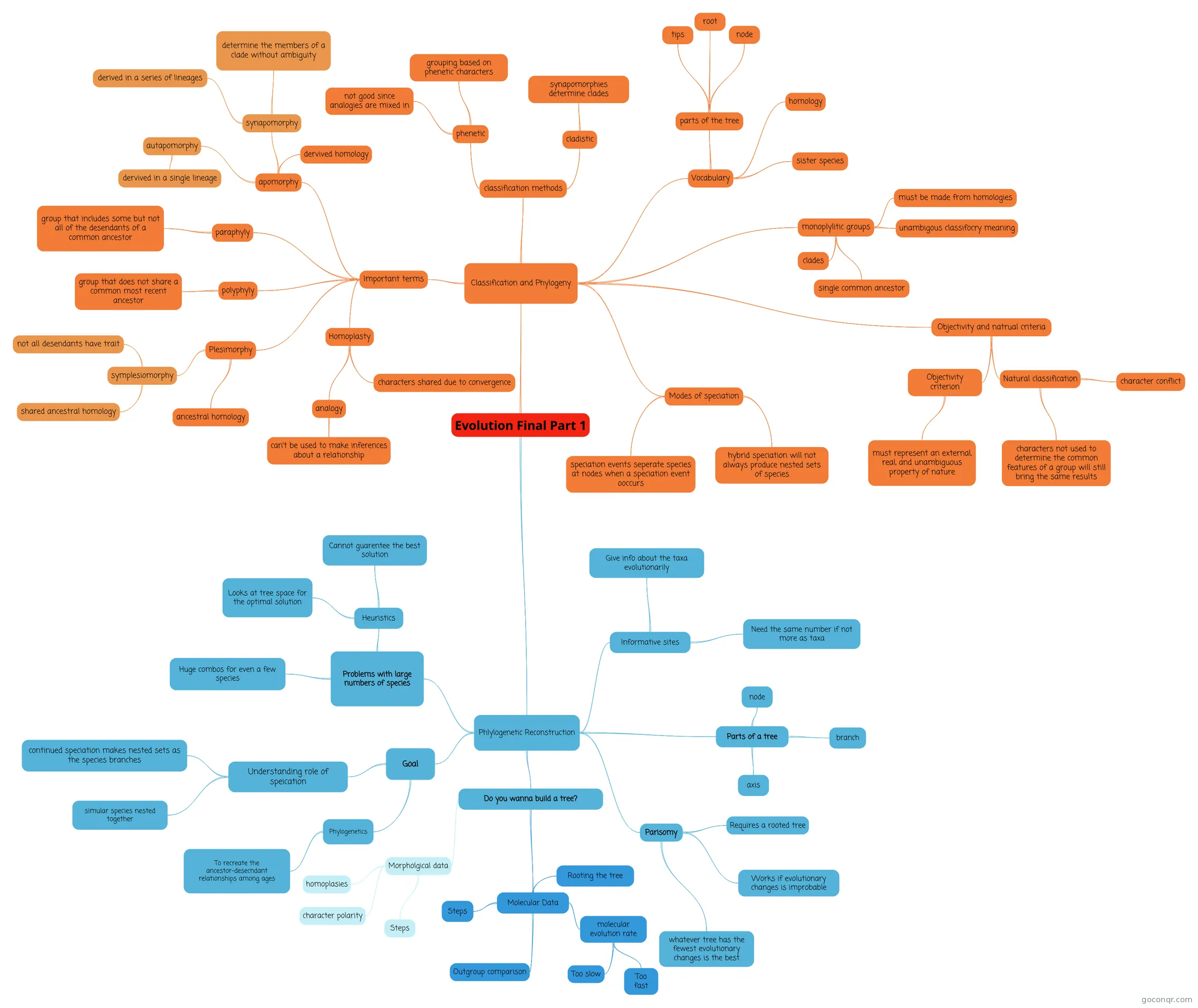
Mind map: Evolution phylogenetic reconstruction
Contenido del mapa
Evolution Final Part 1
Phlylogenetic Reconstruction
- Goal
- Understanding role of speication
- simular species nested together
- continued speciation makes nested sets as the species branches
- Phylogenetics
- To recreate the ancestor-desecndant relationships among ages
- Understanding role of speication
- Parts of a tree
- axis
- One axis represents time
- branch
- Represents the pathway of proposed evolution
- node
- Represents a speciation event
- axis
- Parisomy
- whatever tree has the fewest evolutionary changes is the best
- Works if evolutionary changes is improbable
- Ex: complex organs unlikely to have evolved twice in the same way
- Requires a rooted tree
- Do you wanna build a tree?
- Morpholgical data
- homoplasies
- character polarity
- Steps
- 1. Choose hertiable complex characters unlikely to have evolved twice
- 2. Determine homologies
- 3. Determine ancestral and derived states
- 4. Decision point
- Molecular Data
- Rooting the tree
- Rooting the tree allows you to find the most parisimonious point to add the out group to unroot the tree
- Outgroup comparison
- Only way to order character states
- Steps
- 1. Align sequences for analysis to look for positional homology
- 2. Use parisomy to find the phylogency with the least number of steps
- 3. Determining character polarities
- molecular evolution rate
- Too slow
- Not enough info for the phylogeny
- Too fast
- Too many analogous changes to make sense of the relationship
- Too slow
- Rooting the tree
- Morpholgical data
- Problems with large numbers of species
- Huge combos for even a few species
- Heuristics
- Cannot guarentee the best solution
- Looks at tree space for the optimal solution
- Informative sites
- Need the same number if not more as taxa
- If not enough informative sites, multiple compatable results can be found
- Give info about the taxa evolutionarily
- Need the same number if not more as taxa
- Goal
Classification and Phylogeny
- Modes of speciation
- speciation events seperate species at nodes when a speciation event ooccurs
- hybrid speciation will not always produce nested sets of species
- Some hybrids are unable to reproduce or give inviable offspring
- Objectivity and natrual criteria
- Objectivity criterion
- must represent an external, real, and unambiguous property of nature
- Natural classification
- characters not used to determine the common features of a group will still bring the same results
- character conflict
- when different groups of characters indicate different groupings
- Objectivity criterion
- Vocabulary
- sister species
- species derived from the most common ancestor
- parts of the tree
- root
- Represents the ancestral lineage
- node
- speciation event
- tips
- desendants of the ancestor
- root
- homology
- character shared between species due to common descent
- sister species
- Important terms
- Homoplasty
- analogy
- can't be used to make inferences about a relationship
- could be simular due to simular selective pressures and not common ancestry
- can't be used to make inferences about a relationship
- characters shared due to convergence
- analogy
- Plesimorphy
- ancestral homology
- symplesiomorphy
- shared ancestral homology
- not all desendants have trait
- apomorphy
- dervived homology
- autapomorphy
- dervived in a single lineage
- synapomorphy
- derived in a series of lineages
- determine the members of a clade without ambiguity
- these traits can include different groups
- paraphyly
- group that includes some but not all of the desendants of a common ancestor
- polyphyly
- group that does not share a common most recent ancestor
- Homoplasty
- monoplylitic groups
- clades
- single common ancestor
- unambigous classifocry meaning
- must be made from homologies
- classification methods
- phenetic
- grouping based on phenetic characters
- not good since analogies are mixed in
- can't determine relationships
- cladistic
- synapomorphies determine clades
- phenetic
- Modes of speciation
Información
- Descripción
- College Evolution Mapa Mental sobre Evolution Final Part 1, creado por Theresa Deike el 26/11/2014.
- Creado por
- Theresa Deike
- Visitas
- 6
- Valoración