
Mapa mental
Transcription
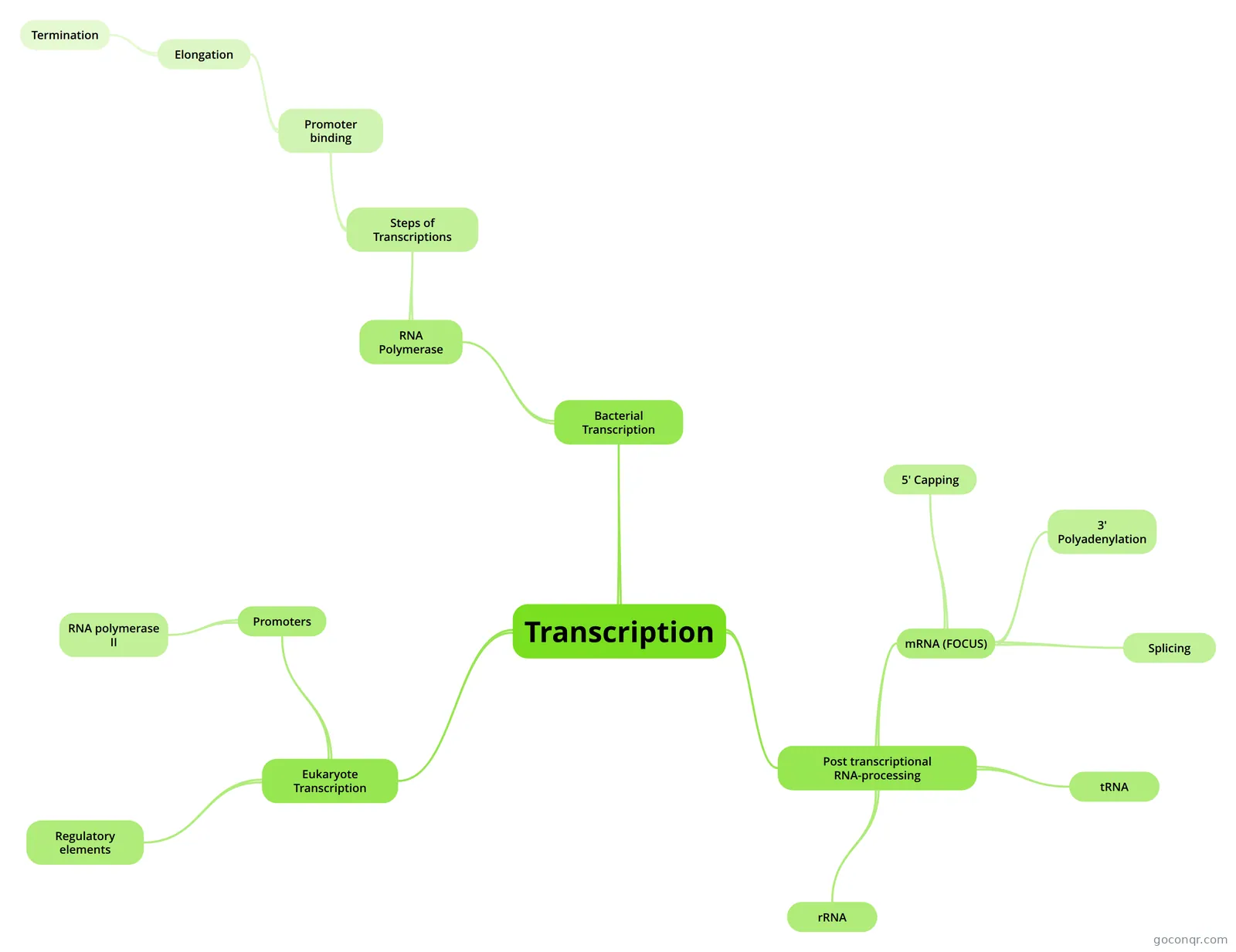
Mind map: Transcription
Contenido del mapa
Transcription
- Transcription is basically synthesis of complementary strand of RNA of a DNA. Contains 2 major types: mRNA rRNA tRNA Uses 5' nucleoside as precursors, 5' to 3' growth. Growing strand is a reverse compliment to template.
Bacterial Transcription
- Bacteria cells contain RNA polymerase, but it is only one compared to the others which had multiple polymerase.
- RNA Polymerase
- 499kD protein complex: Consist of a core tetramer and a sigma subunit.
- Steps of Transcriptions
- Binding of the RNA polymerase to the promoter Initiation of transcription to the start site. ELongation in the 5' to 3' direction Termination DNA that is used as a template is the antisense. the one opposite is the sense and it has the same sequence.
- Promoter binding
- At the upstream before the transcription site, there is something called a promoter, it is because due to certain codes in the DNA upstream in the 10 region and the 35 sites. Holoenzyme bind loosely on the DNA until it found the promoter region, then the sigma factor dissociates from the core and carries on with elongation.
- Elongation
- The polymerase unwinds and rewinds in the "transcription bubble" it is around 17 bp.
- Termination
- Termination signal is formed by a repeat of G-C rich sequence followed by a few Adenines so they can be terminated by several U residues.
Eukaryote Transcription
- Similar in bacteria and eukaryotes, but it has multiple DNA polymerase and complicated control sequences and complex. From RNA polymerase I (nucleoli, makes rRNA precursors) and II and III (both located in the nucleoplasm) , II synthesise mRNA while III synthesise 5s rRNA precursors and tRNA and others.
- Promoters
- Accessory proteins are the ones that recognise the transcription factors and the promoters. 3 main polymerase recognise the different promoters.
- RNA polymerase II
- They code for both constitutively and non-constituitively expressed genes. Constitutively transcribed are expressed in all tissues while... The non-constituitively transcribed or selective is only 'selective' and expressed as needed. Typical promoter, is TATA box, located at 25-30 upstream. GC box binds Sp1 and CAAT box, where it binds to CTF.
- Regulatory elements
- Some things are like, Enhancers (increase transcription rate) Silencers (decrease transcription rate) Response elements (signalling elements)
Post transcriptional RNA-processing
- mRNA (FOCUS)
- 5' Capping, 3' polyadenylation and splicing
- 5' Capping
- 7-methylguanosine residue join to the 5' triphosphate bridge Involved several enzymatic reactions The cap identify the eukaryotic translation start site and it protects the polynucleotide from degradation by 5' exonuclease.
- 3' Polyadenylation
- 3' ends. terminates by poly (adenosine). Protect 3' end from 3' exonuclease. Serve as a handle for proteins that deliver mRNA to ribosomes.
- Splicing
- Splicing is the removal of unexpressed regions It is the excision of non-expressed region (intron) and expressed regions (exons) nad they are spliced together.
- rRNA
- Endonucelolytic Cleavage, methylation and splicing
- tRNA
- Nucelotide removal, addition and modification
- mRNA (FOCUS)
Información
- Descripción
- Principles of Molecular Biology Mapa Mental sobre Transcription, creado por Daniel Elandix G el 25/08/2013.
- Creado por
- Daniel Elandix G
- Visitas
- 76
- Etiquetas
- Valoración