
Mapa mental
Outsourcing vs Subcontracting
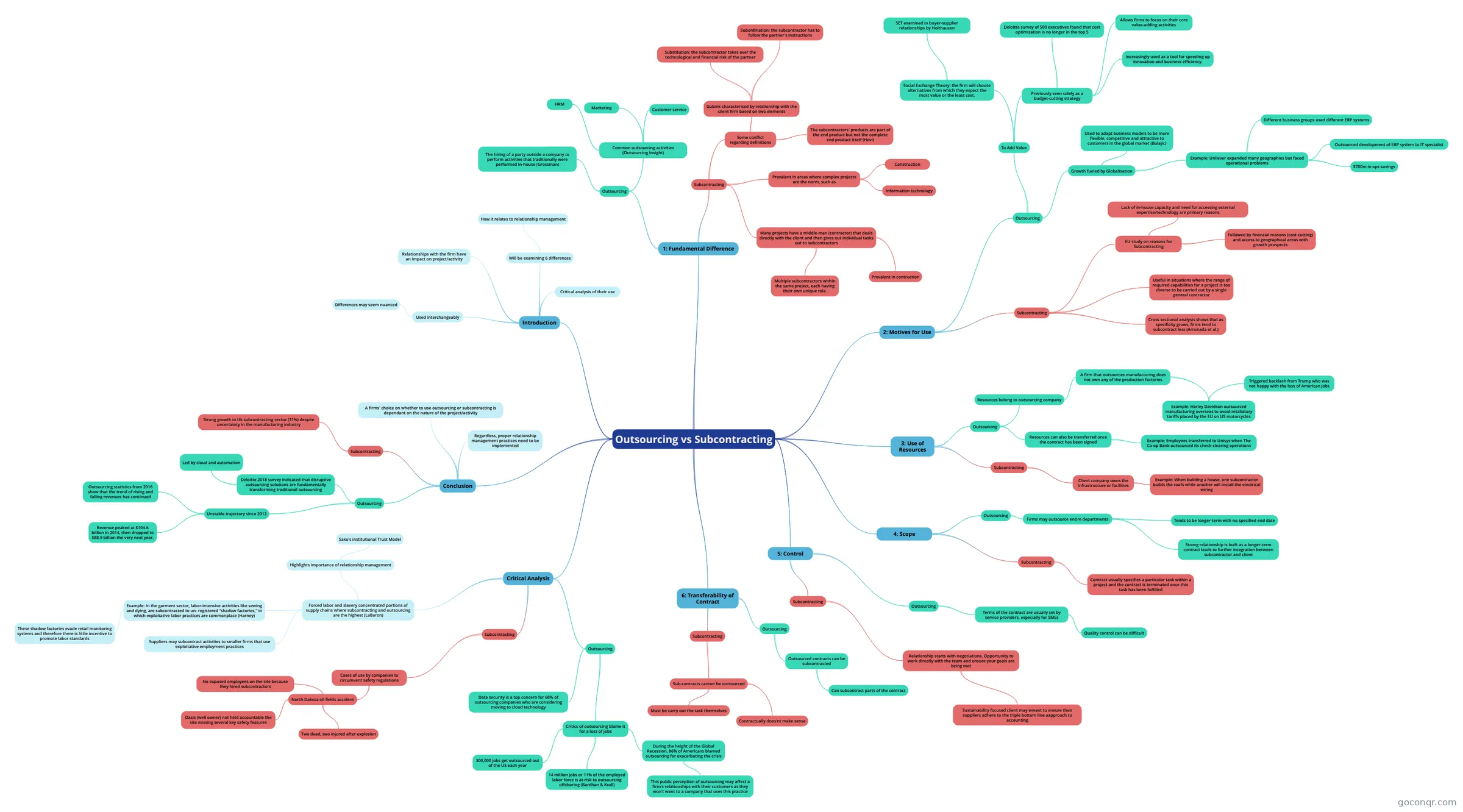
Mind map: Outsourcing vs subcontracting
Contenido del mapa
Outsourcing vs Subcontracting
Introduction
- Used interchangeably
- Differences may seem nuanced
- Relationships with the firm have an impact on project/activity
- Will be examining 6 differences
- How it relates to relationship management
- Critical analysis of their use
- Used interchangeably
1: Fundamental Difference
- Outsourcing
- The hiring of a party outside a company to perform activities that traditionally were performed in-house (Grossman)
- Common outsourcing activities (Outsourcing Insight)
- HRM
- Marketing
- Customer service
- Subcontracting
- Prevalent in areas where complex projects are the norm, such as
- Construction
- Information technology
- Many projects have a middle-man (contractor) that deals directly with the client and then gives out individual tasks out to subcontractors
- Multiple subcontractors within the same project, each having their own unique role.
- Prevalent in contruction
- Some conflict regarding definitions
- Gubnik characterised by relationship with the client firm based on two elements
- Substitution: the subcontractor takes over the technological and financial risk of the partner
- Subordination: the subcontractor has to follow the partner's instructions
- The subcontractors' products are part of the end product but not the complete end product itself (Hovi)
- Gubnik characterised by relationship with the client firm based on two elements
- Prevalent in areas where complex projects are the norm, such as
- Outsourcing
2: Motives for Use
- Outsourcing
- To Add Value
- Social Exchange Theory: the firm will choose alternatives from which they expect the most value or the least cost.
- SET examined in buyer-supplier relationships by Holthausen
- Previously seen solely as a budget-cutting strategy
- Increasingly used as a tool for speeding up innovation and business efficiency.
- Allows firms to focus on their core value-adding activities
- Deloitte survey of 500 executives found that cost optimization is no longer in the top 5
- Social Exchange Theory: the firm will choose alternatives from which they expect the most value or the least cost.
- Growth fueled by Globalisation
- Used to adapt business models to be more flexible, competitive and attractive to customers in the global market (Bulajic)
- Example: Unliever expanded many geographies but faced operational problems
- Different business groups used different ERP systems
- Outsourced development of ERP system to IT specialist
- $700m in ops savings
- To Add Value
- Subcontracting
- Cross sectional analysis shows that as specificity grows, firms tend to subcontract less (Arrunada et al.)
- EU study on reasons for Subcontracting
- Followed by financial reasons (cost-cutting) and access to geographical areas with growth prospects
- Lack of in-house capacity and need for accessing external expertise/technology are primary reasons
- Useful in situations where the range of required capabilities for a project is too diverse to be carried out by a single general contractor
- Outsourcing
3: Use of Resources
- Outsourcing
- Resources belong to outsourcing company
- A firm that outsources manufacturing does not own any of the production factories
- Example: Harley Davidson outsourced manufacturing overseas to avoid retaliatory tariffs placed by the EU on US motorcycles
- Triggered backlash from Trump who was not happy with the loss of American jobs
- Example: Harley Davidson outsourced manufacturing overseas to avoid retaliatory tariffs placed by the EU on US motorcycles
- A firm that outsources manufacturing does not own any of the production factories
- Resources can also be transferred once the contract has been signed
- Example: Employees transferred to Unisys when The Co-op Bank outsourced its check-clearing operations
- Resources belong to outsourcing company
- Subcontracting
- Client company owns the infrastructure or facilities
- Example: When building a house, one subcontractor builds the roofs while another will install the electrical wiring
- Client company owns the infrastructure or facilities
- Outsourcing
4: Scope
- Outsourcing
- Firms may outsource entire departments
- Tends to be longer-term with no specified end date
- Strong relationship is built as a longer-term contract leads to further integration between subcontractor and client
- Firms may outsource entire departments
- Subcontracting
- Contract usually specifies a particular task within a project and the contract is terminated once this task has been fulfilled
- Outsourcing
6: Transferability of Contract
- Outsourcing
- Outsourced contracts can be subcontracted
- Can subcontract parts of the contract
- Outsourced contracts can be subcontracted
- Subcontracting
- Sub-contracts cannot be outsourced
- Must be carry out the task themselves
- Contractually does'nt make sense
- Sub-contracts cannot be outsourced
- Outsourcing
5: Control
- Outsourcing
- Terms of the contract are usually set by service providers, especially for SMEs
- Quality control can be difficult
- Terms of the contract are usually set by service providers, especially for SMEs
- Subcontracting
- Relationship starts with negotiations. Opportunity to work directly with the team and ensure your goals are being met
- Sustainability focused client may wwant to ensure their suppliers adhere to the triple bottom line aapproach to accounting
- Relationship starts with negotiations. Opportunity to work directly with the team and ensure your goals are being met
- Outsourcing
Critical Analysis
- Outsourcing
- Critics of outsourcing blame it for a loss of jobs
- 14 million jobs or 11% of the employed labor force is at-risk to outsourcing offshoring (Bardhan & Kroll)
- 300,000 jobs get outsourced out of the US each year
- During the height of the Global Recession, 86% of Americans blamed outsourcing for exacerbating the crisis
- This public perception of outsourcing may affect a firm's relationships with their customers as they won't want to a company that uses this practice
- Data security is a top concern for 68% of outsourcing companies who are considering moving to cloud technology
- Critics of outsourcing blame it for a loss of jobs
- Subcontracting
- Cases of use by companies to circumvent safety regulations
- North Dakota oil fields accident
- Oasis (well owner) not held accountable the site missing several key safety features
- Two dead, two injured after explosion
- No exposed employees on the site because they hired subcontractors
- North Dakota oil fields accident
- Cases of use by companies to circumvent safety regulations
- Forced labor and slavery concentrated portions of supply chains where subcontracting and outsourcing are the highest (LaBaron)
- Example: In the garment sector, labor-intensive activities like sewing and dying, are subcontracted to un- registered “shadow factories,” in which exploitative labor practices are commonplace (Harney)
- These shadow factories evade retail monitoring systems and therefore there is little incentive to promote labor standards
- Suppliers may subcontract activities to smaller firms that use exploitative employment practices
- Highlights importance of relationship management
- Sako's institutional Trust Model
- Example: In the garment sector, labor-intensive activities like sewing and dying, are subcontracted to un- registered “shadow factories,” in which exploitative labor practices are commonplace (Harney)
- Outsourcing
Conclusion
- Outsourcing
- Unstable trajectory since 2012
- Revenue peaked at $104.6 billion in 2014, then dropped to $88.9 billion the very next year.
- Outsourcing statistics from 2018 show that the trend of rising and falling revenues has continued
- Deloitte 2018 survey indicated that disruptive outsourcing solutions are fundamentally transforming traditional outsourcing
- Led by cloud and automation
- Unstable trajectory since 2012
- Subcontracting
- Strong growth in Uk subcontracting sector (31%) despite uncertainty in the manufacturing industry
- A firms' choice on whether to use outsourcing or subcontracting is dependant on the nature of the project/activity
- Regardless, proper relationship management practices need to be implemented
- Outsourcing
Información
- Descripción
- Social Science Mapa Mental sobre Outsourcing vs Subcontracting, creado por Stephen Barry el 21/01/2020.
- Creado por
- Stephen Barry
- Visitas
- 0
- Valoración