
Mapa mental
Culture
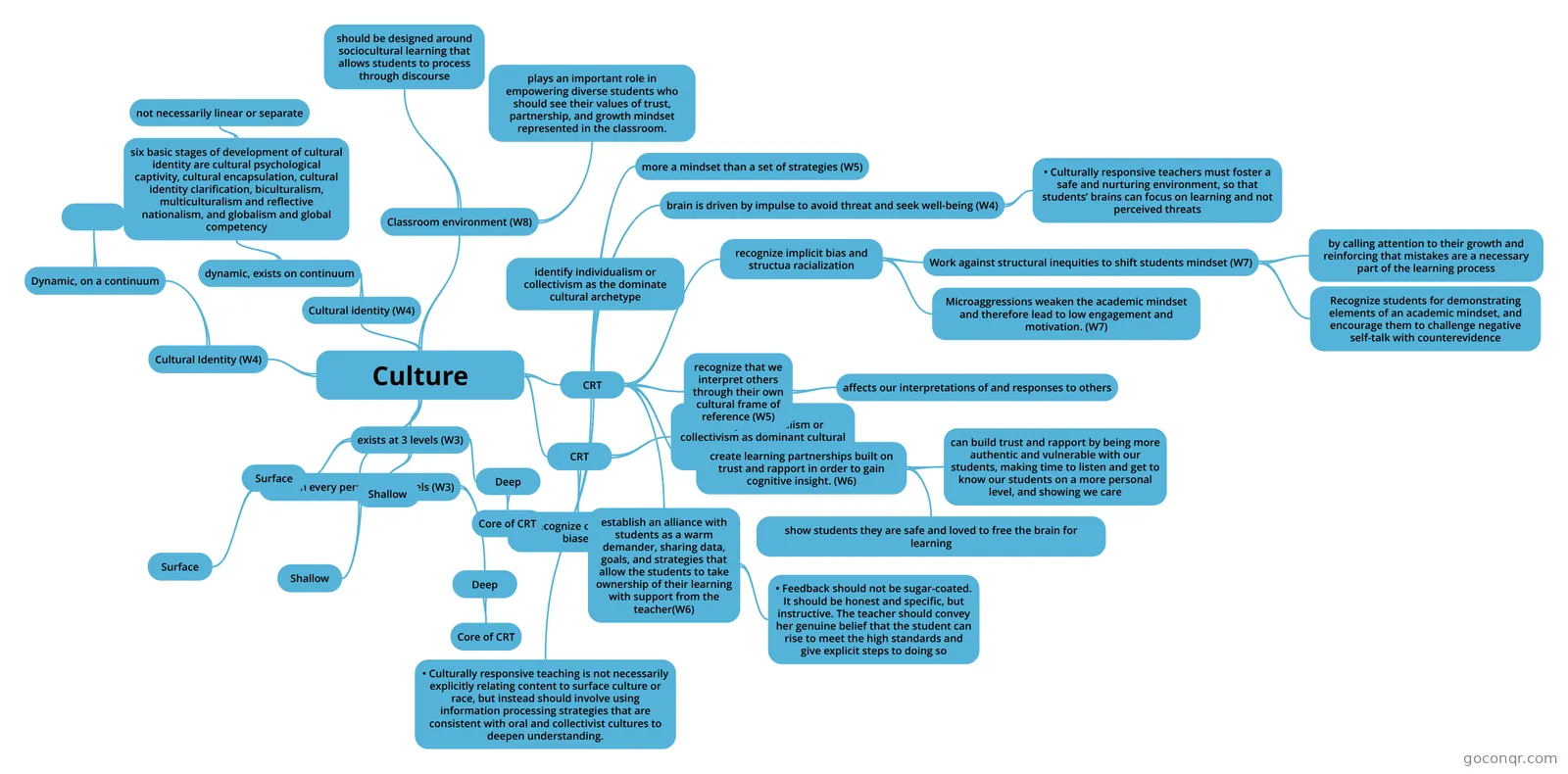
Mind map: Culture
Contenido del mapa
Culture
exists in every person at 3 Levels (W3)
- Surface
- Shallow
- Deep
- Core of CRT
CRT
- Recognize our own biases
- Identify individualism or collectivism as dominant cultural archetype
Cultural Identity (W4)
- Dynamic, on a continuum
- Dynamic, on a continuum
exists at 3 levels (W3)
- Surface
- Shallow
- Deep
- Core of CRT
CRT
- recognize implicit bias and structua racialization
- Work against structural inequities to shift students mindset (W7)
- by calling attention to their growth and reinforcing that mistakes are a necessary part of the learning process
- Recognize students for demonstrating elements of an academic mindset, and encourage them to challenge negative self-talk with counterevidence
- Microaggressions weaken the academic mindset and therefore lead to low engagement and motivation. (W7)
- Work against structural inequities to shift students mindset (W7)
- identify individualism or collectivism as the dominate cultural archetype
- brain is driven by impulse to avoid threat and seek well-being (W4)
- • Culturally responsive teachers must foster a safe and nurturing environment, so that students’ brains can focus on learning and not perceived threats
- more a mindset than a set of strategies (W5)
- recognize that we interpret others through their own cultural frame of reference (W5)
- affects our interpretations of and responses to others
- create learning partnerships built on trust and rapport in order to gain cognitive insight. (W6)
- can build trust and rapport by being more authentic and vulnerable with our students, making time to listen and get to know our students on a more personal level, and showing we care
- show students they are safe and loved to free the brain for learning
- establish an alliance with students as a warm demander, sharing data, goals, and strategies that allow the students to take ownership of their learning with support from the teacher(W6)
- • Feedback should not be sugar-coated. It should be honest and specific, but instructive. The teacher should convey her genuine belief that the student can rise to meet the high standards and give explicit steps to doing so
- • Culturally responsive teaching is not necessarily explicitly relating content to surface culture or race, but instead should involve using information processing strategies that are consistent with oral and collectivist cultures to deepen understanding.
- recognize implicit bias and structua racialization
Cultural identity (W4)
- dynamic, exists on continuum
- six basic stages of development of cultural identity are cultural psychological captivity, cultural encapsulation, cultural identity clarification, biculturalism, multiculturalism and reflective nationalism, and globalism and global competency
- not necessarily linear or separate
- six basic stages of development of cultural identity are cultural psychological captivity, cultural encapsulation, cultural identity clarification, biculturalism, multiculturalism and reflective nationalism, and globalism and global competency
- dynamic, exists on continuum
Classroom environment (W8)
- plays an important role in empowering diverse students who should see their values of trust, partnership, and growth mindset represented in the classroom.
- should be designed around sociocultural learning that allows students to process through discourse
Información
- Descripción
- Mapa Mental sobre Culture, creado por Catie Hanson el 18/07/2020.
- Creado por
- Catie Hanson
- Visitas
- 4
- Valoración
Más sobre Culturally Responsive Teaching