
Mapa mental
Biodiversity
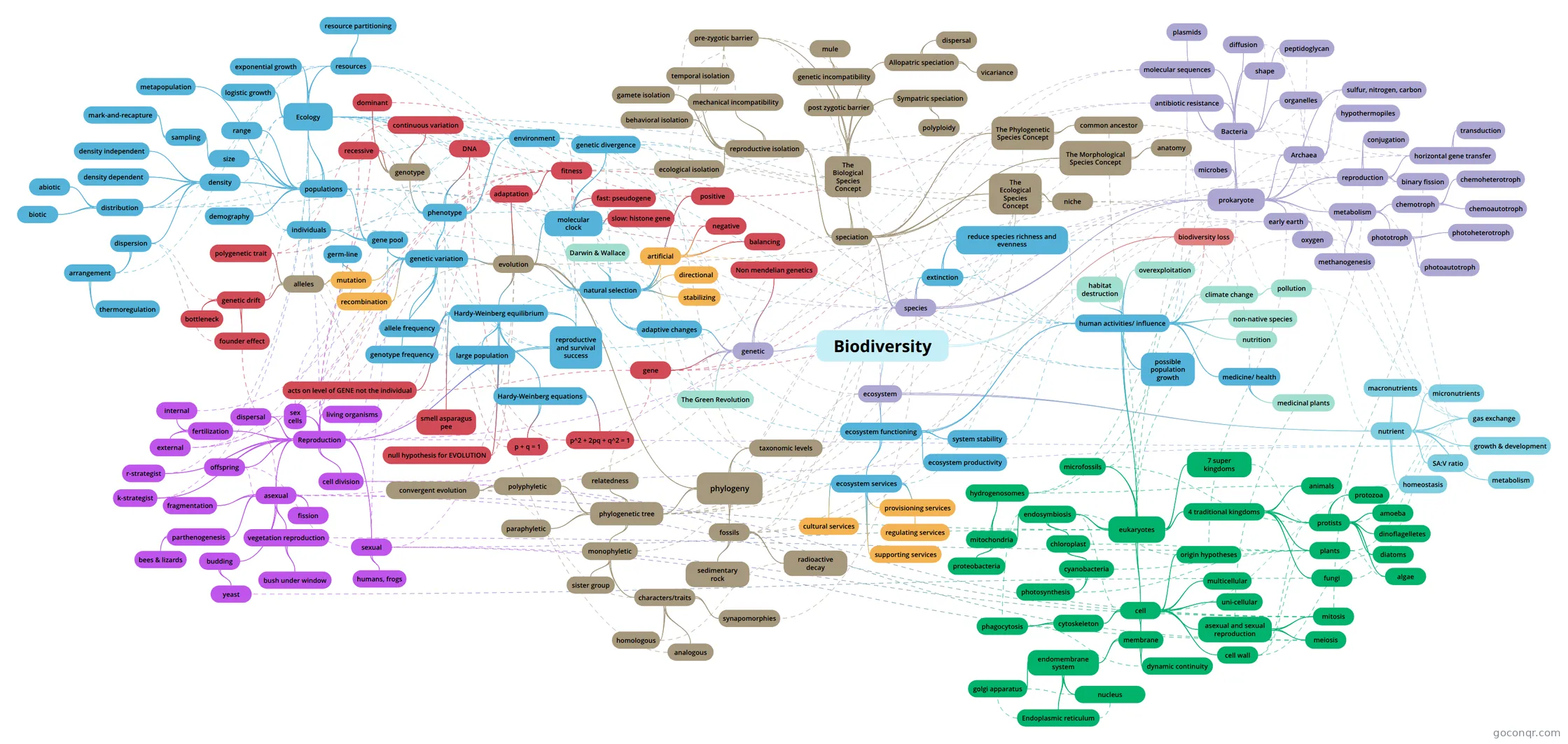
Mind map: Biodiversity
Contenido del mapa
Biodiversity
biodiversity loss
- biodiversity loss is like a domino effect; losing even one species can change the entire ecosystem and those that benefit from it
genetic
- First level
- adaptive changes
- The genes of organisms change to best fit their environment. Humans influence the way that organisms adapt because of the strain we put on their ecosystems. only work on PHENOTYPES (what is shown)
- natural selection
- allele frequency change over generations based on the fitness of the individuals in a population can drive evolution Allele frequencies change based on ability to survive and reproduce (not by lucky chance)
- evolution
- evolution is a change in allele and/or genotype frequency over generations *evo doesnt strive fro perfection; just have to be better than others beside you (ex. being chased by bear, i dont have to be fastest like usane bolt, just have to be faster than my friend) *individuals cannot evolve; populations can evolve
- Hardy-Weinberg equilibrium
- Helps to tell if evolution is occurring. If not, then all conditions of the equilibrium will be met.
- large population
- Large population prevents sampling errors
- reproductive and survival success
- In order to have Hardy-Weinberg equilibrium, there must be no difference in reproductive and survival success
- Reproduction
- living organisms
- fertilization
- internal
- inside female fertilization adaptation for on land reproduction
- external
- outside female body fertilization benefit: energy efficient, not take care of babies cost: risky ( =lots of offspring)
- internal
- dispersal
- way offspring/ zygotes are dispersed characteristics have evolved increasing organisms fitness
- asexual
- Prokaryotes and some eukaryotes are capable of asexual reproduction creates identical diploid daughter cells(offspring) consists of only mitosis
- fragmentation
- parthenogenesis
- bees & lizards
- fission
- vegetation reproduction
- bush under window
- budding
- yeast
- sexual
- only eukaryotes are capable of sexual reproduction creates unique haploid daughter cells (offspring) consists of both mitosis and meiosis
- humans, frogs
- offspring
- cell division
- r-strategist
- care less for offspring, reproduce large amounts of offspring ex. frogs
- k-strategist
- 'K'are for their offspring more, less offspring during reproduction ex. humans
- sex cells
- Hardy-Weinberg equations
- p + q = 1
- allele frequency equation
- p^2 + 2pq + q^2 = 1
- genotype frequency equation
- p + q = 1
- smell asparagus pee
- Example: people who can smell their asparagus pee
- acts on level of GENE not the individual
- null hypothesis for EVOLUTION
- molecular clock
- fast: pseudogene
- slow: histone gene
- genetic divergence
- -natural selection can cause genetic divergence which can lead to speciation if the pops can no longer exchange genetic material/reproduce -BSC: species
- genetic variation
- Hardy-Weinberg equilibrium helps measure the change in genetic variation in populations/species that leads to evolution
- phenotype
- genotype
- The genotype codes for the phenotype that we observe. Which allows us to see traits that demonstrate genetic variation. -genotype is 1 of 2 factors that contribute to phenotype in an individual
- continuous variation
- ex. eye color multiple genes (sequence of letters that are pairs of alleles) control what type of phenotype is expressed
- dominant
- ex. BB -is the p^2 variable in genotype HWE and p variable in allele HWE -dominant suppresses recessive allele
- recessive
- ex. bb -is the q2 variable in genotype HWE and q variable in allele HWE -homozygous recessive is the only genotype that can tell genotype from just looking at individual/seeing phenotype
- environment
- The environment of a species can affect evolution based on how fit the individuals of a species are for the environment. But the environment can change due to biodiversity and/or its loss. - environment is 1 of 2 factors that contributes to an individuals phenotype - change in the ecosystem can change the fitness of an individual within environment
- DNA
- DNA involved for coding for protein expressed as phenotype
- genotype
- gene pool
- populations
- dependent on individuals within a species who can reproduce and survive at a particular place (environment) and time
- size
- 'N'
- sampling
- a way to measure population size
- mark-and-recapture
- range
- density
- # ind./area D= N/A
- density dependent
- density independent
- distribution
- interactions b/w biotic and abiotic factors, depends on environmental conditions [geographic barriers]
- abiotic
- biotic
- dispersion
- arrangement
- uniform, clumped, random
- thermoregulation
- arrangement
- Ecology
- organisms-environment interaction
- logistic growth
- graph plateaus at max pop. size limited resources R decrease
- exponential growth
- J-shaped resources unlimited R is constant
- resources
- resource partitioning
- metapopulation
- group of population
- demography
- stats of pop
- individuals
- Individuals represent different combinations of alleles from the species gene pool
- populations
- mutation
- a source of genetic variation
- germ-line
- in order for mutations to influence evolution, they must be germ-line (sex cells) because those are passed to offspring
- alleles
- alleles are variant forms of a gene. ex. eye color, hair type (same gene type but different expression/phenotype) -new alleles can form from mutation and recombination *an individual (diploid) can only have 2 alleles *allele is like type of 4 door sudan. Alleles are the models and gene is the category "4 door sudan"
- polygenetic trait
- : traits controlled by multiple genes. ex. eye color, skin color, height -do not follow Mendel's pattern of inheritance; instead of being measured discretely they are represented as a range of continuous variation-each pair of alleles in sequence code for phenotype
- genetic drift
- alleles of "lucky" individuals get passed down - not based on fitness -mechanism of evolution allele frequencies change by lucky chance
- bottleneck
- ex. finches reduce population size because of disturbance (natural disaster, etc) -geography stays the same time changes
- founder effect
- individuals from large population colonize new areas - random chance which individuals are founders -geography and time change
- recombination
- A source of genetic variation - mutations and/or alleles are shuffled during cell division creating new combos
- allele frequency
- rates of occurrence of alleles in a population ex. mendel peas: if all produces green peas, then only one allele is present (allele freq = 100%)
- genotype frequency
- the PROPORTION of each genotype in a population Ex. mendel peas: 50% aa, 25%Aa, 25%AA
- adaptation
- post-prodcut/consequence of an organism being "fit" in environment organism dosnt TRY to adapt, there is no intent to adapt
- fitness
- being best physiologically built for their environment to increase survival and reproduction
- phylogeny
- phylogenetic tree
- hypothesizes the evolutionary relatedness and relationships between life on earth built based on shared derived traits/ synapomorphies Shows the lineage of how organisms are reproducing and making offspring. At a node, there are evolutionary forces acting on the individuals who are reproducing, so the
- polyphyletic
- group on tree that includes NO common ancestor, when analyzing
- convergent evolution
- organisms that are not closely related independently evolve similar traits/characters
- paraphyletic
- group on tree that includes common ancestor and SOME (not all) descendants, when analyzing
- monophyletic
- group that includes common ancestor and ALL descendants, when analyzing How most species are identified with just observation branches are defined by synapomorphies/ shared derived characters (traits)
- characters/traits
- traits= characters; monophyletic groups are defined by synapomorphies/ shared derived characters (traits)
- homologous
- (same source of character) derived from same common ancestor ex. human coccyx and r. monkey tail, human arm and bat wing
- analogous
- aka homoplasy (same form of character) similar character but not due to common ancestor same physical look because evolution selected for it in their populations Ex. human arm and dolphin flippers, bat wing vs insect wing vs bird wing
- synapomorphies
- sister group
- groups that are most closely related to each other in comparison to everyone else
- relatedness
- The relatedness tells us how much their genomes match
- fossils
- data from phylogeny and fossil records complement each other in providing evidence for evolution Can give insight to the environment and how ecosystems functioned at the time
- sedimentary rock
- fossil remains are preserve this
- radioactive decay
- gives info on the dating of rocks half life
- taxonomic levels
- Dear King Phillip Came Over For Good Spaghetti
- phylogenetic tree
- Darwin & Wallace
- Darwin- father of natural selection, wrote "On the Origins of Species" Wallace- had similar ideas about natural selection and helped Darwin with an experiment
- stabilizing
- directional
- artificial
- negative
- the variant is "purged"
- balancing
- - heterozygous advantage ex. sickle cell trait in malaria prone countries - frequency dependent selection ex. school of gray fish, but one fish has a variant that makes it orange, which is not beneficial in survival - difference in environmental conditions across species range
- negative
- positive
- variant increase in population until fixation (spreads in population)
- The Green Revolution
- Non mendelian genetics
- you can tell genotype from just looking at individuals within species ex. bird beaks small, med, large example from class
- gene
- 1 gene= 2 alleles speciation- pops that no longer exchange genes (not reproduce successfully)
species
- Second level of Biodiversity Has many different definitions, which are determined by how the individuals are separated (all concepts mutually exclusive)
- extinction
- MSC- works best for fossils and extinct species
- reduce species richness and evenness
- Extinction of species reduces species richness and evenness and overall changes the ecosystem
- speciation
- : the by-product of genetic divergence from fixation of populations that no longer exchange genes -requires: time, separation -underlies the diversity of life on earth
- The Biological Species Concept
- reproductive isolation is key to using the BSC -pops must diverge & reproductive isolation must evolve to maintain differences
- pre-zygotic barrier
- human activities, like building a highway or bridge can create pre-zygotic barriers like ecological isolation
- post zygotic barrier
- genetic incompatibility
- different species produce Infertile offspring
- mule
- a mule is sterile, because a horse and donkey reproduced together (genetically incompatible)
- genetic incompatibility
- Allopatric speciation
- dispersal
- vicariance
- Sympatric speciation
- polyploidy
- autoploidy- same species alloploidy- different species
- polyploidy
- The Ecological Species Concept
- niche
- ESC- says species and niche correspond; the niche determines the characteristics of the species
- niche
- The Phylogenetic Species Concept
- common ancestor
- PSC- says members of same species share a common ancestor can be shown on a phylogenetic tree works best with extinct animals
- common ancestor
- reproductive isolation
- behavioral isolation
- gamete isolation
- mechanical incompatibility
- temporal isolation
- ecological isolation
- The Morphological Species Concept
- anatomy
- MSC- says individuals that share the same anatomical features are the same species
- anatomy
- prokaryote
- Play a major role in ecosystems; convert gases and compounds into usable material for other living things (like plants and animals) Some prokaryotes are very specific to their niche/environment; over billions of years they evolved making the best fit characters fixated. Prokaryotes are a different domain from eukaryotes but in this domain, while archaea and bacteria are similar phenotypically, archaea are more closely related to eukaryotes genetically
- Bacteria
- phylogenetic tree should look more like a 'bush' with intertwined branches because of horizontal gene transfer
- antibiotic resistance
- over years bacteria have become resistant to the antibiotics that humans use, this is done by the bacteria with mutant genes surviving and reproducing in an environment containing antibiotics -mutant genes are positively selected for
- organelles
- (bacteria and archaea) no membrane-bound organelles, no nucleus, peptidoglycan in cell membrane
- molecular sequences
- its difficult to make phylogenetic trees using molecular sequences because molecular sequences are constantly changing
- diffusion
- shape
- 4 shapes: rod, spiral, sphere, filament
- plasmids
- peptidoglycan
- bacteria have peptidoglycan in membrane, archaea do not (they have hydrocarbon lipid membrane)
- Archaea
- hypothermopiles
- early earth
- prokaryotes have been on earth for billion years, they have given scientists insight on how the environment in early earth was like (no oxygen)
- oxygen
- evidence from prokaryotic cells show that early earth probably did not have oxygen (or not a lot of oxygen)
- metabolism
- phototroph
- photoautotroph
- photoheterotroph
- chemotroph
- chemoautotroph
- chemoheterotroph
- methanogenesis
- only archaea can produce methane as a by-product of metabolism
- phototroph
- reproduction
- bacteria and archaea are asexual reproducers- reproduce with binary fission the size of the individual affects the rate of reproduction (depends on their surface area) the genes of an antibiotic resistant bacteria will be passed down to offspring once that bacteria undergoes binary fission
- horizontal gene transfer
- transduction
- conjugation
- binary fission
- idnetical daughter cells considered precursor to mitosis
- sulfur, nitrogen, carbon
- all three elements can be cycled by both bacteria and archaea -both participate in the carbon cycle, the nitrogen cycle, the sulfur cycle
- microbes
ecosystem
- Third level
- ecosystem functioning
- human activities/ influence
- possible population growth
- climate change
- pollution
- nutrition
- medicine/ health
- medicinal plants
- overexploitation
- habitat destruction
- non-native species
- eukaryotes
- -are capable of less ways to obtain energy and carbon than prokaryotes (who can do all metabolic processes) -closely related to archaea
- 7 super kingdoms
- -the idea of super kingdoms was formed due to the vast range of protist characteristics (hard to classify)
- 4 traditional kingdoms
- animals
- -animals are only eukaryotes that are not capable of asexual reproduction
- plants
- -contain chloroplast for metabolic function -evidence of cyanobacteria genes in nucleus
- fungi
- protists
- amoeba
- dinoflagelletes
- diatoms
- protozoa
- algae
- red algae: green algae: -close relation to land plants
- animals
- cell
- membrane
- flexible membrane; dynamic continuity which allows shape change and engulfing materials
- endomembrane system
- allows transportation of materials into cell
- nucleus
- nuclear membrane is 1 part (out of 3) in the endomembrane system
- golgi apparatus
- 1 part of endomembrane system
- Endoplasmic reticulum
- 1 part of endomembrane system
- dynamic continuity
- -both allow engulfing of other material
- uni-cellular
- origin hypotheses
- -eukaryotes date back only 2 billion years ago
- asexual and sexual reproduction
- eukaryotes have more genetic diversity than prokaryotes
- meiosis
- diploid (2n) produce four haploid (n) daughter cells -used in sexual reproducing cells -provides genetic diversity
- mitosis
- diploid create diploid -parent cells divide to produce identical daughter cells (2n)
- cell wall
- eukaryotes have complex cell wall -not all protists have cell wall
- cytoskeleton
- eukaryotes have flexible cytoskeleton; allows phagocytosis
- phagocytosis
- change shape and engulf other materials/cells
- multicellular
- membrane
- endosymbiosis
- engulf other cell, can be mutual, beneficial or parasitic - eukaryotic origin hypothesis
- mitochondria
- mitochondria in eukaryotes allow respiration, and origin single-celled archaea
- hydrogenosomes
- eukaryotes without mitochondria, use anaerobic respiration to generate ATP -seem adapted to no-oxygen environment (like early earth)
- proteobacteria
- chloroplast
- cyanobacteria
- during chloroplast endosymbiosis into eukaryotes, cyanobacteria genes were transported to the eukaryote nucleus
- photosynthesis
- cyanobacteria
- microfossils
- ecosystem services
- The ecosystems provide us with 4 types of ecosystem services that benefit us, as humans
- supporting services
- provisioning services
- regulating services
- cultural services
- ecosystem productivity
- system stability
- The influence of humans and our activities can damage ecosystem system stability
- human activities/ influence
- nutrient
- macronutrients
- micronutrients
- SA:V ratio
- gas exchange
- homeostasis
- metabolism
- growth & development
Información
- Descripción
- Mapa Mental sobre Biodiversity, creado por Ayana Simpson el 28/08/2020.
- Creado por
- Ayana Simpson
- Visitas
- 9
- Valoración