
Mapa mental
Gene Technologies
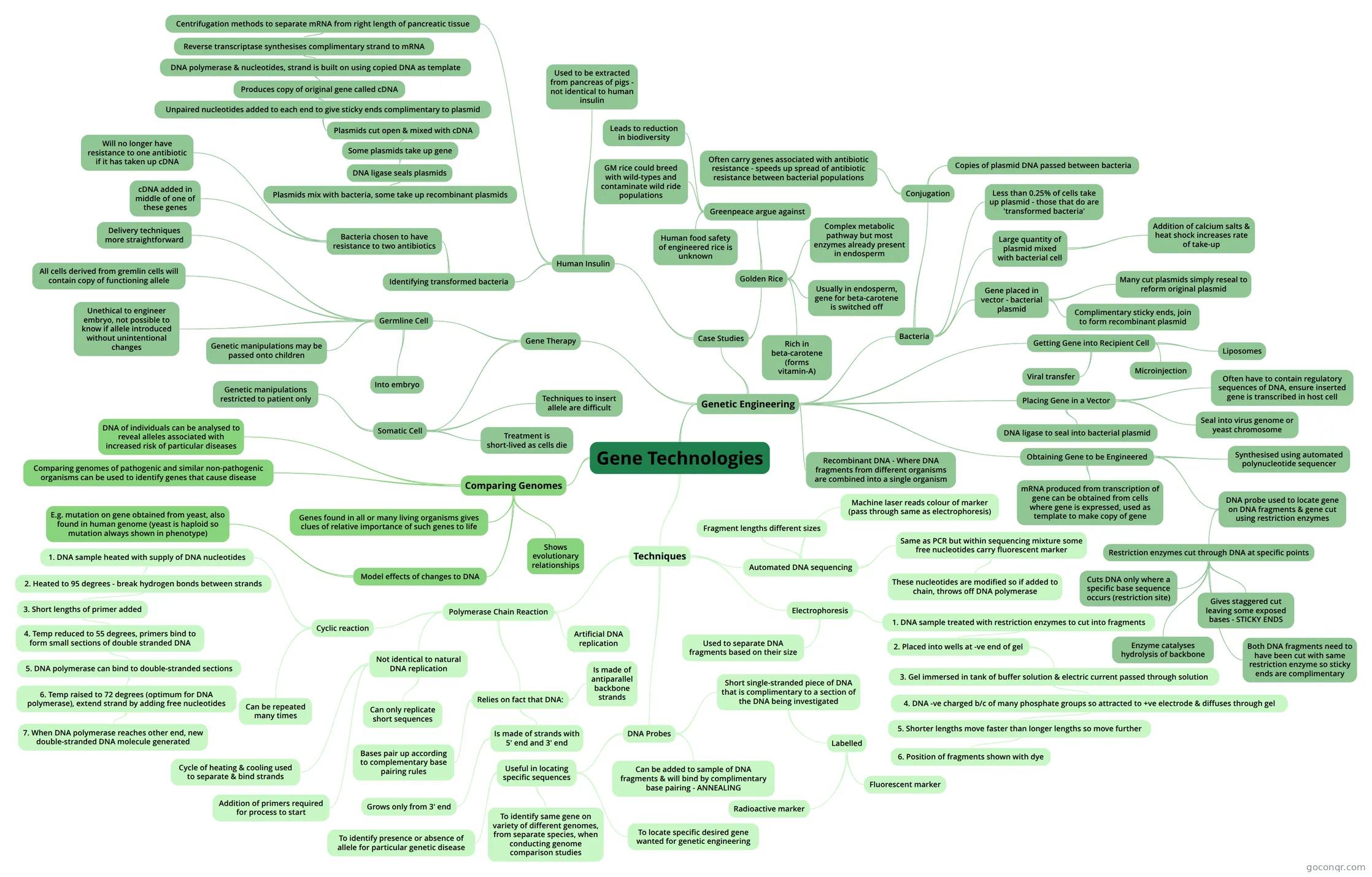
Mind map: Gene technologies
Contenido del mapa
Gene Technologies
Techniques
- Polymerase Chain Reaction
- Artificial DNA replication
- Relies on fact that DNA:
- Is made of antiparallel backbone strands
- Is made of strands with 5' end and 3' end
- Grows only from 3' end
- Bases pair up according to complementary base pairing rules
- Not identical to natural DNA replication
- Can only replicate short sequences
- Addition of primers required for process to start
- Cycle of heating & cooling used to separate & bind strands
- Cyclic reaction
- 1. DNA sample heated with supply of DNA nucleotides
- 2. Heated to 95 degrees - break hydrogen bonds between strands
- 3. Short lengths of primer added
- 4. Temp reduced to 55 degrees, primers bind to form small sections of double stranded DNA
- 5. DNA polymerase can bind to double-stranded sections
- 6. Temp raised to 72 degrees (optimum for DNA polymerase), extend strand by adding free nucleotides
- 7. When DNA polymerase reaches other end, new double-stranded DNA molecule generated
- 6. Temp raised to 72 degrees (optimum for DNA polymerase), extend strand by adding free nucleotides
- 5. DNA polymerase can bind to double-stranded sections
- 4. Temp reduced to 55 degrees, primers bind to form small sections of double stranded DNA
- 3. Short lengths of primer added
- 2. Heated to 95 degrees - break hydrogen bonds between strands
- Can be repeated many times
- 1. DNA sample heated with supply of DNA nucleotides
- Electrophoresis
- Used to separate DNA fragments based on their size
- 1. DNA sample treated with restriction enzymes to cut into fragments
- 2. Placed into wells at -ve end of gel
- 3. Gel immersed in tank of buffer solution & electric current passed through solution
- 4. DNA -ve charged b/c of many phosphate groups so attracted to +ve electrode & diffuses through gel
- 5. Shorter lengths move faster than longer lengths so move further
- 6. Position of fragments shown with dye
- 5. Shorter lengths move faster than longer lengths so move further
- 4. DNA -ve charged b/c of many phosphate groups so attracted to +ve electrode & diffuses through gel
- 3. Gel immersed in tank of buffer solution & electric current passed through solution
- 2. Placed into wells at -ve end of gel
- DNA Probes
- Short single-stranded piece of DNA that is complimentary to a section of the DNA being investigated
- Labelled
- Radioactive marker
- Fluorescent marker
- Labelled
- Can be added to sample of DNA fragments & will bind by complimentary base pairing - ANNEALING
- Useful in locating specific sequences
- To locate specific desired gene wanted for genetic engineering
- To identify same gene on variety of different genomes, from separate species, when conducting genome comparison studies
- To identify presence or absence of allele for particular genetic disease
- Short single-stranded piece of DNA that is complimentary to a section of the DNA being investigated
- Automated DNA sequencing
- Same as PCR but within sequencing mixture some free nucleotides carry fluorescent marker
- These nucleotides are modified so if added to chain, throws off DNA polymerase
- Fragment lengths different sizes
- Machine laser reads colour of marker (pass through same as electrophoresis)
- Same as PCR but within sequencing mixture some free nucleotides carry fluorescent marker
- Polymerase Chain Reaction
Genetic Engineering
- Recombinant DNA - Where DNA fragments from different organisms are combined into a single organism
- Obtaining Gene to be Engineered
- mRNA produced from transcription of gene can be obtained from cells where gene is expressed, used as template to make copy of gene
- Synthesised using automated polynucleotide sequencer
- DNA probe used to locate gene on DNA fragments & gene cut using restriction enzymes
- Restriction enzymes cut through DNA at specific points
- Cuts DNA only where a specific base sequence occurs (restriction site)
- Enzyme catalyses hydrolysis of backbone
- Gives staggered cut leaving some exposed bases - STICKY ENDS
- Both DNA fragments need to have been cut with same restriction enzyme so sticky ends are complimentary
- Restriction enzymes cut through DNA at specific points
- Placing Gene in a Vector
- DNA ligase to seal into bacterial plasmid
- Seal into virus genome or yeast chromosome
- Often have to contain regulatory sequences of DNA, ensure inserted gene is transcribed in host cell
- Getting Gene into Recipient Cell
- Microinjection
- Viral transfer
- Liposomes
- Bacteria
- Gene placed in vector - bacterial plasmid
- Complimentary sticky ends, join to form recombinant plasmid
- Many cut plasmids simply reseal to reform original plasmid
- Large quantity of plasmid mixed with bacterial cell
- Addition of calcium salts & heat shock increases rate of take-up
- Less than 0.25% of cells take up plasmid - those that do are 'transformed bacteria'
- Conjugation
- Copies of plasmid DNA passed between bacteria
- Often carry genes associated with antibiotic resistance - speeds up spread of antibiotic resistance between bacterial populations
- Gene placed in vector - bacterial plasmid
- Case Studies
- Human Insulin
- Used to be extracted from pancreas of pigs - not identical to human insulin
- Centrifugation methods to separate mRNA from right length of pancreatic tissue
- Reverse transcriptase synthesises complimentary strand to mRNA
- DNA polymerase & nucleotides, strand is built on using copied DNA as template
- Produces copy of original gene called cDNA
- Unpaired nucleotides added to each end to give sticky ends complimentary to plasmid
- Plasmids cut open & mixed with cDNA
- Some plasmids take up gene
- DNA ligase seals plasmids
- Plasmids mix with bacteria, some take up recombinant plasmids
- DNA ligase seals plasmids
- Some plasmids take up gene
- Plasmids cut open & mixed with cDNA
- Unpaired nucleotides added to each end to give sticky ends complimentary to plasmid
- Produces copy of original gene called cDNA
- DNA polymerase & nucleotides, strand is built on using copied DNA as template
- Reverse transcriptase synthesises complimentary strand to mRNA
- Identifying transformed bacteria
- Bacteria chosen to have resistance to two antibiotics
- cDNA added in middle of one of these genes
- Will no longer have resistance to one antibiotic if it has taken up cDNA
- Bacteria chosen to have resistance to two antibiotics
- Golden Rice
- Rich in beta-carotene (forms vitamin-A)
- Usually in endosperm, gene for beta-carotene is switched off
- Complex metabolic pathway but most enzymes already present in endosperm
- Greenpeace argue against
- Leads to reduction in biodiversity
- Human food safety of engineered rice is unknown
- GM rice could breed with wild-types and contaminate wild ride populations
- Human Insulin
- Gene Therapy
- Somatic Cell
- Techniques to insert allele are difficult
- Treatment is short-lived as cells die
- Genetic manipulations restricted to patient only
- Germline Cell
- Into embryo
- Delivery techniques more straightforward
- All cells derived from gremlin cells will contain copy of functioning allele
- Unethical to engineer embryo, not possible to know if allele introduced without unintentional changes
- Genetic manipulations may be passed onto children
- Somatic Cell
Comparing Genomes
- Genes found in all or many living organisms gives clues of relative importance of such genes to life
- Shows evolutionary relationships
- Model effects of changes to DNA
- E.g. mutation on gene obtained from yeast, also found in human genome (yeast is haploid so mutation always shown in phenotype)
- Comparing genomes of pathogenic and similar non-pathogenic organisms can be used to identify genes that cause disease
- DNA of individuals can be analysed to reveal alleles associated with increased risk of particular diseases
Información
- Descripción
- A-Level (A2 Unit 2) Biology Mapa Mental sobre Gene Technologies, creado por Maria Derv el 20/04/2015.
- Creado por
- Maria Derv
- Visitas
- 2
- Valoración