
Mapa mental
GLOBALISATION
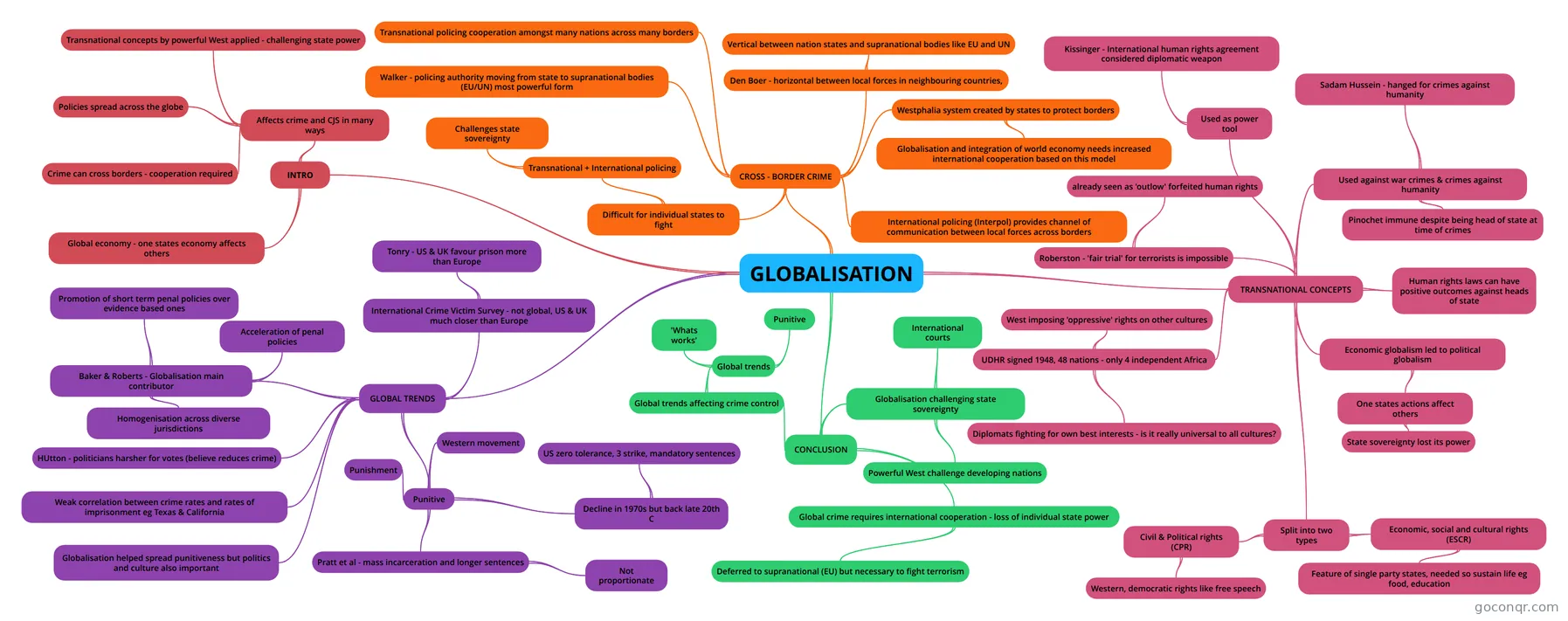
Mind map: globalisation and crime
Contenido del mapa
GLOBALISATION
INTRO
- Affects crime and CJS in many ways
- Transnational concepts by powerful West applied - challenging state power
- Crime can cross borders - cooperation required
- Policies spread across the globe
- Global economy - one states economy affects others
- Affects crime and CJS in many ways
CONCLUSION
- Global crime requires international cooperation - loss of individual state power
- Deferred to supranational (EU) but necessary to fight terrorism
- Globalisation challenging state sovereignty
- International courts
- Powerful West challenge developing nations
- Global trends affecting crime control
- Global trends
- 'Whats works'
- Punitive
- Global trends
- Global crime requires international cooperation - loss of individual state power
GLOBAL TRENDS
- Baker & Roberts - Globalisation main contributor
- Homogenisation across diverse jurisdictions
- Acceleration of penal policies
- Promotion of short term penal policies over evidence based ones
- Globalisation helped spread punitiveness but politics and culture also important
- HUtton - politicians harsher for votes (believe reduces crime)
- Weak correlation between crime rates and rates of imprisonment eg Texas & California
- Punitive
- Punishment
- Pratt et al - mass incarceration and longer sentences
- Not proportionate
- Western movement
- Decline in 1970s but back late 20th C
- US zero tolerance, 3 strike, mandatory sentences
- International Crime Victim Survey - not global, US & UK much closer than Europe
- Tonry - US & UK favour prison more than Europe
- Baker & Roberts - Globalisation main contributor
CROSS - BORDER CRIME
- Difficult for individual states to fight
- Transnational + International policing
- Challenges state sovereignty
- Transnational + International policing
- Westphalia system created by states to protect borders
- Globalisation and integration of world economy needs increased international cooperation based on this model
- International policing (Interpol) provides channel of communication between local forces across borders
- Transnational policing cooperation amongst many nations across many borders
- Walker - policing authority moving from state to supranational bodies (EU/UN) most powerful form
- Den Boer - horizontal between local forces in neighbouring countries,
- Vertical between nation states and supranational bodies like EU and UN
- Difficult for individual states to fight
TRANSNATIONAL CONCEPTS
- UDHR signed 1948, 48 nations - only 4 independent Africa
- West imposing 'oppressive' rights on other cultures
- Diplomats fighting for own best interests - is it really universal to all cultures?
- Roberston - 'fair trial' for terrorists is impossible
- already seen as 'outlow' forfeited human rights
- Split into two types
- Civil & Political rights (CPR)
- Western, democratic rights like free speech
- Economic, social and cultural rights (ESCR)
- Feature of single party states, needed so sustain life eg food, education
- Civil & Political rights (CPR)
- Used as power tool
- Kissinger - International human rights agreement considered diplomatic weapon
- Economic globalism led to political globalism
- One states actions affect others
- State sovereignty lost its power
- One states actions affect others
- Used against war crimes & crimes against humanity
- Sadam Hussein - hanged for crimes against humanity
- Pinochet immune despite being head of state at time of crimes
- Human rights laws can have positive outcomes against heads of state
- UDHR signed 1948, 48 nations - only 4 independent Africa