
Mapa mental
History and Archaeology
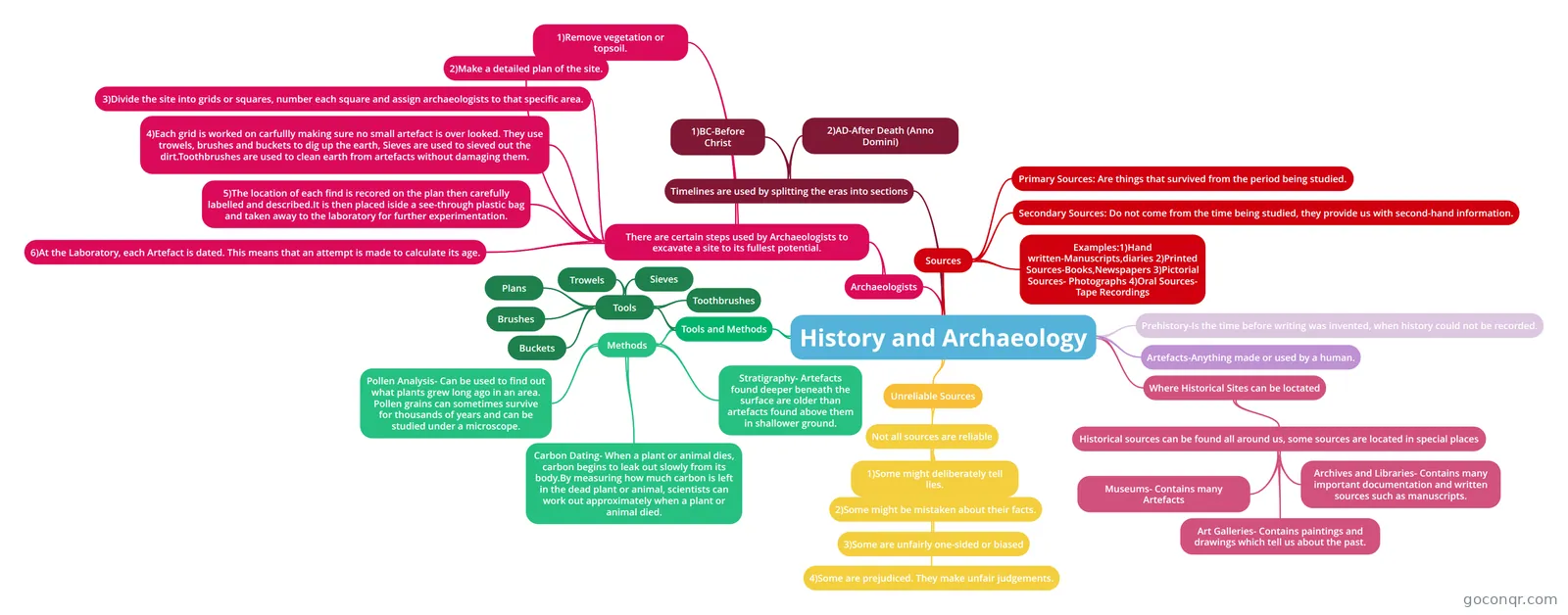
Mind map: History and archaeology
Contenido del mapa
History and Archaeology
Sources
- Primary Sources: Are things that survived from the period being studied.
- Secondary Sources: Do not come from the time being studied, they provide us with second-hand information.
- Examples:1)Hand written-Manuscripts,diaries 2)Printed Sources-Books,Newspapers 3)Pictorial Sources- Photographs 4)Oral Sources- Tape Recordings
Artefacts-Anything made or used by a human.
Where Historical Sites can be loctated
- Historical sources can be found all around us, some sources are located in special places
- Museums- Contains many Artefacts
- Archives and Libraries- Contains many important documentation and written sources such as manuscripts.
- Art Galleries- Contains paintings and drawings which tell us about the past.
- Historical sources can be found all around us, some sources are located in special places
Unreliable Sources
- Not all sources are reliable
- 1)Some might deliberately tell lies.
- 2)Some might be mistaken about their facts.
- 3)Some are unfairly one-sided or biased
- 4)Some are prejudiced. They make unfair judgements.
- Not all sources are reliable
Tools and Methods
- Tools
- Trowels
- Brushes
- Buckets
- Sieves
- Toothbrushes
- Plans
- Methods
- Stratigraphy- Artefacts found deeper beneath the surface are older than artefacts found above them in shallower ground.
- Carbon Dating- When a plant or animal dies, carbon begins to leak out slowly from its body.By measuring how much carbon is left in the dead plant or animal, scientists can work out approximately when a plant or animal died.
- Pollen Analysis- Can be used to find out what plants grew long ago in an area. Pollen grains can sometimes survive for thousands of years and can be studied under a microscope.
- Tools
Timelines are used by splitting the eras into sections
- 1)BC-Before Christ
- 2)AD-After Death (Anno Domini)
Archaeologists
- There are certain steps used by Archaeologists to excavate a site to its fullest potential.
- 1)Remove vegetation or topsoil.
- 2)Make a detailed plan of the site.
- 3)Divide the site into grids or squares, number each square and assign archaeologists to that specific area.
- 4)Each grid is worked on carfullly making sure no small artefact is over looked. They use trowels, brushes and buckets to dig up the earth, Sieves are used to sieved out the dirt.Toothbrushes are used to clean earth from artefacts without damaging them.
- 5)The location of each find is recored on the plan then carefully labelled and described.It is then placed iside a see-through plastic bag and taken away to the laboratory for further experimentation.
- 6)At the Laboratory, each Artefact is dated. This means that an attempt is made to calculate its age.
- There are certain steps used by Archaeologists to excavate a site to its fullest potential.
Prehistory-Is the time before writing was invented, when history could not be recorded.
Información
- Descripción
- A Mind-map on History and Archaeology!! :D
- Creado por
- Hannah Walsh
- Visitas
- 496
- Etiquetas
- Valoración