
Mapa mental
Social Learning Theory
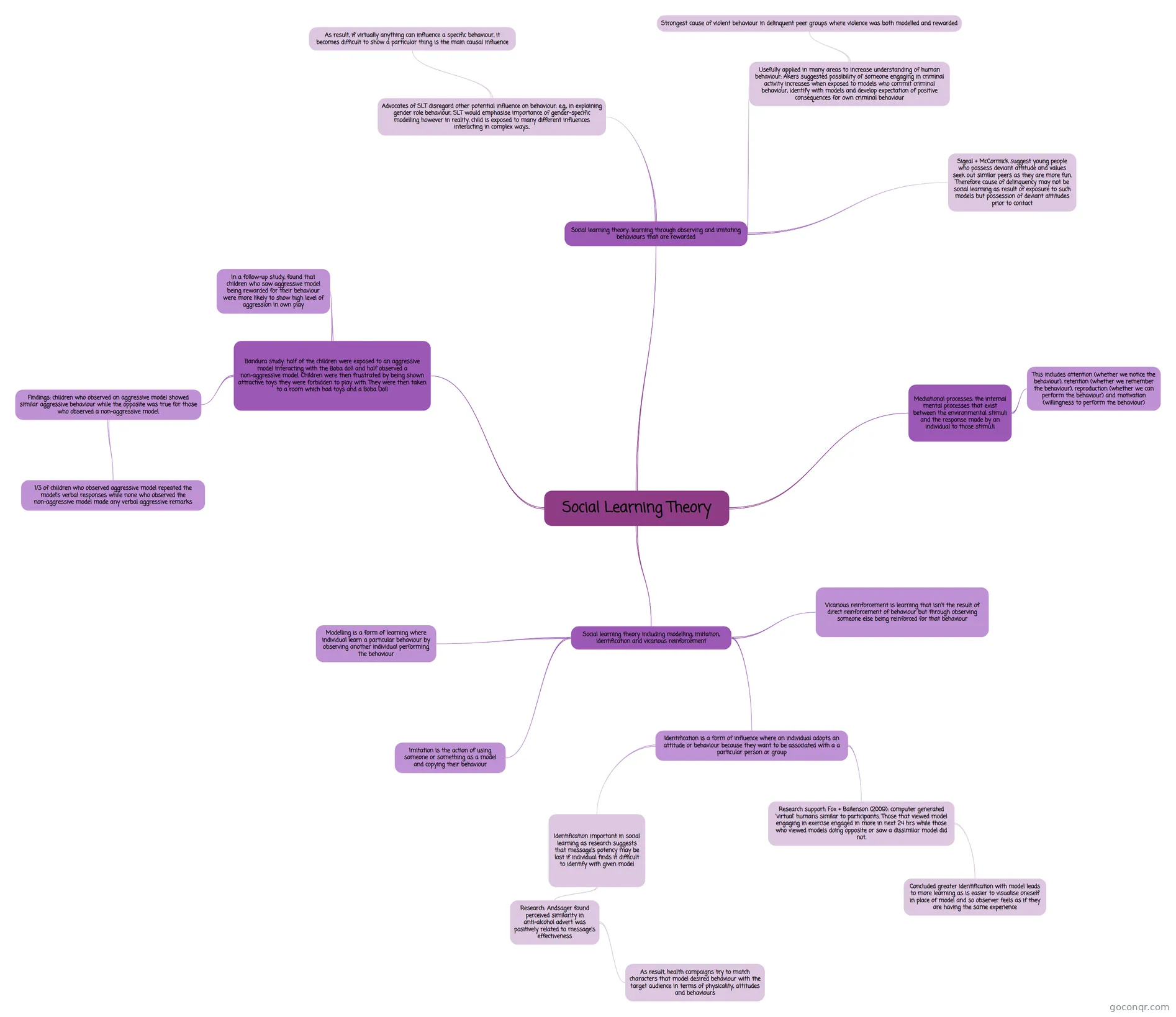
Mind map: Social learning theory
Contenido del mapa
Social Learning Theory
Social learning theory: learning through observing and imitating behaviours that are rewarded
- Advocates of SLT disregard other potential influence on behaviour: e.g., in explaining gender role behaviour, SLT would emphasise importance of gender-specific modelling however in reality, child is exposed to many different influences interacting in complex ways..
- This includes genetic predispositions, media portrayals, locus of control, etc.
- As result, if virtually anything can influence a specific behaviour, it becomes difficult to show a particular thing is the main causal influence
- As is the main belief of the SLT
- Usefully applied in many areas to increase understanding of human behaviour: Akers suggested possibility of someone engaging in criminal activity increases when exposed to models who commit criminal behaviour, identify with models and develop expectation of positive consequences for own criminal behaviour
- Strongest cause of violent behaviour in delinquent peer groups where violence was both modelled and rewarded
- Sigeal + McCormick suggest young people who possess deviant attitude and values seek out similar peers as they are more fun. Therefore cause of delinquency may not be social learning as result of exposure to such models but possession of deviant attitudes prior to contact
- Advocates of SLT disregard other potential influence on behaviour: e.g., in explaining gender role behaviour, SLT would emphasise importance of gender-specific modelling however in reality, child is exposed to many different influences interacting in complex ways..
Mediational processes: the internal mental processes that exist between the environmental stimuli and the response made by an individual to those stimu.li
- This includes attention (whether we notice the behaviour), retention (whether we remember the behaviour), reproduction (whether we can perform the behaviour) and motivation (willingness to perform the behaviour)
Social learning theory including modelling, imitation, identification and vicarious reinforcement
- Modelling is a form of learning where individual learn a particular behaviour by observing another individual performing the behaviour
- Imitation is the action of using someone or something as a model and copying their behaviour
- Identification is a form of influence where an individual adopts an attitude or behaviour because they want to be associated with a a particular person or group
- Research support: Fox + Bailenson (2009): computer generated 'virtual' humans similar to participants. Those that viewed model engaging in exercise engaged in more in next 24 hrs while those who viewed models doing opposite or saw a dissimilar model did not.
- Concluded greater identification with model leads to more learning as is easier to visualise oneself in place of model and so observer feels as if they are having the same experience
- Identification important in social learning as research suggests that message's potency may be lost if individual finds it difficult to identify with given model
- Research: Andsager found perceived similarity in anti-alcohol advert was positively related to message's effectiveness
- As result, health campaigns try to match characters that model desired behaviour with the target audience in terms of physicality, attitudes and behaviours
- Research: Andsager found perceived similarity in anti-alcohol advert was positively related to message's effectiveness
- Research support: Fox + Bailenson (2009): computer generated 'virtual' humans similar to participants. Those that viewed model engaging in exercise engaged in more in next 24 hrs while those who viewed models doing opposite or saw a dissimilar model did not.
- Vicarious reinforcement is learning that isn't the result of direct reinforcement of behaviour but through observing someone else being reinforced for that behaviour
Bandura study: half of the children were exposed to an aggressive model interacting with the Boba doll and half observed a non-aggressive model. Children were then frustrated by being shown attractive toys they were forbidden to play with. They were then taken to a room which had toys and a Boba Doll
- Findings: children who observed an aggressive model showed similar aggressive behaviour while the opposite was true for those who observed a non-aggressive model.
- 1/3 of children who observed aggressive model repeated the model's verbal responses while none who observed the non-aggressive model made any verbal aggressive remarks
- In a follow-up study, found that children who saw aggressive model being rewarded for their behaviour were more likely to show high level of aggression in own play
- Findings: children who observed an aggressive model showed similar aggressive behaviour while the opposite was true for those who observed a non-aggressive model.
Información
- Descripción
- Useful for blurting revision Dark purple: Main Point Light Purple: Expanding on main point Extra light purple/lilac: evaluation points
- Creado por
- Malaika Noor
- Visitas
- 7
- Valoración
Más sobre Social and observational learning