
Mapa mental
2.1 The Nervous System and Endocrine System
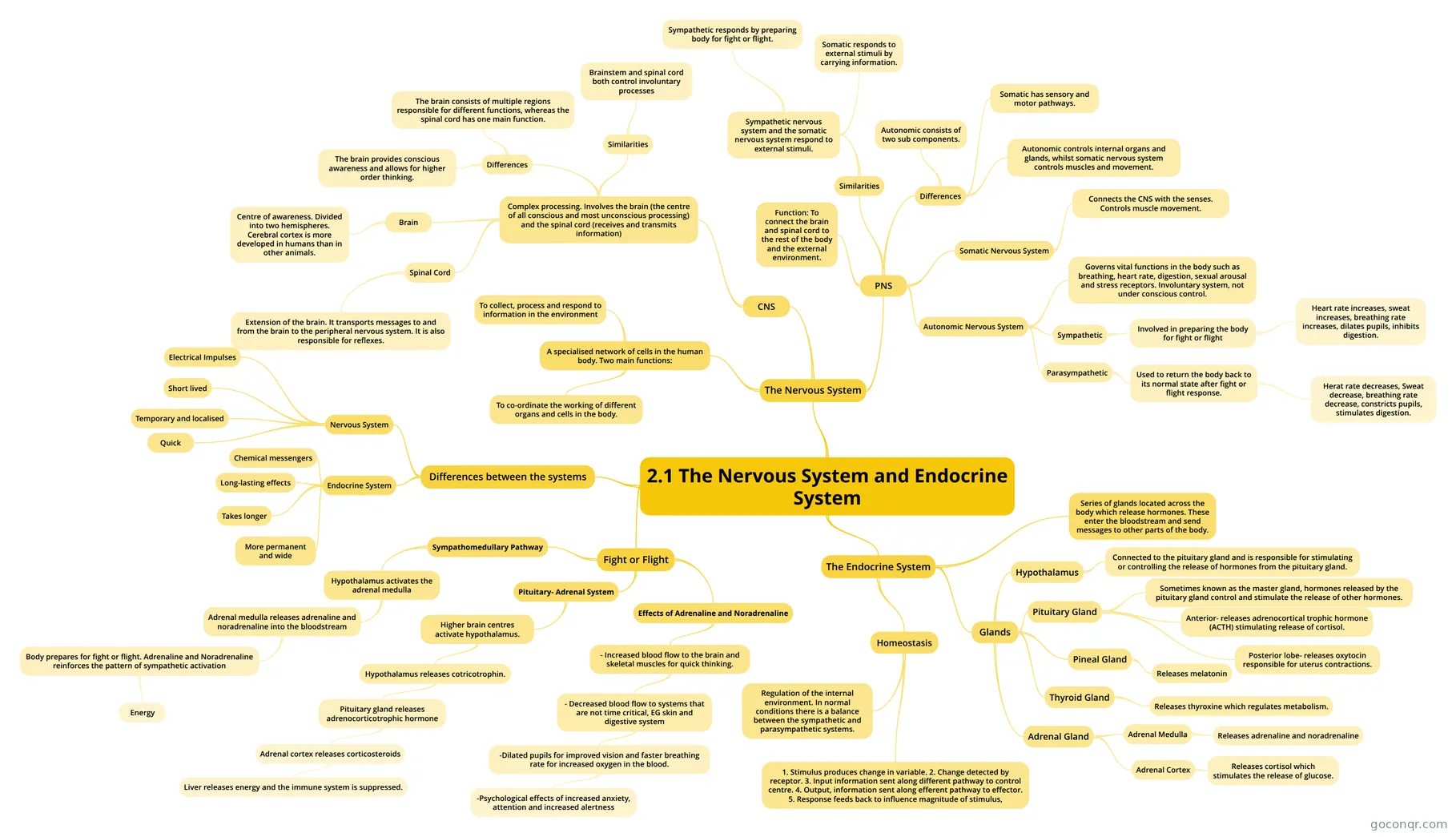
Mind map: nervous system and endocrine system
Contenido del mapa
2.1 The Nervous System and Endocrine System
The Nervous System
- A specialised network of cells in the human body. Two main functions:
- To collect, process and respond to information in the environment
- To co-ordinate the working of different organs and cells in the body.
- CNS
- Complex processing. Involves the brain (the centre of all conscious and most unconscious processing) and the spinal cord (receives and transmits information)
- Similarities
- Brainstem and spinal cord both control involuntary processes
- Differences
- The brain provides conscious awareness and allows for higher order thinking.
- The brain consists of multiple regions responsible for different functions, whereas the spinal cord has one main function.
- Brain
- Centre of awareness. Divided into two hemispheres. Cerebral cortex is more developed in humans than in other animals.
- Spinal Cord
- Extension of the brain. It transports messages to and from the brain to the peripheral nervous system. It is also responsible for reflexes.
- Similarities
- Complex processing. Involves the brain (the centre of all conscious and most unconscious processing) and the spinal cord (receives and transmits information)
- PNS
- Function: To connect the brain and spinal cord to the rest of the body and the external environment.
- Somatic Nervous System
- Connects the CNS with the senses. Controls muscle movement.
- Autonomic Nervous System
- Governs vital functions in the body such as breathing, heart rate, digestion, sexual arousal and stress receptors. Involuntary system, not under conscious control.
- Sympathetic
- Involved in preparing the body for fight or flight
- Heart rate increases, sweat increases, breathing rate increases, dilates pupils, inhibits digestion.
- Involved in preparing the body for fight or flight
- Parasympathetic
- Used to return the body back to its normal state after fight or flight response.
- Herat rate decreases, Sweat decrease, breathing rate decrease, constricts pupils, stimulates digestion.
- Used to return the body back to its normal state after fight or flight response.
- Similarities
- Sympathetic nervous system and the somatic nervous system respond to external stimuli.
- Sympathetic responds by preparing body for fight or flight.
- Somatic responds to external stimuli by carrying information.
- Sympathetic nervous system and the somatic nervous system respond to external stimuli.
- Differences
- Autonomic consists of two sub components.
- Somatic has sensory and motor pathways.
- Autonomic controls internal organs and glands, whilst somatic nervous system controls muscles and movement.
- A specialised network of cells in the human body. Two main functions:
The Endocrine System
- Series of glands located across the body which release hormones. These enter the bloodstream and send messages to other parts of the body.
- Homeostasis
- Regulation of the internal environment. In normal conditions there is a balance between the sympathetic and parasympathetic systems.
- 1. Stimulus produces change in variable. 2. Change detected by receptor. 3. Input information sent along different pathway to control centre. 4. Output, information sent along efferent pathway to effector. 5. Response feeds back to influence magnitude of stimulus,
- Glands
- Hypothalamus
- Connected to the pituitary gland and is responsible for stimulating or controlling the release of hormones from the pituitary gland.
- Pituitary Gland
- Sometimes known as the master gland, hormones released by the pituitary gland control and stimulate the release of other hormones.
- Anterior- releases adrenocortical trophic hormone (ACTH) stimulating release of cortisol.
- Posterior lobe- releases oxytocin responsible for uterus contractions.
- Pineal Gland
- Releases melatonin
- Thyroid Gland
- Releases thyroxine which regulates metabolism.
- Adrenal Gland
- Adrenal Medulla
- Releases adrenaline and noradrenaline
- Adrenal Cortex
- Releases cortisol which stimulates the release of glucose.
- Adrenal Medulla
- Hypothalamus
Differences between the systems
- Nervous System
- Electrical Impulses
- Short lived
- Quick
- Temporary and localised
- Endocrine System
- Chemical messengers
- Long-lasting effects
- Takes longer
- More permanent and wide
- Nervous System
Fight or Flight
- Sympathomedullary Pathway
- Hypothalamus activates the adrenal medulla
- Adrenal medulla releases adrenaline and noradrenaline into the bloodstream
- Body prepares for fight or flight. Adrenaline and Noradrenaline reinforces the pattern of sympathetic activation
- Energy
- Body prepares for fight or flight. Adrenaline and Noradrenaline reinforces the pattern of sympathetic activation
- Adrenal medulla releases adrenaline and noradrenaline into the bloodstream
- Hypothalamus activates the adrenal medulla
- Pituitary- Adrenal System
- Higher brain centres activate hypothalamus.
- Hypothalamus releases cotricotrophin.
- Pituitary gland releases adrenocorticotrophic hormone
- Adrenal cortex releases corticosteroids
- Liver releases energy and the immune system is suppressed.
- Adrenal cortex releases corticosteroids
- Pituitary gland releases adrenocorticotrophic hormone
- Hypothalamus releases cotricotrophin.
- Higher brain centres activate hypothalamus.
- Effects of Adrenaline and Noradrenaline
- - Increased blood flow to the brain and skeletal muscles for quick thinking.
- - Decreased blood flow to systems that are not time critical, EG skin and digestive system
- -Dilated pupils for improved vision and faster breathing rate for increased oxygen in the blood.
- -Psychological effects of increased anxiety, attention and increased alertness
- -Dilated pupils for improved vision and faster breathing rate for increased oxygen in the blood.
- - Decreased blood flow to systems that are not time critical, EG skin and digestive system
- - Increased blood flow to the brain and skeletal muscles for quick thinking.
- Sympathomedullary Pathway
Información
- Descripción
- aqa a level psychology biopsychology
- Creado por
- Alicja Klak
- Visitas
- 40
- Valoración