
Mapa mental
Evolution
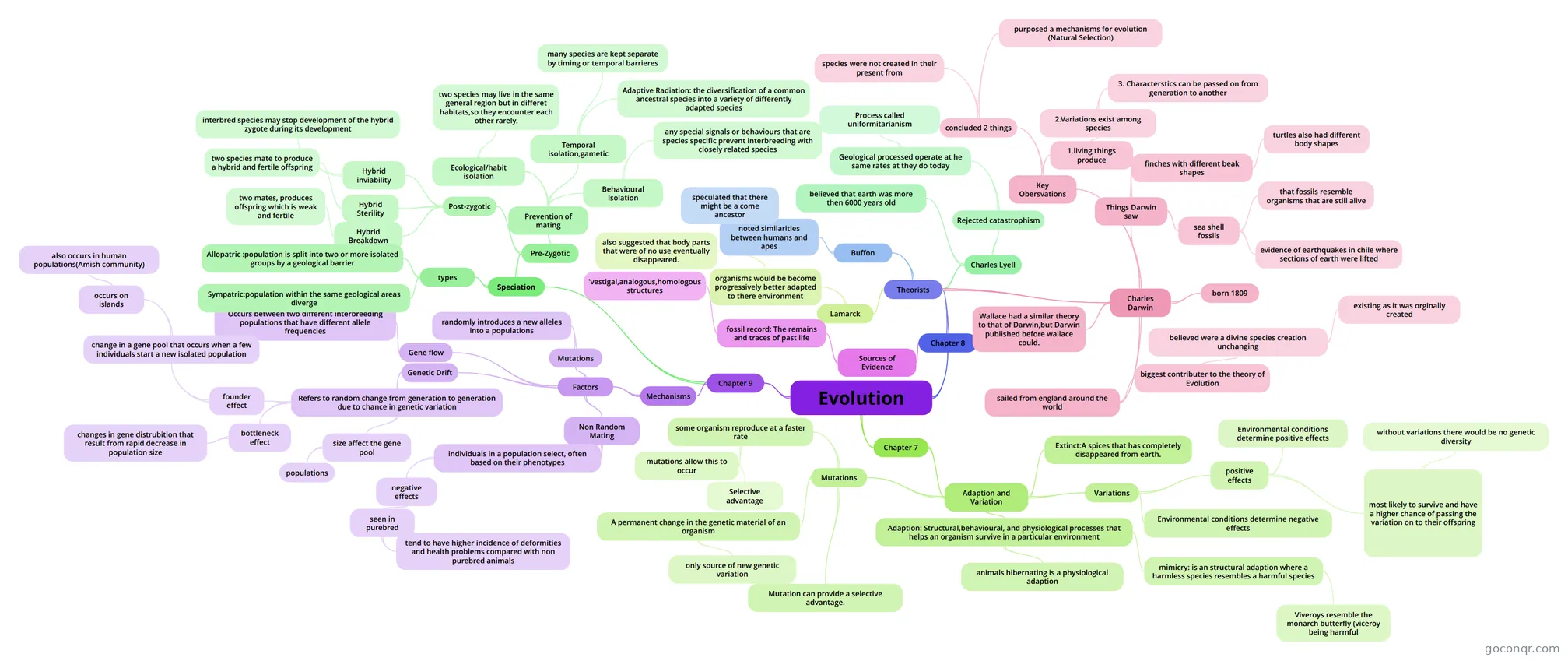
Mind map: Evolution
Contenido del mapa
Evolution
Chapter 7
- Adaption and Variation
- Adaption: Structural,behavioural, and physiological processes that helps an organism survive in a particular environment
- animals hibernating is a physiological adaption
- mimicry: is an structural adaption where a harmless species resembles a harmful species
- Viveroys resemble the monarch butterfly (viceroy being harmful
- Extinct:A spices that has completely disappeared from earth.
- Variations
- positive effects
- Environmental conditions determine positive effects
- most likely to survive and have a higher chance of passing the variation on to their offspring
- without variations there would be no genetic diversity
- Environmental conditions determine negative effects
- positive effects
- Mutations
- A permanent change in the genetic material of an organism
- only source of new genetic variation
- Mutation can provide a selective advantage.
- some organism reproduce at a faster rate
- mutations allow this to occur
- Selective advantage
- mutations allow this to occur
- A permanent change in the genetic material of an organism
- Adaption: Structural,behavioural, and physiological processes that helps an organism survive in a particular environment
- Adaption and Variation
Chapter 8
- Theorists
- Charles Darwin
- born 1809
- sailed from england around the world
- biggest contributer to the theory of Evolution
- believed were a divine species creation unchanging
- existing as it was orginally created
- believed were a divine species creation unchanging
- biggest contributer to the theory of Evolution
- Things Darwin saw
- sea shell fossils
- evidence of earthquakes in chile where sections of earth were lifted
- that fossils resemble organisms that are still alive
- finches with different beak shapes
- turtles also had different body shapes
- sea shell fossils
- Key Obersvations
- 1.living things produce
- 2.Variations exist among species
- 3. Characterstics can be passed on from generation to another
- 2.Variations exist among species
- concluded 2 things
- species were not created in their present from
- purposed a mechanisms for evolution (Natural Selection)
- 1.living things produce
- Wallace had a similar theory to that of Darwin,but Darwin published before wallace could.
- Charles Lyell
- Rejected catastrophism
- Geological processed operate at he same rates at they do today
- Process called uniformitarianism
- Geological processed operate at he same rates at they do today
- believed that earth was more then 6000 years old
- Rejected catastrophism
- Buffon
- noted similarities between humans and apes
- speculated that there might be a come ancestor
- noted similarities between humans and apes
- Lamarck
- organisms would be become progressively better adapted to there environment
- also suggested that body parts that were of no use eventually disappeared.
- organisms would be become progressively better adapted to there environment
- Charles Darwin
- Sources of Evidence
- fossil record: The remains and traces of past life
- 'vestigal,analogous,homologous structures
- fossil record: The remains and traces of past life
- Theorists
Chapter 9
- Mechanisms
- Factors
- Mutations
- randomly introduces a new alleles into a populations
- Gene flow
- Occurs between two different interbreeding populations that have different allele frequencies
- Non Random Mating
- individuals in a population select, often based on their phenotypes
- negative effects
- seen in purebred
- tend to have higher incidence of deformities and health problems compared with non purebred animals
- seen in purebred
- negative effects
- individuals in a population select, often based on their phenotypes
- Genetic Drift
- Refers to random change from generation to generation due to chance in genetic variation
- size affect the gene pool
- populations
- founder effect
- change in a gene pool that occurs when a few individuals start a new isolated population
- occurs on islands
- also occurs in human populations(Amish community)
- occurs on islands
- change in a gene pool that occurs when a few individuals start a new isolated population
- bottleneck effect
- changes in gene distrubition that result from rapid decrease in population size
- size affect the gene pool
- Refers to random change from generation to generation due to chance in genetic variation
- Mutations
- Factors
- Speciation
- Pre-Zygotic
- Prevention of mating
- Behavioural Isolation
- any special signals or behaviours that are species specific prevent interbreeding with closely related species
- Temporal isolation,gametic
- many species are kept separate by timing or temporal barrieres
- Adaptive Radiation: the diversification of a common ancestral species into a variety of differently adapted species
- Ecological/habit isolation
- two species may live in the same general region but in differet habitats,so they encounter each other rarely.
- Behavioural Isolation
- Post-zygotic
- Hybrid inviability
- interbred species may stop development of the hybrid zygote during its development
- Hybrid Sterility
- two species mate to produce a hybrid and fertile offspring
- Hybrid Breakdown
- two mates, produces offspring which is weak and fertile
- Hybrid inviability
- Prevention of mating
- types
- Allopatric :population is split into two or more isolated groups by a geological barrier
- Sympatric:population within the same geological areas diverge
- Pre-Zygotic
- Mechanisms
Información
- Descripción
- Mapa Mental sobre Evolution, creado por balsharangill01 el 27/11/2013.
- Creado por
- balsharangill01
- Visitas
- 17
- Valoración