
Mapa mental
Memory
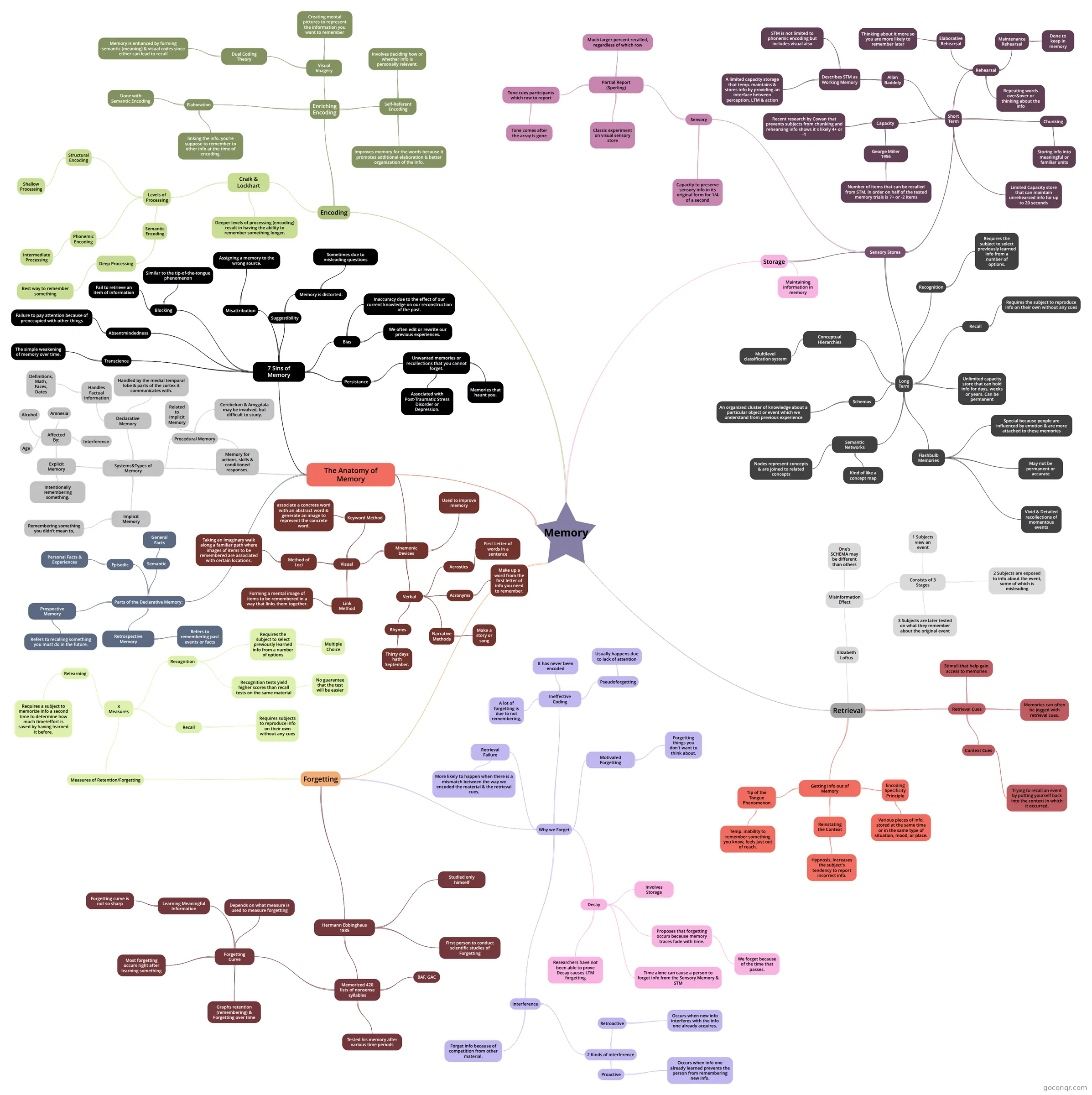
Mind map: Memory
Contenido del mapa
Memory
Storage
- Maintaining information in memory
- Sensory Stores
- Sensory
- Capacity to preserve sensory info in its original form for 1/4 of a second
- Partial Report (Sperling)
- Classic experiment on visual sensory store
- Tone cues participants which row to report
- Tone comes after the array is gone
- Much larger percent recalled, regardless of which row
- Short Term
- Limited Capacity store that can maintain unrehearsed info for up to 20 seconds
- Capacity
- George Miller 1956
- Number of items that can be recalled from STM, in order on half of the tested memory trials is 7+ or -2 items
- Recent research by Cowan that prevents subjects from chunking and rehearsing info shows it s likely 4+ or -1
- George Miller 1956
- Chunking
- Storing info into meaningful or familiar units
- Rehearsal
- Repeating words over&over or thinking about the info
- Maintenance Rehearsal
- Done to keep in memory
- Elaborative Rehearsal
- Thinking about it more so you are more likely to remember later
- Allan Baddely
- Describes STM as Working Memory
- A limited capacity storage that temp. maintains & stores info by providing an interface between perception, LTM & action
- STM is not limited to phonemic encoding but includes visual also
- Describes STM as Working Memory
- Long Term
- Unlimited capacity store that can hold info for days, weeks or years. Can be permanent
- Flashbulb Memories
- Vivid & Detailed recollections of momentous events
- May not be permanent or accurate
- Special because people are influenced by emotion & are more attached to these memories
- Recognition
- Requires the subject to select previously learned info from a number of options.
- Recall
- Requires the subject to reproduce info on their own without any cues
- Conceptual Hierarchies
- Multilevel classification system
- Schemas
- An organized cluster of knowledge about a particular object or event which we understand from previous experience
- Semantic Networks
- Nodes represent concepts & are joined to related concepts
- Kind of like a concept map
- Sensory
Encoding
- Craik & Lockhart
- Levels of Processing
- Structural Encoding
- Shallow Processing
- Phonemic Encoding
- Intermediate Processing
- Semantic Encoding
- Deep Processing
- Best way to remember something
- Deep Processing
- Structural Encoding
- Deeper levels of processing (encoding) result in having the ability to remember something longer.
- Levels of Processing
- Enriching Encoding
- Elaboration
- linking the info. you're suppose to remember to other info at the time of encoding.
- Done with Semantic Encoding
- Visual Imagery
- Dual Coding Theory
- Memory is enhanced by forming semantic (meaning) & visual codes since either can lead to recall
- Creating mental pictures to represent the information you want to remember
- Dual Coding Theory
- Self-Referent Encoding
- Involves deciding how or whether info is personally relevant.
- Improves memory for the words because it promotes additional elaboration & better organization of the info.
- Elaboration
- Craik & Lockhart
Retrieval
- Getting Info out of Memory
- Tip of the Tongue Phenomenon
- Temp. inability to remember something you know, feels just out of reach.
- Reinstating the Context
- Hypnosis, increases the subject's tendency to report incorrect info.
- Encoding Specificity Principle
- Various pieces of info. stored at the same time or in the same type of situation, mood, or place.
- Tip of the Tongue Phenomenon
- Retrieval Cues
- Context Cues
- Trying to recall an event by putting yourself back into the context in which it occurred.
- Memories can often be jogged with retrieval cues.
- Stimuli that help gain access to memories
- Context Cues
- Elizabeth Loftus
- Misinformation Effect
- Consists of 3 Stages
- 1 Subjects view an event
- 2 Subjects are exposed to info about the event, some of which is misleading
- 3 Subjects are later tested on what they remember about the original event
- One's SCHEMA may be different than others
- Consists of 3 Stages
- Misinformation Effect
- Getting Info out of Memory
Forgetting
- Hermann Ebbinghaus 1885
- Studied only himself
- Memorized 420 lists of nonsense syllables
- BAF, GAC
- Tested his memory after various time periods
- Forgetting Curve
- Graphs retention (remembering) & Forgetting over time
- Most forgetting occurs right after learning something
- Learning Meaningful Information
- Forgetting curve is not so sharp
- Depends on what measure is used to measure forgetting
- First person to conduct scientific studies of Forgetting
- Measures of Retention/Forgetting
- 3 Measures
- Recall
- Requires subjects to reproduce info on their own without any cues
- Recognition
- Requires the subject to select previously learned info from a number of options
- Multiple Choice
- Recognition tests yield higher scores than recall tests on the same material
- No guarantee that the test will be easier
- Requires the subject to select previously learned info from a number of options
- Relearning
- Requires a subject to memorize info a second time to determine how much time/effort is saved by having learned it before.
- Recall
- 3 Measures
- Why we Forget
- Ineffective Coding
- A lot of forgetting is due to not remembering,
- It has never been encoded
- Pseudoforgetting
- Usually happens due to lack of attention
- Decay
- Involves Storage
- Proposes that forgetting occurs because memory traces fade with time.
- We forget because of the time that passes.
- Time alone can cause a person to forget info from the Sensory Memory & STM
- Researchers have not been able to prove Decay causes LTM forgetting
- Interference
- Forget info because of competition from other material.
- 2 Kinds of interference
- Retroactive
- Occurs when new info interferes with the info one already acquires.
- Proactive
- Occurs when info one already learned prevents the person from remembering new info.
- Retroactive
- Retrieval Failure
- More likely to happen when there is a mismatch between the way we encoded the material & the retrieval cues.
- Motivated Forgetting
- Forgetting things you don't want to think about.
- Ineffective Coding
- Hermann Ebbinghaus 1885
The Anatomy of Memory
- 7 Sins of Memory
- Transcience
- The simple weakening of memory over time.
- Absentmindedness
- Failure to pay attention because of preoccupied with other things
- Blocking
- Fail to retrieve an item of information
- Similar to the tip-of-the-tongue phenomenon
- Misattribution
- Assigning a memory to the wrong source.
- Suggestibility
- Memory is distorted.
- Sometimes due to misleading questions
- Memory is distorted.
- Bias
- Inaccuracy due to the effect of our current knowledge on our reconstruction of the past.
- We often edit or rewrite our previous experiences.
- Persistance
- Unwanted memories or recollections that you cannot forget.
- Memories that haunt you.
- Associated with Post-Traumatic Stress Disorder or Depression.
- Unwanted memories or recollections that you cannot forget.
- Transcience
- Systems&Types of Memory
- Implicit Memory
- Remembering something you didn't mean to,
- Explicit Memory
- Intentionally remembering something.
- Affected By:
- Age
- Alcohol
- Amnesia
- Interference
- Declarative Memory
- Handles Factual Information
- Definitions, Math, Faces, Dates
- Handled by the medial temporal lobe & parts of the cortex it communicates with.
- Handles Factual Information
- Procedural Memory
- Memory for actions, skills & conditioned responses.
- Related to Implicit Memory
- Cerebelum & Amygdala may be involved, but difficult to study.
- Implicit Memory
- Parts of the Declarative Memory:
- Semantic
- General Facts
- Episodic
- Personal Facts & Experiences
- Prospective Memory
- Refers to recalling something you must do in the future.
- Retrospective Memory
- Refers to remembering past events or facts
- Semantic
- Mnemonic Devices
- Used to improve memory
- Visual
- Link Method
- Forming a mental image of items to be remembered in a way that links them together.
- Method of Loci
- Taking an imaginary walk along a familiar path where images of items to be remembered are associated with certain locations.
- Keyword Method
- associate a concrete word with an abstract word & generate an image to represent the concrete word.
- Link Method
- Verbal
- Acrostics
- First Letter of words in a sentence
- Acronyms
- Make up a word from the first letter of info you need to remember.
- Narrative Methods
- Make a story or song
- Rhymes
- Thirty days hath September.
- Acrostics
- 7 Sins of Memory
Información
- Descripción
- Mapa Mental sobre Memory, creado por Jessica Auger el 05/11/2015.
- Creado por
- Jessica Auger
- Visitas
- 0
- Valoración