
Mapa mental
Xerophytes
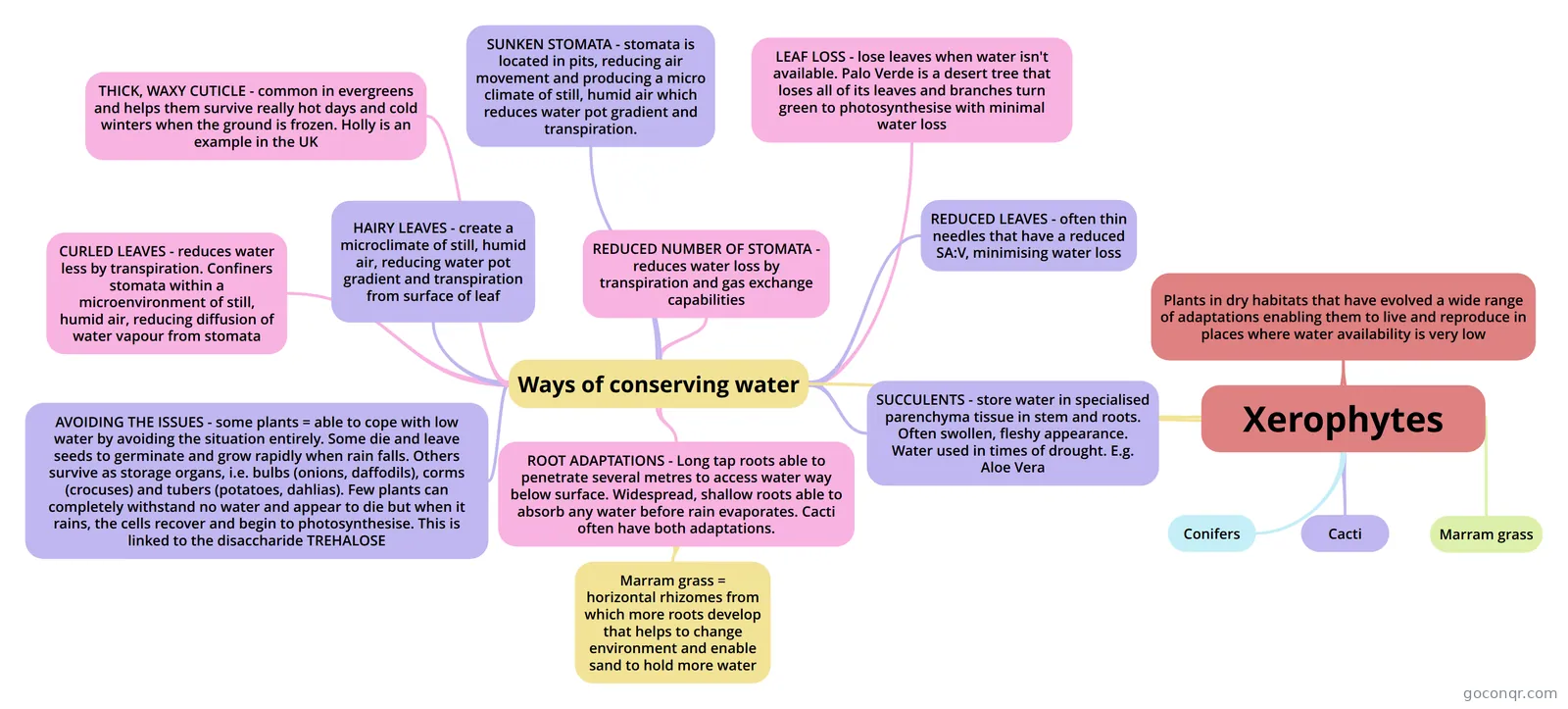
Mind map: Xerophytes
Contenido del mapa
Xerophytes
Plants in dry habitats that have evolved a wide range of adaptations enabling them to live and reproduce in places where water availability is very low
Conifers
Cacti
Marram grass
Ways of conserving water
- THICK, WAXY CUTICLE - common in evergreens and helps them survive really hot days and cold winters when the ground is frozen. Holly is an example in the UK
- SUNKEN STOMATA - stomata is located in pits, reducing air movement and producing a micro climate of still, humid air which reduces water pot gradient and transpiration.
- REDUCED NUMBER OF STOMATA - reduces water loss by transpiration and gas exchange capabilities
- REDUCED LEAVES - often thin needles that have a reduced SA:V, minimising water loss
- HAIRY LEAVES - create a microclimate of still, humid air, reducing water pot gradient and transpiration from surface of leaf
- CURLED LEAVES - reduces water less by transpiration. Confiners stomata within a microenvironment of still, humid air, reducing diffusion of water vapour from stomata
- SUCCULENTS - store water in specialised parenchyma tissue in stem and roots. Often swollen, fleshy appearance. Water used in times of drought. E.g. Aloe Vera
- LEAF LOSS - lose leaves when water isn't available. Palo Verde is a desert tree that loses all of its leaves and branches turn green to photosynthesise with minimal water loss
- ROOT ADAPTATIONS - Long tap roots able to penetrate several metres to access water way below surface. Widespread, shallow roots able to absorb any water before rain evaporates. Cacti often have both adaptations.
- Marram grass = horizontal rhizomes from which more roots develop that helps to change environment and enable sand to hold more water
- AVOIDING THE ISSUES - some plants = able to cope with low water by avoiding the situation entirely. Some die and leave seeds to germinate and grow rapidly when rain falls. Others survive as storage organs, i.e. bulbs (onions, daffodils), corms (crocuses) and tubers (potatoes, dahlias). Few plants can completely withstand no water and appear to die but when it rains, the cells recover and begin to photosynthesise. This is linked to the disaccharide TREHALOSE
Información
- Descripción
- AS - Level (Chapter 9 - plants) Biology Mapa Mental sobre Xerophytes, creado por Jess Hughes el 02/03/2016.
- Creado por
- Jess Hughes
- Visitas
- 0
- Valoración