
Mapa mental
Conservation in ex situ
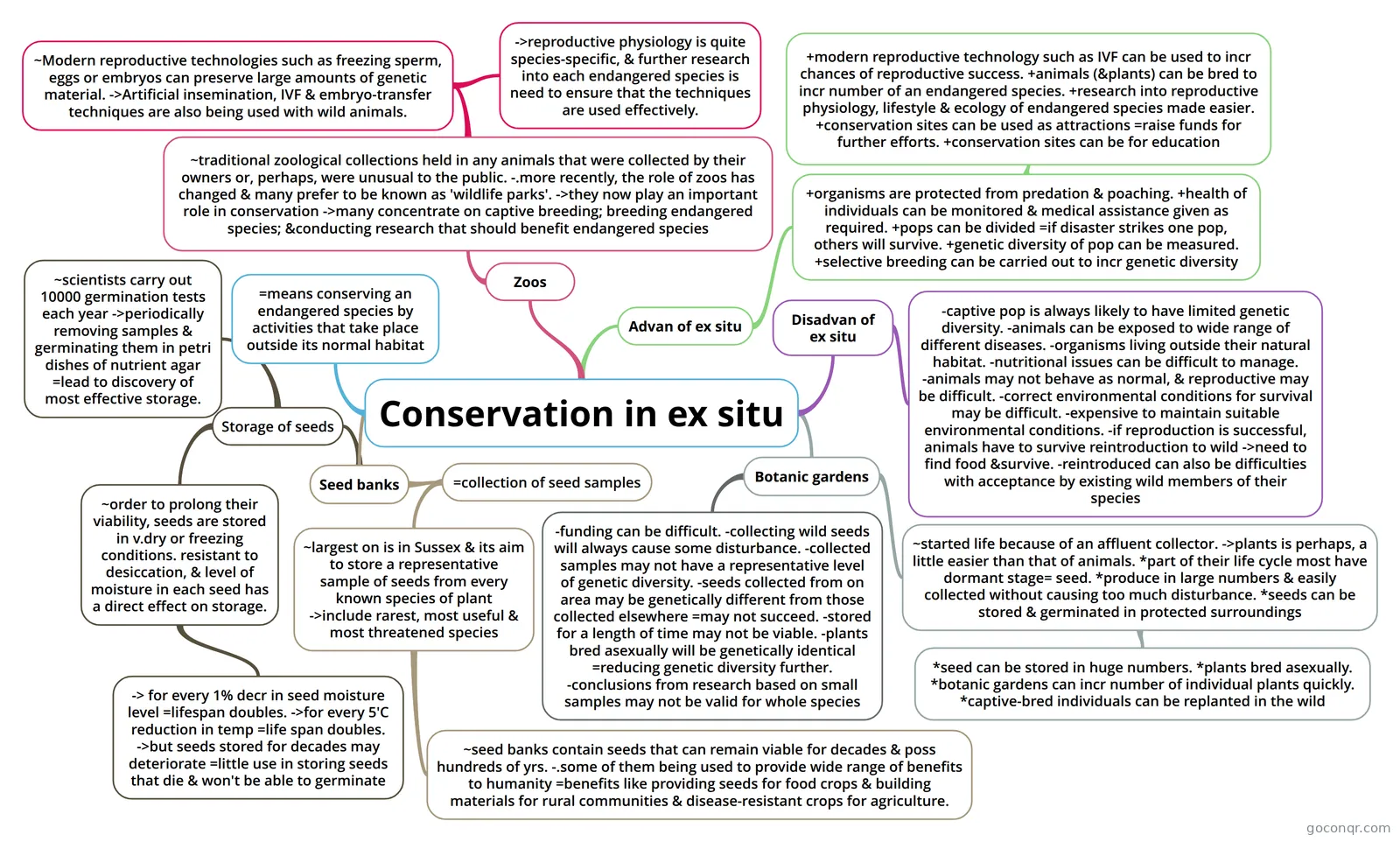
Mind map: Conservation in ex situ
Contenido del mapa
Conservation in ex situ
=means conserving an endangered species by activities that take place outside its normal habitat
Zoos
- ~traditional zoological collections held in any animals that were collected by their owners or, perhaps, were unusual to the public. -.more recently, the role of zoos has changed & many prefer to be known as 'wildlife parks'. ->they now play an important role in conservation ->many concentrate on captive breeding; breeding endangered species; &conducting research that should benefit endangered species
- ~Modern reproductive technologies such as freezing sperm, eggs or embryos can preserve large amounts of genetic material. ->Artificial insemination, IVF & embryo-transfer techniques are also being used with wild animals.
- ->reproductive physiology is quite species-specific, & further research into each endangered species is need to ensure that the techniques are used effectively.
- ~Modern reproductive technologies such as freezing sperm, eggs or embryos can preserve large amounts of genetic material. ->Artificial insemination, IVF & embryo-transfer techniques are also being used with wild animals.
- ~traditional zoological collections held in any animals that were collected by their owners or, perhaps, were unusual to the public. -.more recently, the role of zoos has changed & many prefer to be known as 'wildlife parks'. ->they now play an important role in conservation ->many concentrate on captive breeding; breeding endangered species; &conducting research that should benefit endangered species
Advan of ex situ
- +organisms are protected from predation & poaching. +health of individuals can be monitored & medical assistance given as required. +pops can be divided =if disaster strikes one pop, others will survive. +genetic diversity of pop can be measured. +selective breeding can be carried out to incr genetic diversity
- +modern reproductive technology such as IVF can be used to incr chances of reproductive success. +animals (&plants) can be bred to incr number of an endangered species. +research into reproductive physiology, lifestyle & ecology of endangered species made easier. +conservation sites can be used as attractions =raise funds for further efforts. +conservation sites can be for education
- +organisms are protected from predation & poaching. +health of individuals can be monitored & medical assistance given as required. +pops can be divided =if disaster strikes one pop, others will survive. +genetic diversity of pop can be measured. +selective breeding can be carried out to incr genetic diversity
Disadvan of ex situ
- -captive pop is always likely to have limited genetic diversity. -animals can be exposed to wide range of different diseases. -organisms living outside their natural habitat. -nutritional issues can be difficult to manage. -animals may not behave as normal, & reproductive may be difficult. -correct environmental conditions for survival may be difficult. -expensive to maintain suitable environmental conditions. -if reproduction is successful, animals have to survive reintroduction to wild ->need to find food &survive. -reintroduced can also be difficulties with acceptance by existing wild members of their species
Botanic gardens
- ~started life because of an affluent collector. ->plants is perhaps, a little easier than that of animals. *part of their life cycle most have dormant stage= seed. *produce in large numbers & easily collected without causing too much disturbance. *seeds can be stored & germinated in protected surroundings
- *seed can be stored in huge numbers. *plants bred asexually. *botanic gardens can incr number of individual plants quickly. *captive-bred individuals can be replanted in the wild
- -funding can be difficult. -collecting wild seeds will always cause some disturbance. -collected samples may not have a representative level of genetic diversity. -seeds collected from on area may be genetically different from those collected elsewhere =may not succeed. -stored for a length of time may not be viable. -plants bred asexually will be genetically identical =reducing genetic diversity further. -conclusions from research based on small samples may not be valid for whole species
- ~started life because of an affluent collector. ->plants is perhaps, a little easier than that of animals. *part of their life cycle most have dormant stage= seed. *produce in large numbers & easily collected without causing too much disturbance. *seeds can be stored & germinated in protected surroundings
Seed banks
- =collection of seed samples
- ~largest on is in Sussex & its aim to store a representative sample of seeds from every known species of plant ->include rarest, most useful & most threatened species
- ~seed banks contain seeds that can remain viable for decades & poss hundreds of yrs. -.some of them being used to provide wide range of benefits to humanity =benefits like providing seeds for food crops & building materials for rural communities & disease-resistant crops for agriculture.
- ~largest on is in Sussex & its aim to store a representative sample of seeds from every known species of plant ->include rarest, most useful & most threatened species
- Storage of seeds
- ~order to prolong their viability, seeds are stored in v.dry or freezing conditions. resistant to desiccation, & level of moisture in each seed has a direct effect on storage.
- -> for every 1% decr in seed moisture level =lifespan doubles. ->for every 5'C reduction in temp =life span doubles. ->but seeds stored for decades may deteriorate =little use in storing seeds that die & won't be able to germinate
- ~scientists carry out 10000 germination tests each year ->periodically removing samples & germinating them in petri dishes of nutrient agar =lead to discovery of most effective storage.
- ~order to prolong their viability, seeds are stored in v.dry or freezing conditions. resistant to desiccation, & level of moisture in each seed has a direct effect on storage.
- =collection of seed samples
Información
- Descripción
- AS - Level AS Biology Mapa Mental sobre Conservation in ex situ, creado por S M el 12/03/2016.
- Creado por
- S M
- Visitas
- 0
- Valoración
Más sobre Biodiversity conservation methods