
Mapa mental
Interviews
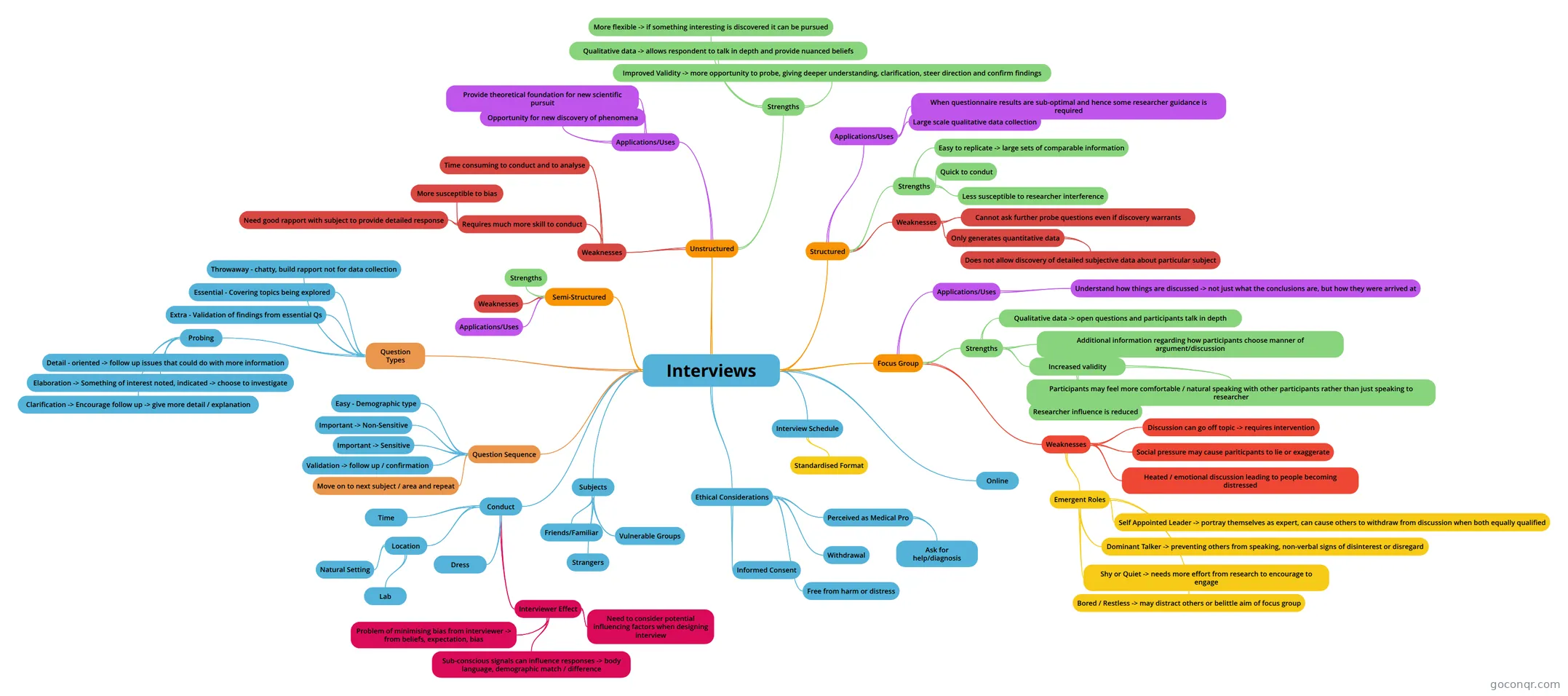
Mind map: Interviews
Contenido del mapa
Interviews
- Involves the interaction between participant and researcher -> Need training in order to correctly conduct interview - Not introduce bias - Ask the right questions - Have good rapport with subject - Ensure truthful answers - Not upset or distress subject -> stick to ethics
Semi-Structured
- A mix between the two - Follows a general interview schedule but allows for probes questions and deviations if warrented
- Strengths
- Weaknesses
- Applications/Uses
Structured
- Essentially an interactive questionnaire - Follows interview schedule - So no further probe questions are allowed even if desired -> Produces large set of comparable data
- Strengths
- Easy to replicate -> large sets of comparable information
- Quick to condut
- Less susceptible to researcher interference
- Relying on the assumption that interview schedule was well thought-out and constructed
- Weaknesses
- Cannot ask further probe questions even if discovery warrants
- Only generates quantitative data
- Does not allow discovery of detailed subjective data about particular subject
- Applications/Uses
- Large scale qualitative data collection
- When questionnaire results are sub-optimal and hence some researcher guidance is required
Unstructured
- Discovery interview / guided conversation - Contains open-ended question allowing for detailed subjective information - Generates qualitative data
- Strengths
- More flexible -> if something interesting is discovered it can be pursued
- Qualitative data -> allows respondent to talk in depth and provide nuanced beliefs
- Improved Validity -> more opportunity to probe, giving deeper understanding, clarification, steer direction and confirm findings
- Weaknesses
- Time consuming to conduct and to analyse
- Requires much more skill to conduct
- More susceptible to bias
- Need good rapport with subject to provide detailed response
- Applications/Uses
- Opportunity for new discovery of phenomena
- Provide theoretical foundation for new scientific pursuit
Interview Schedule
- Set of prepared questions to be asked the same way for every participant
- Standardised Format
- Same questions, in the same order -> Allows for reproducible, generalisable findings -> Can be used to demonstrate reliability in object being measured-> Demonstrate validity in the relationship between some objects
Question Sequence
- Easy - Demographic type
- Important -> Non-Sensitive
- Important -> Sensitive
- Validation -> follow up / confirmation
- Move on to next subject / area and repeat
Focus Group
- Several people involved in a discussion -> interesting findings are to do with types of interactions between participants as well as conclusions from discussion -> Researcher's role is to ensure all the group interacts and remains on topic
- Strengths
- Qualitative data -> open questions and participants talk in depth
- Additional information regarding how participants choose manner of argument/discussion
- Increased validity
- Researcher influence is reduced
- Participants may feel more comfortable / natural speaking with other participants rather than just speaking to researcher
- Weaknesses
- Discussion can go off topic -> requires intervention
- Social pressure may cause pariticpants to lie or exaggerate
- Heated / emotional discussion leading to people becoming distressed
- Emergent Roles
- Self Appointed Leader -> portray themselves as expert, can cause others to withdraw from discussion when both equally qualified
- Dominant Talker -> preventing others from speaking, non-verbal signs of disinterest or disregard
- Shy or Quiet -> needs more effort from research to encourage to engage
- Bored / Restless -> may distract others or belittle aim of focus group
- Applications/Uses
- Understand how things are discussed -> not just what the conclusions are, but how they were arrived at
Conduct
- Dress
- Location
- Lab
- Natural Setting
- Time
- Interviewer Effect
- Problem of minimising bias from interviewer -> from beliefs, expectation, bias
- Sub-conscious signals can influence responses -> body language, demographic match / difference
- Need to consider potential influencing factors when designing interview
Subjects
- Friends/Familiar
- Strangers
- Vulnerable Groups
Ethical Considerations
- Informed Consent
- Withdrawal
- Perceived as Medical Pro
- Ask for help/diagnosis
- Free from harm or distress
Online
Question Types
- Throwaway - chatty, build rapport not for data collection
- Essential - Covering topics being explored
- Extra - Validation of findings from essential Qs
- Probing
- Elaboration -> Something of interest noted, indicated -> choose to investigate
- Clarification -> Encourage follow up -> give more detail / explanation
- Detail - oriented -> follow up issues that could do with more information
Información
- Descripción
- Exam (Section 1) Methodology 2 Mapa Mental sobre Interviews, creado por christopher.lamb el 28/04/2016.
- Creado por
- christopher.lamb
- Visitas
- 1
- Valoración