
Mapa mental
Early Social Development
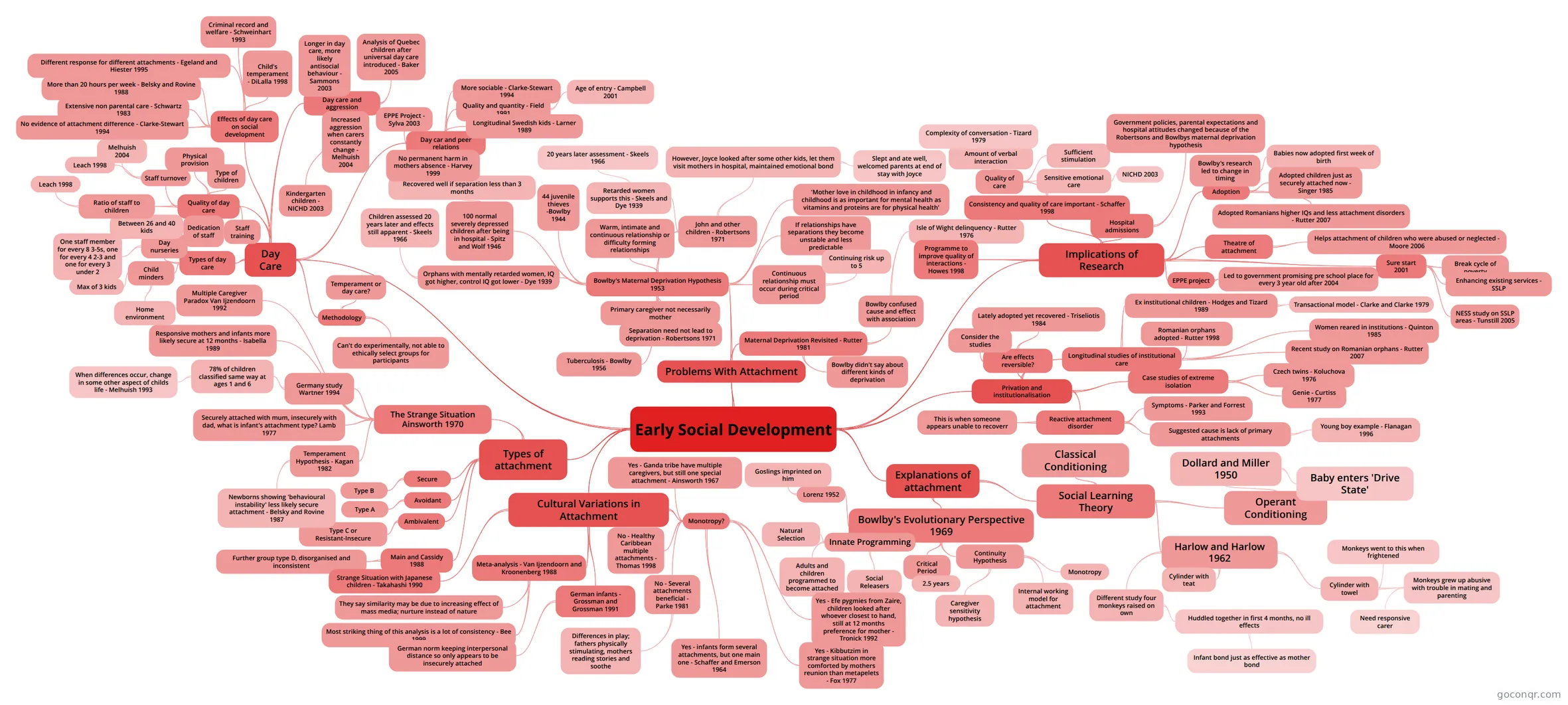
Mind map: Early social development
Contenido del mapa
Early Social Development
Explanations of attachment
- Social Learning Theory
- Classical Conditioning
- Operant Conditioning
- Dollard and Miller 1950
- Baby enters 'Drive State'
- Dollard and Miller 1950
- Harlow and Harlow 1962
- Cylinder with towel
- Monkeys went to this when frightened
- Monkeys grew up abusive with trouble in mating and parenting
- Need responsive carer
- Cylinder with teat
- Different study four monkeys raised on own
- Huddled together in first 4 months, no ill effects
- Infant bond just as effective as mother bond
- Huddled together in first 4 months, no ill effects
- Cylinder with towel
- Bowlby's Evolutionary Perspective 1969
- Innate Programming
- Natural Selection
- Adults and children programmed to become attached
- Social Releasers
- Critical Period
- 2.5 years
- Continuity Hypothesis
- Monotropy
- Internal working model for attachment
- Caregiver sensitivity hypothesis
- Lorenz 1952
- Goslings imprinted on him
- Innate Programming
- Social Learning Theory
Types of attachment
- The Strange Situation Ainsworth 1970
- Germany study Wartner 1994
- 78% of children classified same way at ages 1 and 6
- When differences occur, change in some other aspect of childs life - Melhuish 1993
- 78% of children classified same way at ages 1 and 6
- Securely attached with mum, insecurely with dad, what is infant's attachment type? Lamb 1977
- Multiple Caregiver Paradox Van Ijzendoorn 1992
- Responsive mothers and infants more likely secure at 12 months - Isabella 1989
- Temperament Hypothesis - Kagan 1982
- Newborns showing 'behavioural instability' less likely secure attachment - Belsky and Rovine 1987
- Germany study Wartner 1994
- Secure
- Type B
- Avoidant
- Type A
- Ambivalent
- Type C or Resistant-Insecure
- Main and Cassidy 1988
- Further group type D, disorganised and inconsistent
- The Strange Situation Ainsworth 1970
Cultural Variations in Attachment
- Strange Situation with Japanese children - Takahashi 1990
- Meta-analysis - Van Ijzendoorn and Kroonenberg 1988
- Most striking thing of this analysis is a lot of consistency - Bee 1999
- They say similarity may be due to increasing effect of mass media; nurture instead of nature
- German infants - Grossman and Grossman 1991
- German norm keeping interpersonal distance so only appears to be insecurely attached
- Monotropy?
- No - Healthy Caribbean multiple attachments - Thomas 1998
- No - Several attachments beneficial - Parke 1981
- Differences in play; fathers physically stimulating, mothers reading stories and soothe
- Yes - infants form several attachments, but one main one - Schaffer and Emerson 1964
- Yes - Ganda tribe have multiple caregivers, but still one special attachment - Ainsworth 1967
- Yes - Efe pygmies from Zaire, children looked after whoever closest to hand, still at 12 months preference for mother - Tronick 1992
- Yes - Kibbutzim in strange situation more comforted by mothers reunion than metapelets - Fox 1977
Problems With Attachment
- Bowlby's Maternal Deprivation Hypothesis 1953
- Warm, intimate and continuous relationship or difficulty forming relationships
- If relationships have separations they become unstable and less predictable
- Continuous relationship must occur during critical period
- Continuing risk up to 5
- Primary caregiver not necessarily mother
- 'Mother love in childhood in infancy and childhood is as important for mental health as vitamins and proteins are for physical health'
- 44 juvenile thieves -Bowlby 1944
- Separation need not lead to deprivation - Robertsons 1971
- 100 normal severely depressed children after being in hospital - Spitz and Wolf 1946
- Recovered well if separation less than 3 months
- John and other children - Robertsons 1971
- However, Joyce looked after some other kids, let them visit mothers in hospital, maintained emotional bond
- Slept and ate well, welcomed parents at end of stay with Joyce
- Retarded women supports this - Skeels and Dye 1939
- 20 years later assessment - Skeels 1966
- However, Joyce looked after some other kids, let them visit mothers in hospital, maintained emotional bond
- Orphans with mentally retarded women, IQ got higher, control IQ got lower - Dye 1939
- Children assessed 20 years later and effects still apparent - Skeels 1966
- Tuberculosis - Bowlby 1956
- Maternal Deprivation Revisited - Rutter 1981
- Bowlby confused cause and effect with association
- Isle of Wight delinquency - Rutter 1976
- Bowlby didn't say about different kinds of deprivation
- Bowlby confused cause and effect with association
- Bowlby's Maternal Deprivation Hypothesis 1953
Day Care
- Methodology
- Can't do experimentally, not able to ethically select groups for participants
- Temperament or day care?
- Types of day care
- Day nurseries
- Between 26 and 40 kids
- One staff member for every 8 3-5s, one for every 4 2-3 and one for every 3 under 2
- Child minders
- Max of 3 kids
- Home environment
- Day nurseries
- Quality of day care
- Ratio of staff to children
- Leach 1998
- Staff turnover
- Leach 1998
- Melhuish 2004
- Physical provision
- Staff training
- Dedication of staff
- Type of children
- Ratio of staff to children
- Effects of day care on social development
- No evidence of attachment difference - Clarke-Stewart 1994
- Extensive non parental care - Schwartz 1983
- More than 20 hours per week - Belsky and Rovine 1988
- Different response for different attachments - Egeland and Hiester 1995
- Child's temperament - DiLalla 1998
- Criminal record and welfare - Schweinhart 1993
- Day care and aggression
- Longer in day care, more likely antisocial behaviour - Sammons 2003
- Increased aggression when carers constantly change - Melhuish 2004
- Kindergarten children - NICHD 2003
- Analysis of Quebec children after universal day care introduced - Baker 2005
- Day car and peer relations
- EPPE Project - Sylva 2003
- More sociable - Clarke-Stewart 1994
- No permanent harm in mothers absence - Harvey 1999
- Quality and quantity - Field 1991
- Age of entry - Campbell 2001
- Longitudinal Swedish kids - Larner 1989
- Methodology
Implications of Research
- Consistency and quality of care important - Schaffer 1998
- Quality of care
- Amount of verbal interaction
- Complexity of conversation - Tizard 1979
- Sufficient stimulation
- Sensitive emotional care
- NICHD 2003
- Amount of verbal interaction
- Quality of care
- Programme to improve quality of interactions - Howes 1998
- Hospital admissions
- Government policies, parental expectations and hospital attitudes changed because of the Robertsons and Bowlbys maternal deprivation hypothesis
- Adoption
- Bowlby's research led to change in timing
- Babies now adopted first week of birth
- Adopted children just as securely attached now - Singer 1985
- Adopted Romanians higher IQs and less attachment disorders - Rutter 2007
- Bowlby's research led to change in timing
- Theatre of attachment
- Helps attachment of children who were abused or neglected - Moore 2006
- Sure start 2001
- Break cycle of poverty
- Enhancing existing services - SSLP
- NESS study on SSLP areas - Tunstill 2005
- EPPE project
- Led to government promising pre school place for every 3 year old after 2004
- Consistency and quality of care important - Schaffer 1998
Privation and institutionalisation
- Longitudinal studies of institutional care
- Ex institutional children - Hodges and Tizard 1989
- Transactional model - Clarke and Clarke 1979
- Romanian orphans adopted - Rutter 1998
- Women reared in institutions - Quinton 1985
- Recent study on Romanian orphans - Rutter 2007
- Ex institutional children - Hodges and Tizard 1989
- Case studies of extreme isolation
- Czech twins - Koluchova 1976
- Genie - Curtiss 1977
- Reactive attachment disorder
- This is when someone appears unable to recoverr
- Symptoms - Parker and Forrest 1993
- Suggested cause is lack of primary attachments
- Young boy example - Flanagan 1996
- Are effects reversible?
- Lately adopted yet recovered - Triseliotis 1984
- Consider the studies
- Longitudinal studies of institutional care
Información
- Descripción
- Mapa Mental sobre Early Social Development, creado por tom4413 el 22/04/2013.
- Creado por
- tom4413
- Visitas
- 76
- Valoración