
Mapa mental
Muscular system
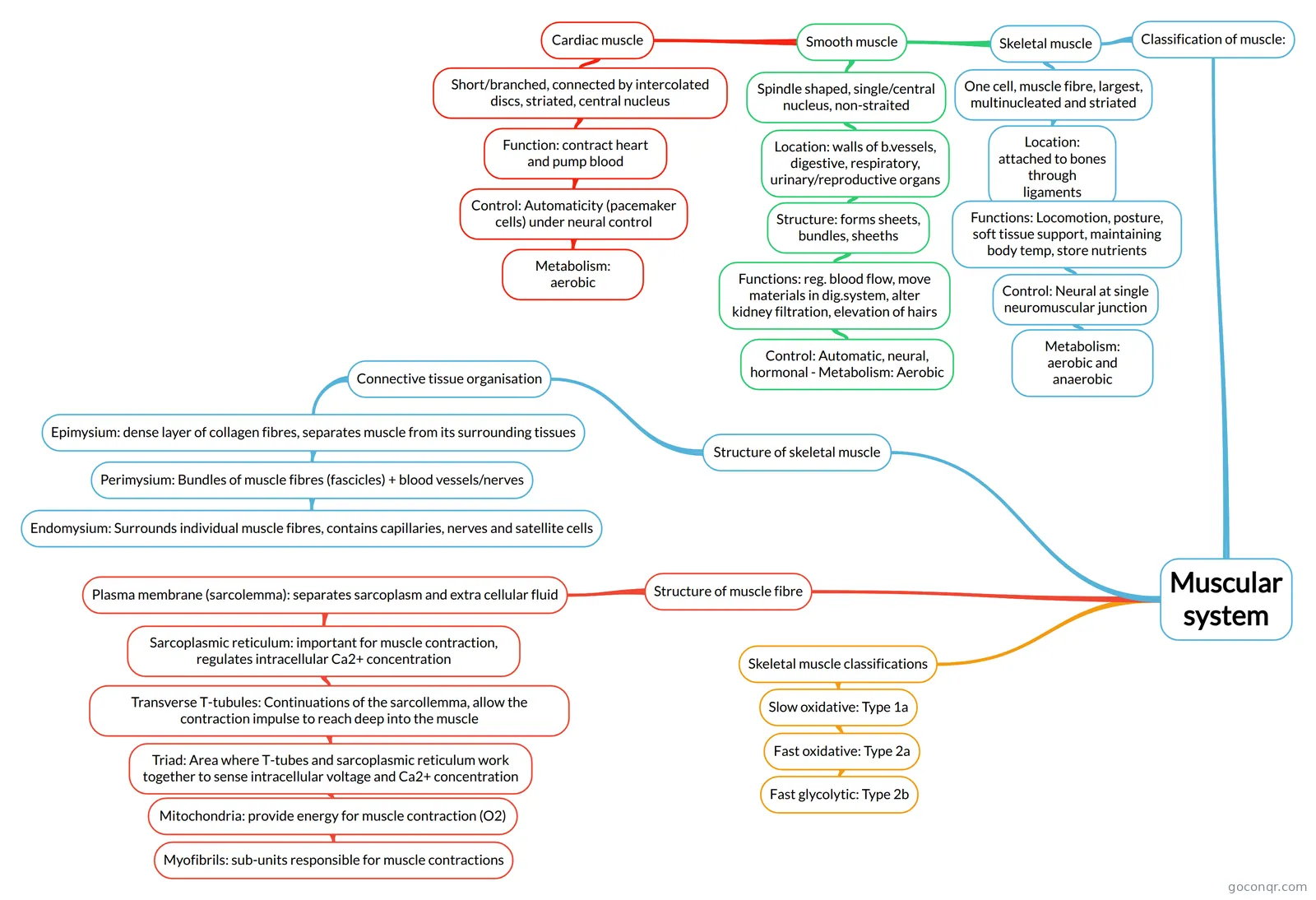
Mind map: Muscular system
Contenido del mapa
Muscular system
Classification of muscle:
- Skeletal muscle
- Smooth muscle
- Cardiac muscle
- Short/branched, connected by intercolated discs, striated, central nucleus
- Function: contract heart and pump blood
- Control: Automaticity (pacemaker cells) under neural control
- Metabolism: aerobic
- Control: Automaticity (pacemaker cells) under neural control
- Function: contract heart and pump blood
- Short/branched, connected by intercolated discs, striated, central nucleus
- Spindle shaped, single/central nucleus, non-straited
- Location: walls of b.vessels, digestive, respiratory, urinary/reproductive organs
- Structure: forms sheets, bundles, sheeths
- Functions: reg. blood flow, move materials in dig.system, alter kidney filtration, elevation of hairs
- Control: Automatic, neural, hormonal - Metabolism: Aerobic
- Functions: reg. blood flow, move materials in dig.system, alter kidney filtration, elevation of hairs
- Structure: forms sheets, bundles, sheeths
- Location: walls of b.vessels, digestive, respiratory, urinary/reproductive organs
- Cardiac muscle
- One cell, muscle fibre, largest, multinucleated and striated
- Location: attached to bones through ligaments
- Functions: Locomotion, posture, soft tissue support, maintaining body temp, store nutrients
- Control: Neural at single neuromuscular junction
- Metabolism: aerobic and anaerobic
- Control: Neural at single neuromuscular junction
- Functions: Locomotion, posture, soft tissue support, maintaining body temp, store nutrients
- Location: attached to bones through ligaments
- Smooth muscle
- Skeletal muscle
Structure of skeletal muscle
- Connective tissue organisation
- Epimysium: dense layer of collagen fibres, separates muscle from its surrounding tissues
- Perimysium: Bundles of muscle fibres (fascicles) + blood vessels/nerves
- Endomysium: Surrounds individual muscle fibres, contains capillaries, nerves and satellite cells
- Perimysium: Bundles of muscle fibres (fascicles) + blood vessels/nerves
- Epimysium: dense layer of collagen fibres, separates muscle from its surrounding tissues
- Connective tissue organisation
Structure of muscle fibre
- Plasma membrane (sarcolemma): separates sarcoplasm and extra cellular fluid
- Sarcoplasmic reticulum: important for muscle contraction, regulates intracellular Ca2+ concentration
- Transverse T-tubules: Continuations of the sarcollemma, allow the contraction impulse to reach deep into the muscle
- Triad: Area where T-tubes and sarcoplasmic reticulum work together to sense intracellular voltage and Ca2+ concentration
- Mitochondria: provide energy for muscle contraction (O2)
- Myofibrils: sub-units responsible for muscle contractions
- Mitochondria: provide energy for muscle contraction (O2)
- Triad: Area where T-tubes and sarcoplasmic reticulum work together to sense intracellular voltage and Ca2+ concentration
- Transverse T-tubules: Continuations of the sarcollemma, allow the contraction impulse to reach deep into the muscle
- Sarcoplasmic reticulum: important for muscle contraction, regulates intracellular Ca2+ concentration
- Plasma membrane (sarcolemma): separates sarcoplasm and extra cellular fluid
Skeletal muscle classifications
- Slow oxidative: Type 1a
- Fast oxidative: Type 2a
- Fast glycolytic: Type 2b
- Fast oxidative: Type 2a
- Slow oxidative: Type 1a
Información
- Descripción
- undergrad PHYSIOLOGY Mapa Mental sobre Muscular system, creado por daniel martin8992 el 12/05/2016.
- Creado por
- daniel martin8992
- Visitas
- 1
- Valoración