
Mapa mental
Psychology research methods
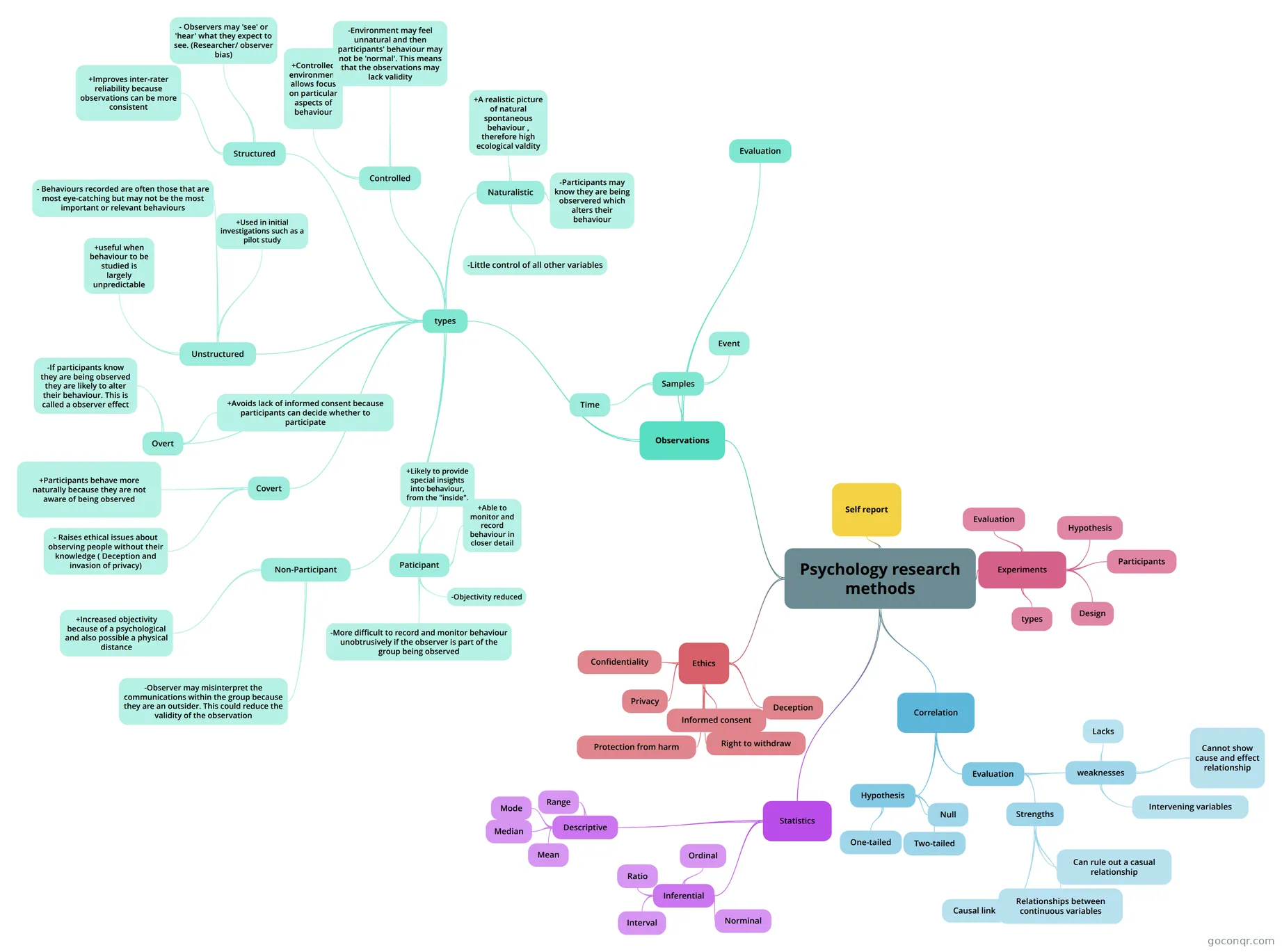
Mind map: Psychology research methods
Contenido del mapa
Psychology research methods
Correlation
- A method used to asses the degree to which two co-variables are related. The term is used to refer to a study that uses a correlational analysis
- Evaluation
- Strengths
- Relationships between continuous variables
- Can look at the relationships between continuous variables rather than the differences
- Can rule out a casual relationship
- If the correlation is not strong then you can rule out a casual relationship. You can't demonstrate a casual relationship but if there's no correlation between co-variables then there can't be a casual relationship
- Causal link
- If the correlation is strong then further investigation is justified because there may be a causal link
- Relationships between continuous variables
- weaknesses
- Cannot show cause and effect relationship
- Cannot show a cause and effect relationship. People often misinterpret correlations and assume that a cause and effect have been found whereas this is not possible
- Intervening variables
- There may be intervening variables that can explain why the co-variables being studied are links. For example, research studies have shown a positive correlation between amount of TV watched and aggressiveness. However, it is wrong to conclude that watching TV is directly related to aggressiveness because it could be that a low boredom threshold was the cause of both of them.
- Lacks
- The method used to measure either co-variable may lack reliability or validity
- Cannot show cause and effect relationship
- Strengths
- Hypothesis
- One-tailed
- "There is a positive relationship between ...."
- Two-tailed
- "There is a relationship between..."
- Null
- "There is no relationship between..."
- One-tailed
Experiments
- types
- Design
- Evaluation
- Hypothesis
- Participants
Self report
Observations
- Samples
- Event
- Draw up a list of behavioural categories. Then count every time each of the behaviours occurs in a specific time period
- Time
- Recording behaviours at regular intervals (every minutes for 30 minutes) or taking a sample at different times of the day
- Event
- types
- Controlled
- Some variables are changed by the research e.g in a lab
- +Controlled environment allows focus on particular aspects of behaviour
- -Environment may feel unnatural and then participants' behaviour may not be 'normal'. This means that the observations may lack validity
- Naturalistic
- Everything is left as usual. Environment unstructured but may use structured techniques
- -Participants may know they are being observered which alters their behaviour
- -Little control of all other variables
- +A realistic picture of natural spontaneous behaviour , therefore high ecological valdity
- Structured
- - Observers may 'see' or 'hear' what they expect to see. (Researcher/ observer bias)
- +Improves inter-rater reliability because observations can be more consistent
- Unstructured
- +useful when behaviour to be studied is largely unpredictable
- +Used in initial investigations such as a pilot study
- - Behaviours recorded are often those that are most eye-catching but may not be the most important or relevant behaviours
- Non-Participant
- +Increased objectivity because of a psychological and also possible a physical distance
- -Observer may misinterpret the communications within the group because they are an outsider. This could reduce the validity of the observation
- Paticipant
- +Likely to provide special insights into behaviour, from the "inside".
- +Able to monitor and record behaviour in closer detail
- -Objectivity reduced
- -More difficult to record and monitor behaviour unobtrusively if the observer is part of the group being observed
- Covert
- +Participants behave more naturally because they are not aware of being observed
- - Raises ethical issues about observing people without their knowledge ( Deception and invasion of privacy)
- Overt
- +Avoids lack of informed consent because participants can decide whether to participate
- -If participants know they are being observed they are likely to alter their behaviour. This is called a observer effect
- Controlled
- Evaluation
- Samples
Ethics
- Confidentiality
- Deception
- Informed consent
- Privacy
- Right to withdraw
- Protection from harm
Statistics
- Descriptive
- Mean
- Mode
- Range
- Median
- Inferential
- Norminal
- Ordinal
- Interval
- Ratio
- Descriptive
Información
- Descripción
- AS level Psychology Mapa Mental sobre Psychology research methods, creado por Grace White el 15/11/2016.
- Creado por
- Grace White
- Visitas
- 0
- Valoración