
Mapa mental
Operant conditioning
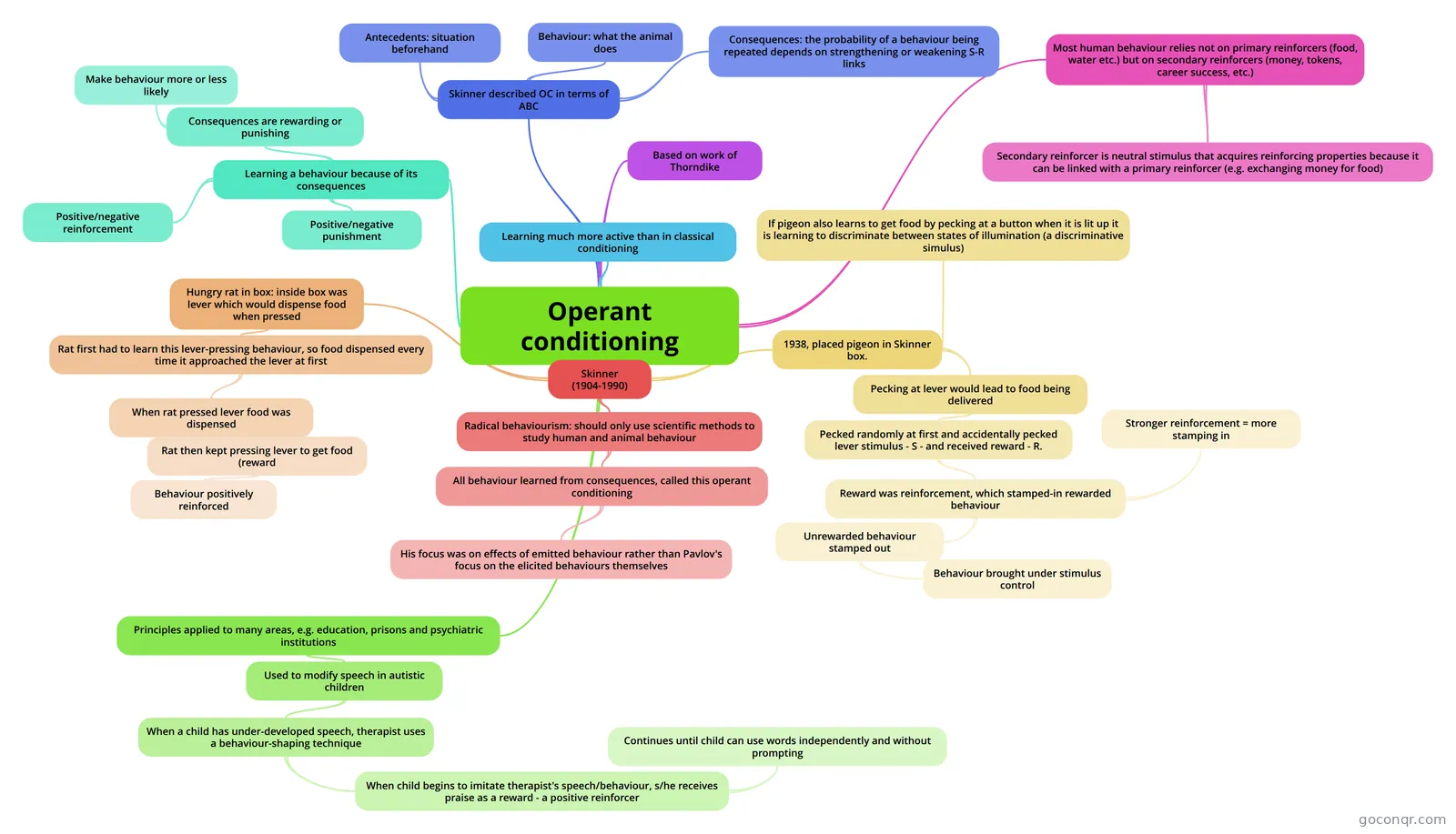
Mind map: operant conditioning
Contenido del mapa
Operant conditioning
Learning much more active than in classical conditioning
Based on work of Thorndike
Learning a behaviour because of its consequences
- Consequences are rewarding or punishing
- Make behaviour more or less likely
- Positive/negative reinforcement
- Positive/negative punishment
- Consequences are rewarding or punishing
Skinner (1904-1990)
- Radical behaviourism: should only use scientific methods to study human and animal behaviour
- All behaviour learned from consequences, called this operant conditioning
- His focus was on effects of emitted behaviour rather than Pavlov's focus on the elicited behaviours themselves
- All behaviour learned from consequences, called this operant conditioning
- 1938, placed pigeon in Skinner box.
- Pecking at lever would lead to food being delivered
- Pecked randomly at first and accidentally pecked lever stimulus - S - and received reward - R.
- Reward was reinforcement, which stamped-in rewarded behaviour
- Unrewarded behaviour stamped out
- Behaviour brought under stimulus control
- Stronger reinforcement = more stamping in
- Unrewarded behaviour stamped out
- Reward was reinforcement, which stamped-in rewarded behaviour
- Pecked randomly at first and accidentally pecked lever stimulus - S - and received reward - R.
- If pigeon also learns to get food by pecking at a button when it is lit up it is learning to discriminate between states of illumination (a discriminative simulus)
- Pecking at lever would lead to food being delivered
- Hungry rat in box: inside box was lever which would dispense food when pressed
- Rat first had to learn this lever-pressing behaviour, so food dispensed every time it approached the lever at first
- When rat pressed lever food was dispensed
- Rat then kept pressing lever to get food (reward
- Behaviour positively reinforced
- Rat then kept pressing lever to get food (reward
- When rat pressed lever food was dispensed
- Rat first had to learn this lever-pressing behaviour, so food dispensed every time it approached the lever at first
- Radical behaviourism: should only use scientific methods to study human and animal behaviour
Skinner described OC in terms of ABC
- Antecedents: situation beforehand
- Behaviour: what the animal does
- Consequences: the probability of a behaviour being repeated depends on strengthening or weakening S-R links
Most human behaviour relies not on primary reinforcers (food, water etc.) but on secondary reinforcers (money, tokens, career success, etc.)
- Secondary reinforcer is neutral stimulus that acquires reinforcing properties because it can be linked with a primary reinforcer (e.g. exchanging money for food)
Principles applied to many areas, e.g. education, prisons and psychiatric institutions
- Used to modify speech in autistic children
- When a child has under-developed speech, therapist uses a behaviour-shaping technique
- When child begins to imitate therapist's speech/behaviour, s/he receives praise as a reward - a positive reinforcer
- Continues until child can use words independently and without prompting
- When child begins to imitate therapist's speech/behaviour, s/he receives praise as a reward - a positive reinforcer
- When a child has under-developed speech, therapist uses a behaviour-shaping technique
- Used to modify speech in autistic children
Información
- Descripción
- A Levels Psychology Mapa Mental sobre Operant conditioning, creado por Greenbird el 04/04/2014.
- Creado por
- Greenbird
- Visitas
- 569
- Etiquetas
- Valoración