
Mapa mental
Ch. 19- Descent with Modification
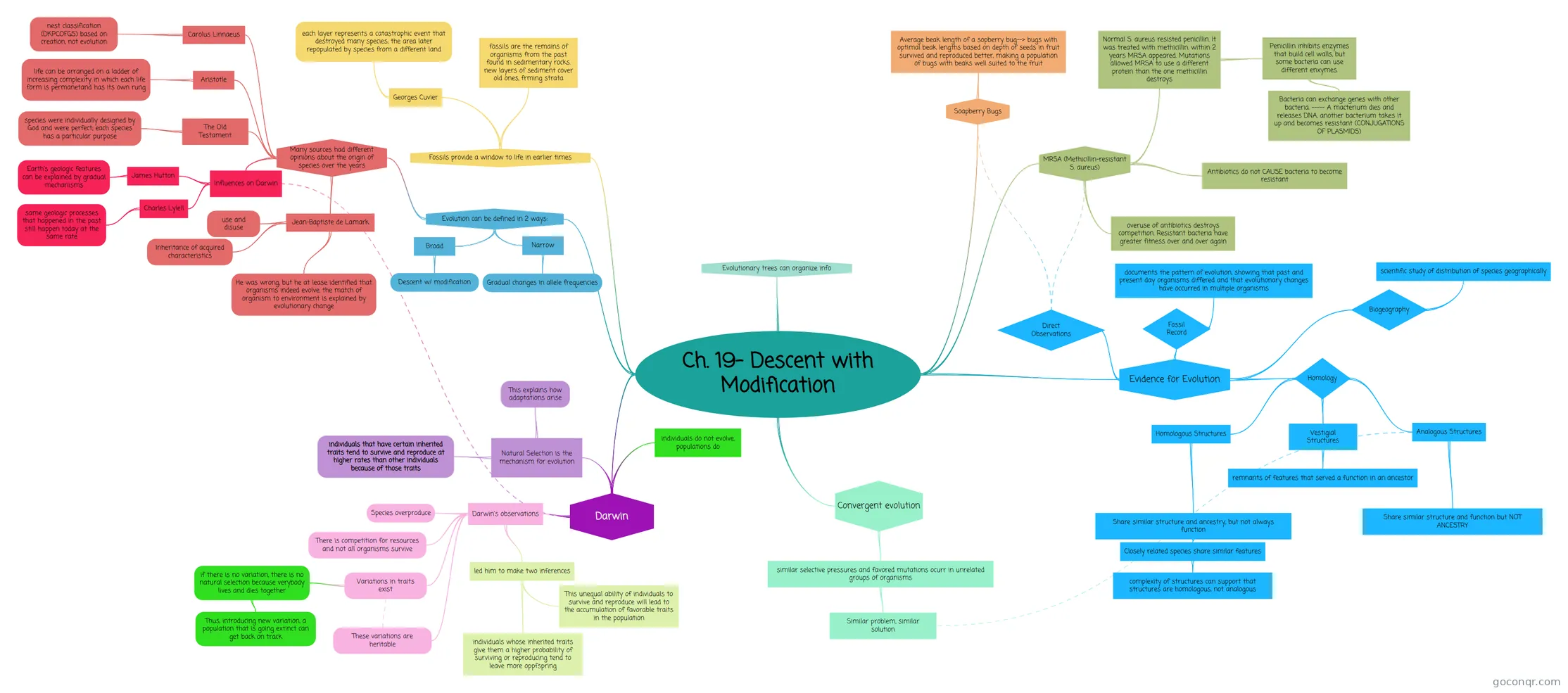
Mind map: Descent with modification
Contenido del mapa
Ch. 19- Descent with Modification
Evolution can be defined in 2 ways:
- Broad
- Descent w/ modification
- Narrow
- Gradual changes in allele frequencies
- Many sources had different opinions about the origin of species over the years
- Aristotle
- life can be arranged on a ladder of increasing complexity in which each life form is permanetand has its own rung
- The Old Testament
- species were individually designed by God and were perfect; each species has a particular purpose
- Carolus Linnaeus
- nest classification (DKPCOFGS) based on creation, not evolution
- Influences on Darwin
- James Hutton
- Earth's geologic features can be explained by gradual mechanisms
- Charles Lylell
- same geologic processes that happened in the past still happen today at the same rate
- James Hutton
- Jean-Baptiste de Lamark
- use and disuse
- Inheritance of acquired characteristics
- He was wrong, but he at lease identified that organisms indeed evolve. the match of organism to environment is explained by evolutionary change
- Aristotle
- Broad
Fossils provide a window to life in earlier times
- Georges Cuvier
- each layer represents a catastrophic event that destroyed many species; the area later repopulated by species from a different land
- fossils are the remains of organisms from the past found in sedimentary rocks. new layers of sediment cover old ones, frming strata
- Georges Cuvier
Darwin
- Natural Selection is the mechanism for evolution
- individuals that have certain inherited traits tend to survive and reproduce at higher rates than other individuals because of those traits
- This explains how adaptations arise
- Darwin's observations
- Variations in traits exist
- if there is no variation, there is no natural selection because verybody lives and dies together
- Thus, introducing new variation, a population that is going extinct can get back on track
- if there is no variation, there is no natural selection because verybody lives and dies together
- These variations are heritable
- Species overproduce
- There is competition for resources and not all organisms survive
- led him to make two inferences
- individuals whose inherited traits give them a higher probability of surviving or reproducing tend to leave more oppfspring
- This unequal ability of individuals to survive and reproduce will lead to the accumulation of favorable traits in the population
- Variations in traits exist
- individuals do not evolve, populations do
- Natural Selection is the mechanism for evolution
Soapberry Bugs
- Average beak length of a sopberry bug--> bugs with optimal beak lengths based on depth of seeds in fruit survived and reproduced better, making a population of bugs with beaks well suited to the fruit
MRSA (Methicillin-resistant S. aureus)
- Normal S. aureus resisted penicillin. It was treated with methicillin. within 2 years MRSA appeared. Mutations allowed MRSA to use a different protein than the one methicillin destroys
- Penicillin inhibits enzymes that build cell walls, but some bacteria can use different enxymes.
- Bacteria can exchange genes with other bacteria. ----- A macterium dies and releases DNA, another bacterium takes it up and becomes resistant (CONJUGATIONS OF PLASMIDS)
- Penicillin inhibits enzymes that build cell walls, but some bacteria can use different enxymes.
- Antibiotics do not CAUSE bacteria to become resistant
- overuse of antibiotics destroys competition. Resistant bacteria have greater fitness over and over again
- Normal S. aureus resisted penicillin. It was treated with methicillin. within 2 years MRSA appeared. Mutations allowed MRSA to use a different protein than the one methicillin destroys
Evidence for Evolution
- Fossil Record
- documents the pattern of evolution, showing that past and present day organisms differed and that evolutionary changes have occurred in multiple organisms
- Homology
- Homologous Structures
- Share similar structure and ancestry, but not always function
- Closely related species share similar features
- complexity of structures can support that structures are homologous, not analogous
- Closely related species share similar features
- Share similar structure and ancestry, but not always function
- Vestigial Structures
- remnants of features that served a function in an ancestor
- Analogous Structures
- Share similar structure and function but NOT ANCESTRY
- Homologous Structures
- Direct Observations
- Biogeography
- scientific study of distribution of species geographically
- Fossil Record
Evolutionary trees can organize info
Convergent evolution
- similar selective pressures and favored mutations ocurr in unrelated groups of organisms
- Similar problem, similar solution
- similar selective pressures and favored mutations ocurr in unrelated groups of organisms
Información
- Descripción
- AP (Unit 6- Evolution) Biology Mapa Mental sobre Ch. 19- Descent with Modification, creado por Luke Detlor el 22/02/2017.
- Creado por
- Luke Detlor
- Visitas
- 11
- Valoración