
Mapa mental
Forgetting
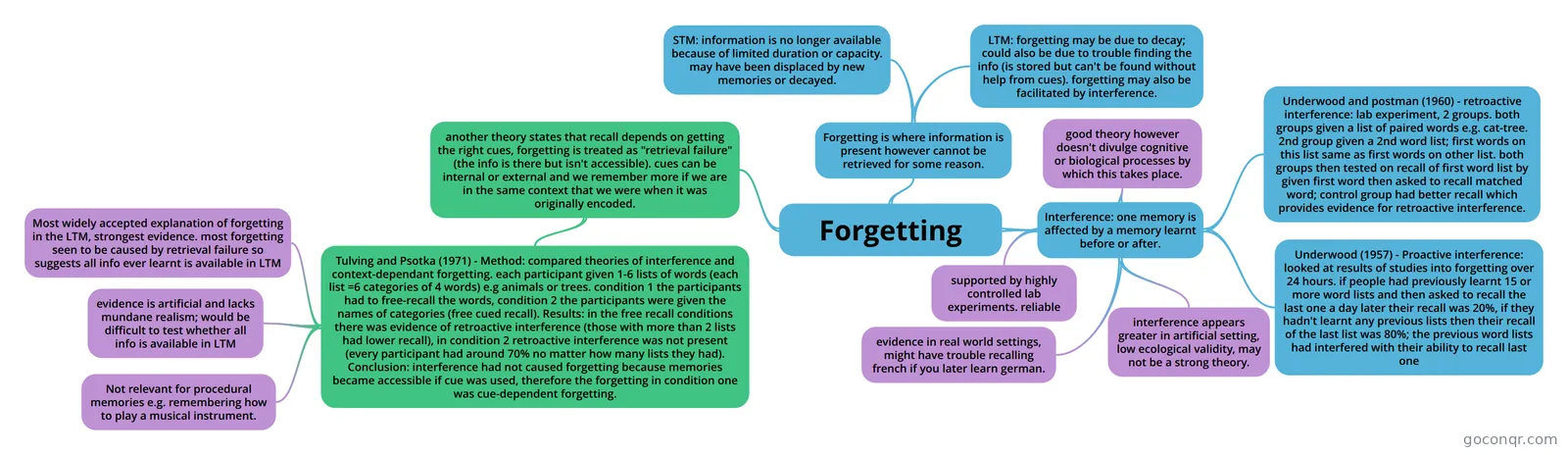
Mind map: Forgetting in memory
Contenido del mapa
Forgetting
Forgetting is where information is present however cannot be retrieved for some reason.
- STM: information is no longer available because of limited duration or capacity. may have been displaced by new memories or decayed.
- LTM: forgetting may be due to decay; could also be due to trouble finding the info (is stored but can't be found without help from cues). forgetting may also be facilitated by interference.
Interference: one memory is affected by a memory learnt before or after.
- Underwood and postman (1960) - retroactive interference: lab experiment, 2 groups. both groups given a list of paired words e.g. cat-tree. 2nd group given a 2nd word list; first words on this list same as first words on other list. both groups then tested on recall of first word list by given first word then asked to recall matched word; control group had better recall which provides evidence for retroactive interference.
- Underwood (1957) - Proactive interference: looked at results of studies into forgetting over 24 hours. if people had previously learnt 15 or more word lists and then asked to recall the last one a day later their recall was 20%, if they hadn't learnt any previous lists then their recall of the last list was 80%; the previous word lists had interfered with their ability to recall last one
- supported by highly controlled lab experiments. reliable
- evidence in real world settings, might have trouble recalling french if you later learn german.
- interference appears greater in artificial setting, low ecological validity, may not be a strong theory.
- good theory however doesn't divulge cognitive or biological processes by which this takes place.
another theory states that recall depends on getting the right cues, forgetting is treated as "retrieval failure" (the info is there but isn't accessible). cues can be internal or external and we remember more if we are in the same context that we were when it was originally encoded.
- Tulving and Psotka (1971) - Method: compared theories of interference and context-dependant forgetting. each participant given 1-6 lists of words (each list =6 categories of 4 words) e.g animals or trees. condition 1 the participants had to free-recall the words, condition 2 the participants were given the names of categories (free cued recall). Results: in the free recall conditions there was evidence of retroactive interference (those with more than 2 lists had lower recall), in condition 2 retroactive interference was not present (every participant had around 70% no matter how many lists they had). Conclusion: interference had not caused forgetting because memories became accessible if cue was used, therefore the forgetting in condition one was cue-dependent forgetting.
- Most widely accepted explanation of forgetting in the LTM, strongest evidence. most forgetting seen to be caused by retrieval failure so suggests all info ever learnt is available in LTM
- evidence is artificial and lacks mundane realism; would be difficult to test whether all info is available in LTM
- Not relevant for procedural memories e.g. remembering how to play a musical instrument.
- Tulving and Psotka (1971) - Method: compared theories of interference and context-dependant forgetting. each participant given 1-6 lists of words (each list =6 categories of 4 words) e.g animals or trees. condition 1 the participants had to free-recall the words, condition 2 the participants were given the names of categories (free cued recall). Results: in the free recall conditions there was evidence of retroactive interference (those with more than 2 lists had lower recall), in condition 2 retroactive interference was not present (every participant had around 70% no matter how many lists they had). Conclusion: interference had not caused forgetting because memories became accessible if cue was used, therefore the forgetting in condition one was cue-dependent forgetting.
Información
- Descripción
- A level (Memory) Psychology Mapa Mental sobre Forgetting, creado por Connor Hargrave el 07/04/2017.
- Creado por
- Connor Hargrave
- Visitas
- 0
- Valoración