
Mapa mental
Memory
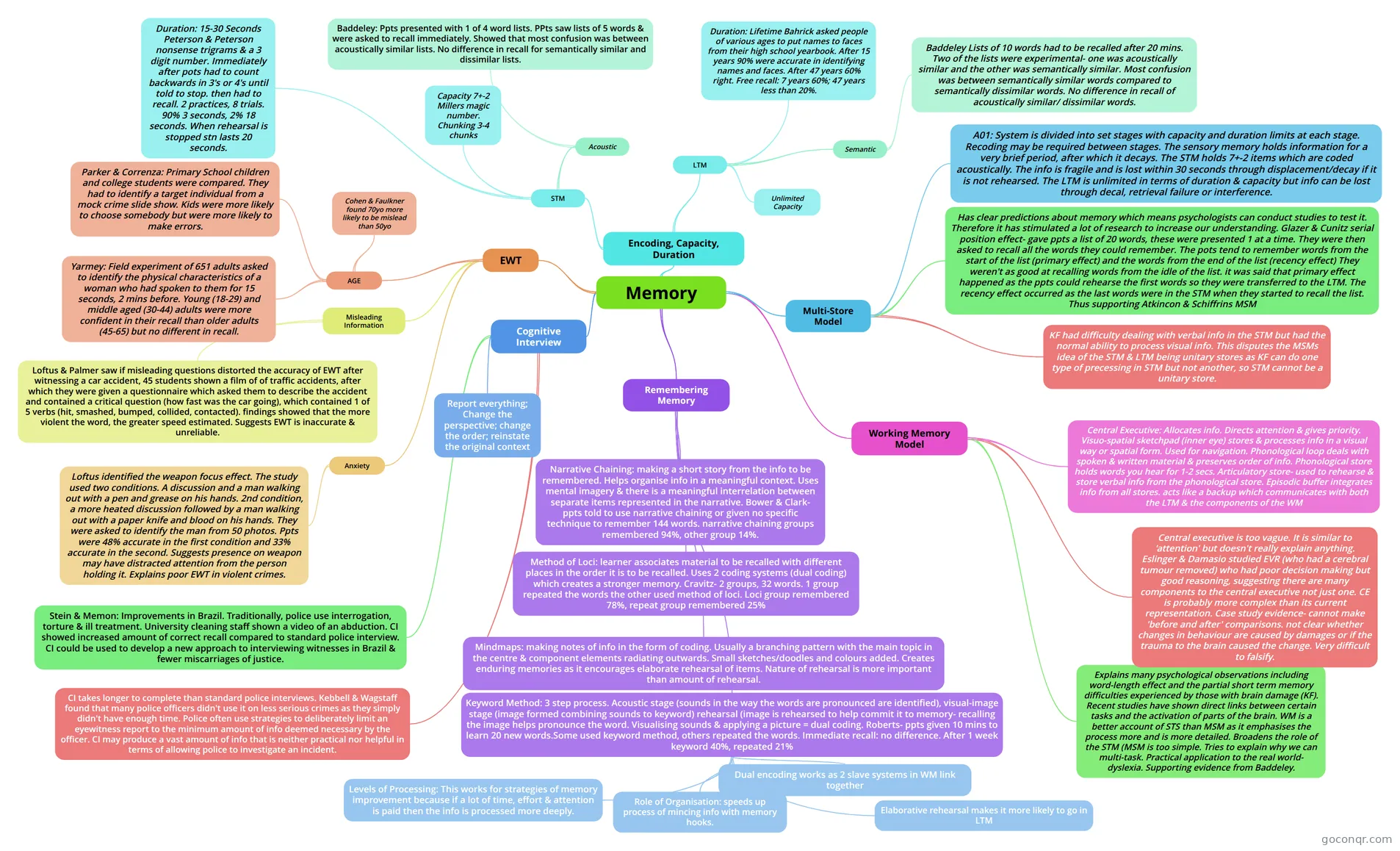
Mind map: Memory
Contenido del mapa
Memory
Encoding, Capacity, Duration
- LTM
- Semantic
- Baddeley Lists of 10 words had to be recalled after 20 mins. Two of the lists were experimental- one was acoustically similar and the other was semantically similar. Most confusion was between semantically similar words compared to semantically dissimilar words. No difference in recall of acoustically similar/ dissimilar words.
- Unlimited Capacity
- Duration: Lifetime Bahrick asked people of various ages to put names to faces from their high school yearbook. After 15 years 90% were accurate in identifying names and faces. After 47 years 60% right. Free recall: 7 years 60%; 47 years less than 20%.
- Semantic
- STM
- Acoustic
- Baddeley: Ppts presented with 1 of 4 word lists. PPts saw lists of 5 words & were asked to recall immediately. Showed that most confusion was between acoustically similar lists. No difference in recall for semantically similar and dissimilar lists.
- Capacity 7+-2 Millers magic number. Chunking 3-4 chunks
- Duration: 15-30 Seconds Peterson & Peterson nonsense trigrams & a 3 digit number. Immediately after pots had to count backwards in 3's or 4's until told to stop. then had to recall. 2 practices, 8 trials. 90% 3 seconds, 2% 18 seconds. When rehearsal is stopped stn lasts 20 seconds.
- Acoustic
- LTM
Multi-Store Model
- A01: System is divided into set stages with capacity and duration limits at each stage. Recoding may be required between stages. The sensory memory holds information for a very brief period, after which it decays. The STM holds 7+-2 items which are coded acoustically. The info is fragile and is lost within 30 seconds through displacement/decay if it is not rehearsed. The LTM is unlimited in terms of duration & capacity but info can be lost through decal, retrieval failure or interference.
- Has clear predictions about memory which means psychologists can conduct studies to test it. Therefore it has stimulated a lot of research to increase our understanding. Glazer & Cunitz serial position effect- gave ppts a list of 20 words, these were presented 1 at a time. They were then asked to recall all the words they could remember. The pots tend to remember words from the start of the list (primary effect) and the words from the end of the list (recency effect) They weren't as good at recalling words from the idle of the list. it was said that primary effect happened as the ppts could rehearse the first words so they were transferred to the LTM. The recency effect occurred as the last words were in the STM when they started to recall the list. Thus supporting Atkincon & Schiffrins MSM
- KF had difficulty dealing with verbal info in the STM but had the normal ability to process visual info. This disputes the MSMs idea of the STM & LTM being unitary stores as KF can do one type of precessing in STM but not another, so STM cannot be a unitary store.
EWT
- AGE
- Yarmey: Field experiment of 651 adults asked to identify the physical characteristics of a woman who had spoken to them for 15 seconds, 2 mins before. Young (18-29) and middle aged (30-44) adults were more confident in their recall than older adults (45-65) but no different in recall.
- Parker & Correnza: Primary School children and college students were compared. They had to identify a target individual from a mock crime slide show. Kids were more likely to choose somebody but were more likely to make errors.
- Cohen & Faulkner found 70yo more likely to be mislead than 50yo
- Anxiety
- Loftus identified the weapon focus effect. The study used two conditions. A discussion and a man walking out with a pen and grease on his hands. 2nd condition, a more heated discussion followed by a man walking out with a paper knife and blood on his hands. They were asked to identify the man from 50 photos. Ppts were 48% accurate in the first condition and 33% accurate in the second. Suggests presence on weapon may have distracted attention from the person holding it. Explains poor EWT in violent crimes.
- Misleading Information
- Loftus & Palmer saw if misleading questions distorted the accuracy of EWT after witnessing a car accident, 45 students shown a film of of traffic accidents, after which they were given a questionnaire which asked them to describe the accident and contained a critical question (how fast was the car going), which contained 1 of 5 verbs (hit, smashed, bumped, collided, contacted). findings showed that the more violent the word, the greater speed estimated. Suggests EWT is inaccurate & unreliable.
- AGE
Working Memory Model
- Central Executive: Allocates info. Directs attention & gives priority. Visuo-spatial sketchpad (inner eye) stores & processes info in a visual way or spatial form. Used for navigation. Phonological loop deals with spoken & written material & preserves order of info. Phonological store holds words you hear for 1-2 secs. Articulatory store- used to rehearse & store verbal info from the phonological store. Episodic buffer integrates info from all stores. acts like a backup which communicates with both the LTM & the components of the WM
- Explains many psychological observations including word-length effect and the partial short term memory difficulties experienced by those with brain damage (KF). Recent studies have shown direct links between certain tasks and the activation of parts of the brain. WM is a better account of STS than MSM as it emphasises the process more and is more detailed. Broadens the role of the STM (MSM is too simple. Tries to explain why we can multi-task. Practical application to the real world- dyslexia. Supporting evidence from Baddeley.
- Central executive is too vague. It is similar to 'attention' but doesn't really explain anything. Eslinger & Damasio studied EVR (who had a cerebral tumour removed) who had poor decision making but good reasoning, suggesting there are many components to the central executive not just one. CE is probably more complex than its current representation. Case study evidence- cannot make 'before and after' comparisons. not clear whether changes in behaviour are caused by damages or if the trauma to the brain caused the change. Very difficult to falsify.
Cognitive Interview
- Report everything; Change the perspective; change the order; reinstate the original context
- Stein & Memon: Improvements in Brazil. Traditionally, police use interrogation, torture & ill treatment. University cleaning staff shown a video of an abduction. CI showed increased amount of correct recall compared to standard police interview. CI could be used to develop a new approach to interviewing witnesses in Brazil & fewer miscarriages of justice.
- CI takes longer to complete than standard police interviews. Kebbell & Wagstaff found that many police officers didn't use it on less serious crimes as they simply didn't have enough time. Police often use strategies to deliberately limit an eyewitness report to the minimum amount of info deemed necessary by the officer. CI may produce a vast amount of info that is neither practical nor helpful in terms of allowing police to investigate an incident.
Remembering Memory
- Method of Loci: learner associates material to be recalled with different places in the order it is to be recalled. Uses 2 coding systems (dual coding) which creates a stronger memory. Cravitz- 2 groups, 32 words. 1 group repeated the words the other used method of loci. Loci group remembered 78%, repeat group remembered 25%
- Narrative Chaining: making a short story from the info to be remembered. Helps organise info in a meaningful context. Uses mental imagery & there is a meaningful interrelation between separate items represented in the narrative. Bower & Clark- ppts told to use narrative chaining or given no specific technique to remember 144 words. narrative chaining groups remembered 94%, other group 14%.
- Keyword Method: 3 step process. Acoustic stage (sounds in the way the words are pronounced are identified), visual-image stage (image formed combining sounds to keyword) rehearsal (image is rehearsed to help commit it to memory- recalling the image helps pronounce the word. Visualising sounds & applying a picture = dual coding. Roberts- ppts given 10 mins to learn 20 new words.Some used keyword method, others repeated the words. Immediate recall: no difference. After 1 week keyword 40%, repeated 21%
- Levels of Processing: This works for strategies of memory improvement because if a lot of time, effort & attention is paid then the info is processed more deeply.
- Role of Organisation: speeds up process of mincing info with memory hooks.
- Dual encoding works as 2 slave systems in WM link together
- Elaborative rehearsal makes it more likely to go in LTM
- Mindmaps: making notes of info in the form of coding. Usually a branching pattern with the main topic in the centre & component elements radiating outwards. Small sketches/doodles and colours added. Creates enduring memories as it encourages elaborate rehearsal of items. Nature of rehearsal is more important than amount of rehearsal.
Información
- Descripción
- Mapa Mental sobre Memory, creado por Hannah Wood el 10/05/2014.
- Creado por
- Hannah Wood
- Visitas
- 27
- Valoración