
Mapa mental
EYEWITNESS TESTIMONY EVALUATION
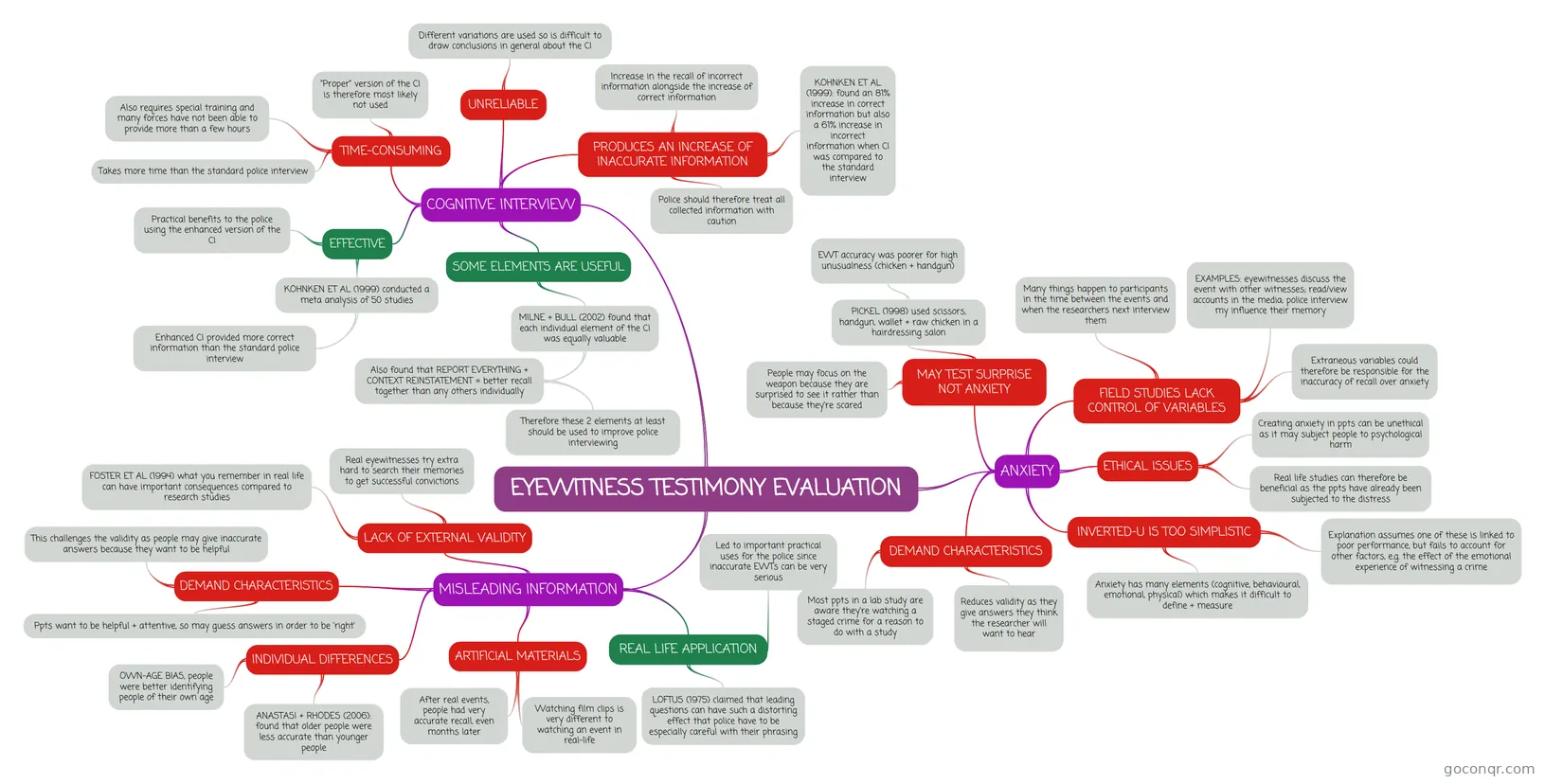
Mind map: Eyewitness testimony evaluation
Contenido del mapa
EYEWITNESS TESTIMONY EVALUATION
ANXIETY
- MAY TEST SURPRISE NOT ANXIETY
- People may focus on the weapon because they are surprised to see it rather than because they're scared
- PICKEL (1998) used scissors, handgun, wallet + raw chicken in a hairdressing salon
- EWT accuracy was poorer for high unusualness (chicken + handgun)
- FIELD STUDIES LACK CONTROL OF VARIABLES
- Many things happen to participants in the time between the events and when the researchers next interview them
- EXAMPLES: eyewitnesses discuss the event with other witnesses; read/view accounts in the media; police interview my influence their memory
- Extraneous variables could therefore be responsible for the inaccuracy of recall over anxiety
- ETHICAL ISSUES
- Creating anxiety in ppts can be unethical as it may subject people to psychological harm
- Real life studies can therefore be beneficial as the ppts have already been subjected to the distress
- INVERTED-U IS TOO SIMPLISTIC
- Anxiety has many elements (cognitive, behavioural, emotional, physical) which makes it difficult to define + measure
- Explanation assumes one of these is linked to poor performance, but fails to account for other factors, e.g. the effect of the emotional experience of witnessing a crime
- DEMAND CHARACTERISTICS
- Most ppts in a lab study are aware they're watching a staged crime for a reason to do with a study
- Reduces validity as they give answers they think the researcher will want to hear
- MAY TEST SURPRISE NOT ANXIETY
MISLEADING INFORMATION
- REAL LIFE APPLICATION
- Led to important practical uses for the police since inaccurate EWTs can be very serious
- LOFTUS (1975) claimed that leading questions can have such a distorting effect that police have to be especially careful with their phrasing
- ARTIFICIAL MATERIALS
- Watching film clips is very different to watching an event in real-life
- After real events, people had very accurate recall, even months later
- INDIVIDUAL DIFFERENCES
- ANASTASI + RHODES (2006): found that older people were less accurate than younger people
- OWN-AGE BIAS, people were better identifying people of their own age
- DEMAND CHARACTERISTICS
- Ppts want to be helpful + attentive, so may guess answers in order to be 'right'
- This challenges the validity as people may give inaccurate answers because they want to be helpful
- LACK OF EXTERNAL VALIDITY
- FOSTER ET AL (1994) what you remember in real life can have important consequences compared to research studies
- Real eyewitnesses try extra hard to search their memories to get successful convictions
- REAL LIFE APPLICATION
COGNITIVE INTERVIEW
- SOME ELEMENTS ARE USEFUL
- MILNE + BULL (2002) found that each individual element of the CI was equally valuable
- Also found that REPORT EVERYTHING + CONTEXT REINSTATEMENT = better recall together than any others individually
- Therefore these 2 elements at least should be used to improve police interviewing
- Also found that REPORT EVERYTHING + CONTEXT REINSTATEMENT = better recall together than any others individually
- MILNE + BULL (2002) found that each individual element of the CI was equally valuable
- EFFECTIVE
- KOHNKEN ET AL (1999) conducted a meta analysis of 50 studies
- Enhanced CI provided more correct information than the standard police interview
- Practical benefits to the police using the enhanced version of the CI
- KOHNKEN ET AL (1999) conducted a meta analysis of 50 studies
- TIME-CONSUMING
- Takes more time than the standard police interview
- Also requires special training and many forces have not been able to provide more than a few hours
- "Proper" version of the CI is therefore most likely not used
- UNRELIABLE
- Different variations are used so is difficult to draw conclusions in general about the CI
- PRODUCES AN INCREASE OF INACCURATE INFORMATION
- Increase in the recall of incorrect information alongside the increase of correct information
- KOHNKEN ET AL (1999): found an 81% increase in correct information but also a 61% increase in incorrect information when CI was compared to the standard interview
- Police should therefore treat all collected information with caution
- SOME ELEMENTS ARE USEFUL
Información
- Descripción
- A2 (Memory) Psychology Mapa Mental sobre EYEWITNESS TESTIMONY EVALUATION, creado por Albie Quelcuti el 15/05/2017.
- Creado por
- Albie Quelcuti
- Visitas
- 41
- Etiquetas
- Valoración