
Mapa mental
Evolution
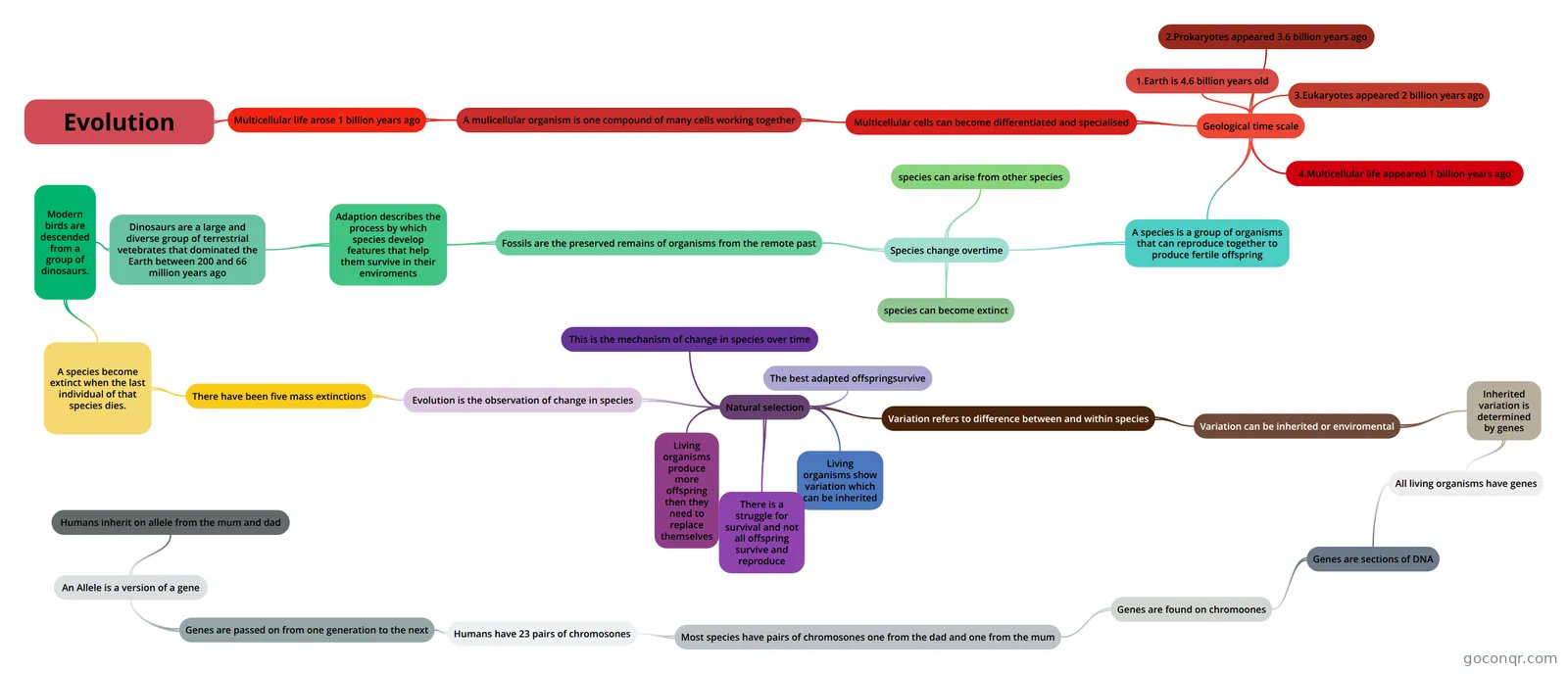
Mind map: evolution and multicellular life
Contenido del mapa
Evolution
Multicellular life arose 1 billion years ago
- A mulicellular organism is one compound of many cells working together
- Multicellular cells can become differentiated and specialised
- Geological time scale
- 1.Earth is 4.6 billion years old
- 2.Prokaryotes appeared 3.6 billion years ago
- 3.Eukaryotes appeared 2 billion years ago
- 4.Multicellular life appeared 1 billion years ago
- A species is a group of organisms that can reproduce together to produce fertile offspring
- Species change overtime
- species can arise from other species
- species can become extinct
- Fossils are the preserved remains of organisms from the remote past
- Adaption describes the process by which species develop features that help them survive in their enviroments
- Dinosaurs are a large and diverse group of terrestrial vetebrates that dominated the Earth between 200 and 66 million years ago
- Modern birds are descended from a group of dinosaurs.
- A species become extinct when the last individual of that species dies.
- There have been five mass extinctions
- Evolution is the observation of change in species
- Natural selection
- This is the mechanism of change in species over time
- Living organisms produce more offspring then they need to replace themselves
- Living organisms show variation which can be inherited
- There is a struggle for survival and not all offspring survive and reproduce
- The best adapted offspringsurvive
- Variation refers to difference between and within species
- Variation can be inherited or enviromental
- Inherited variation is determined by genes
- All living organisms have genes
- Genes are sections of DNA
- Genes are found on chromoones
- Most species have pairs of chromosones one from the dad and one from the mum
- Humans have 23 pairs of chromosones
- Genes are passed on from one generation to the next
- An Allele is a version of a gene
- Humans inherit on allele from the mum and dad
- An Allele is a version of a gene
- Genes are passed on from one generation to the next
- Humans have 23 pairs of chromosones
- Most species have pairs of chromosones one from the dad and one from the mum
- Genes are found on chromoones
- Genes are sections of DNA
- All living organisms have genes
- Inherited variation is determined by genes
- Variation can be inherited or enviromental
- Natural selection
- Evolution is the observation of change in species
- There have been five mass extinctions
- A species become extinct when the last individual of that species dies.
- Modern birds are descended from a group of dinosaurs.
- Dinosaurs are a large and diverse group of terrestrial vetebrates that dominated the Earth between 200 and 66 million years ago
- Adaption describes the process by which species develop features that help them survive in their enviroments
- Species change overtime
- Geological time scale
- Multicellular cells can become differentiated and specialised
- A mulicellular organism is one compound of many cells working together
Información
- Descripción
- GCSE Biology Mapa Mental sobre Evolution, creado por Joe Brackstone el 21/05/2017.
- Creado por
- Joe Brackstone
- Visitas
- 0
- Valoración