
Mapa mental
Cognetive development
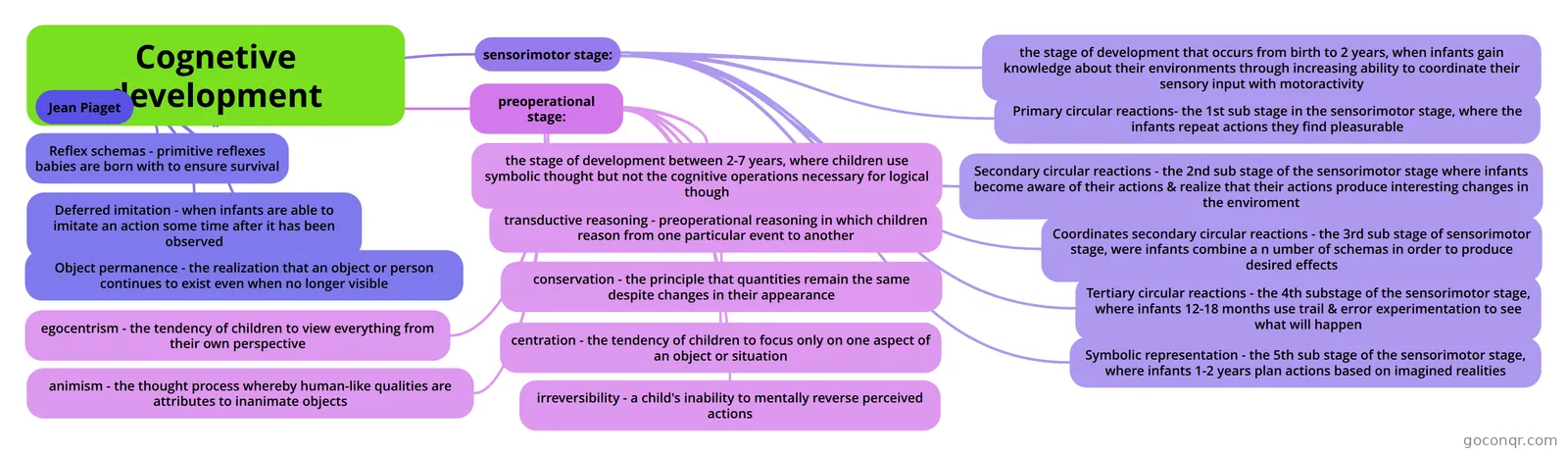
Mind map: Cognitive development
Contenido del mapa
Cognetive development
Jean Piaget
- sensorimotor stage:
- the stage of development that occurs from birth to 2 years, when infants gain knowledge about their environments through increasing ability to coordinate their sensory input with motoractivity
- Primary circular reactions- the 1st sub stage in the sensorimotor stage, where the infants repeat actions they find pleasurable
- Secondary circular reactions - the 2nd sub stage of the sensorimotor stage where infants become aware of their actions & realize that their actions produce interesting changes in the enviroment
- Coordinates secondary circular reactions - the 3rd sub stage of sensorimotor stage, were infants combine a n umber of schemas in order to produce desired effects
- Tertiary circular reactions - the 4th substage of the sensorimotor stage, where infants 12-18 months use trail & error experimentation to see what will happen
- Symbolic representation - the 5th sub stage of the sensorimotor stage, where infants 1-2 years plan actions based on imagined realities
- Reflex schemas - primitive reflexes babies are born with to ensure survival
- Deferred imitation - when infants are able to imitate an action some time after it has been observed
- Object permanence - the realization that an object or person continues to exist even when no longer visible
- preoperational stage:
- the stage of development between 2-7 years, where children use symbolic thought but not the cognitive operations necessary for logical though
- transductive reasoning - preoperational reasoning in which children reason from one particular event to another
- conservation - the principle that quantities remain the same despite changes in their appearance
- centration - the tendency of children to focus only on one aspect of an object or situation
- irreversibility - a child's inability to mentally reverse perceived actions
- egocentrism - the tendency of children to view everything from their own perspective
- animism - the thought process whereby human-like qualities are attributes to inanimate objects
- sensorimotor stage:
Información
- Descripción
- University (Chapter 4) Psychology 144 Mapa Mental sobre Cognetive development, creado por Zeneatha Jònsson el 26/08/2014.
- Creado por
- Zeneatha Jònsson
- Visitas
- 57
- Etiquetas
- Valoración