
Mapa mental
The Endocrine System
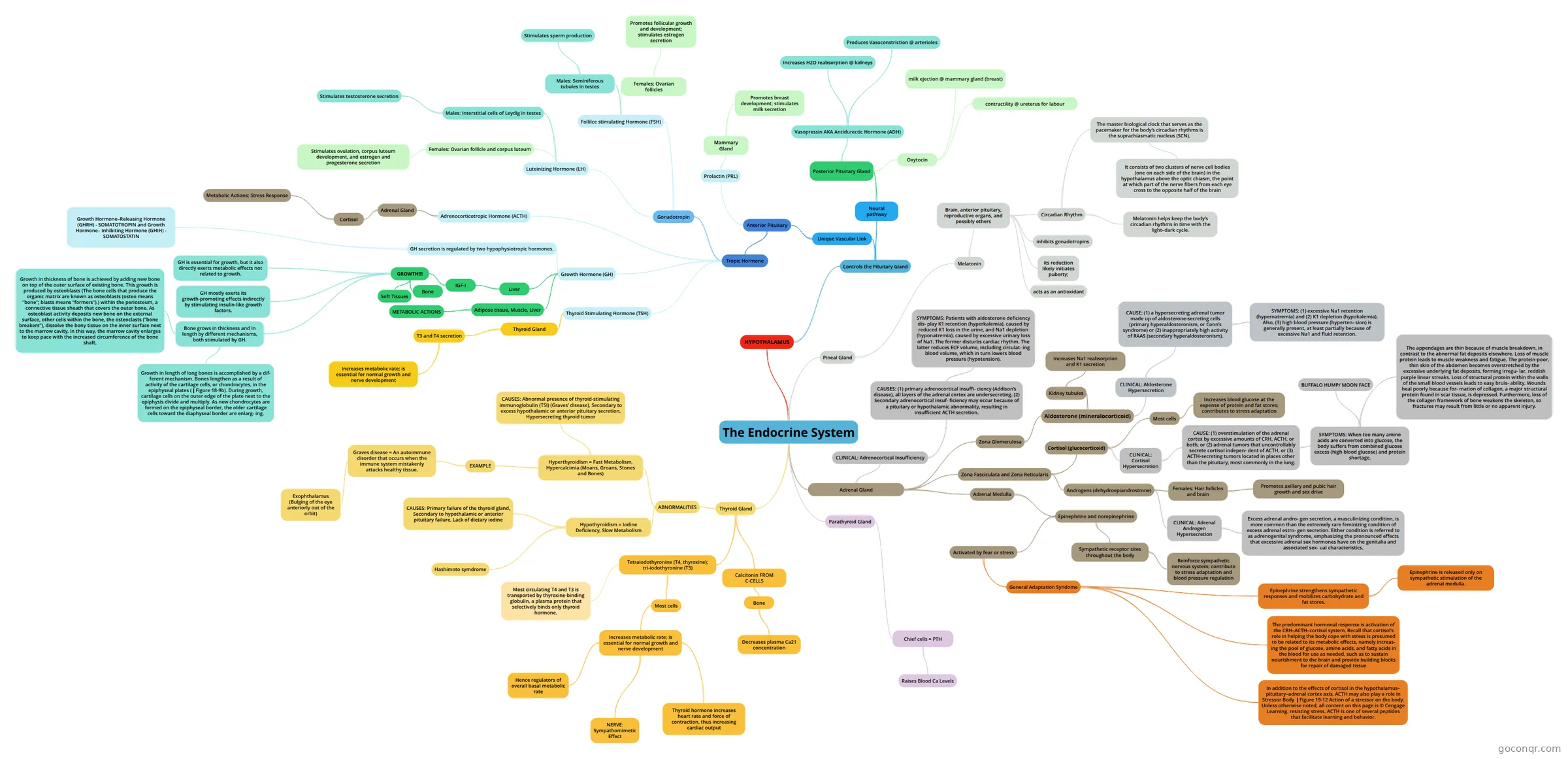
Mind map: The endocrine system
Contenido del mapa
The Endocrine System
Pineal Gland
- Melatonin
- Brain, anterior pituitary, reproductive organs, and possibly others
- Circadian Rhythm
- Entrains body’s biological rhythm with external cues
- The master biological clock that serves as the pacemaker for the body’s circadian rhythms is the suprachiasmatic nucleus (SCN).
- It consists of two clusters of nerve cell bodies (one on each side of the brain) in the hypothalamus above the optic chiasm, the point at which part of the nerve fibers from each eye cross to the opposite half of the brain
- Melatonin helps keep the body’s circadian rhythms in time with the light–dark cycle.
- inhibits gonadotropins
- its reduction likely initiates puberty;
- acts as an antioxidant
- Circadian Rhythm
- Brain, anterior pituitary, reproductive organs, and possibly others
- Melatonin
Thyroid Gland
- Tetraiodothyronine (T4, thyroxine); tri-iodothyronine (T3)
- RMB THIS IS FROM TSH
- Most cells
- Increases metabolic rate; is essential for normal growth and nerve development
- Hence regulators of overall basal metabolic rate
- NERVE: Sympathomimetic Effect
- Any action similar to one pro- duced by the sympathetic nervous system is known as a sympa- thomimetic effect (sympathomimetic means “sympathetic- mimicking”).
- Thyroid hormone increases heart rate and force of contraction, thus increasing cardiac output
- Increases metabolic rate; is essential for normal growth and nerve development
- Most circulating T4 and T3 is transported by thyroxine-binding globulin, a plasma protein that selectively binds only thyroid hormone.
- Calcitonin FROM C-CELLS
- Bone
- Decreases plasma Ca21 concentration
- Bone
- ABNORMALITIES
- Hyperthyroidism = Fast Metabolism, Hypercalcimia (Moans, Groans, Stones and Bones)
- CAUSES: Abnormal presence of thyroid-stimulating immunoglobulin (TSI) (Graves’ disease), Secondary to excess hypothalamic or anterior pituitary secretion, Hypersecreting thyroid tumor
- EXAMPLE
- Graves disease = An autoimmune disorder that occurs when the immune system mistakenly attacks healthy tissue.
- Exophthalamus (Bulging of the eye anteriorly out of the orbit)
- Graves disease = An autoimmune disorder that occurs when the immune system mistakenly attacks healthy tissue.
- Hypothyroidism = Iodine Deficiency, Slow Metabolism
- Hashimoto symdrome
- CAUSES: Primary failure of the thyroid gland, Secondary to hypothalamic or anterior pituitary failure, Lack of dietary iodine
- Hyperthyroidism = Fast Metabolism, Hypercalcimia (Moans, Groans, Stones and Bones)
- Tetraiodothyronine (T4, thyroxine); tri-iodothyronine (T3)
Parathyroid Gland
- Chief cells = PTH
- Raises Blood Ca Levels
- Chief cells = PTH
Adrenal Gland
- Zona Glomerulosa
- Aldosterone (mineralocorticoid)
- ESSENTIAL FOR LIFE
- Kidney tubules
- Increases Na1 reabsorption and K1 secretion
- CLINICAL: Aldosterone Hypersecretion
- CAUSE: (1) a hypersecreting adrenal tumor made up of aldosterone-secreting cells (primary hyperaldosteronism, or Conn’s syndrome) or (2) inappropriately high activity of RAAS (secondary hyperaldosteronism).
- SYMPTOMS: (1) excessive Na1 retention (hypernatremia) and (2) K1 depletion (hypokalemia). Also, (3) high blood pressure (hyperten- sion) is generally present, at least partially because of excessive Na1 and fluid retention.
- CAUSE: (1) a hypersecreting adrenal tumor made up of aldosterone-secreting cells (primary hyperaldosteronism, or Conn’s syndrome) or (2) inappropriately high activity of RAAS (secondary hyperaldosteronism).
- Aldosterone (mineralocorticoid)
- Zona Fasciculata and Zona Reticularis
- Cortisol (glucocorticoid)
- Cortisol, the primary glucocorticoid, plays an important role in carbohydrate, protein, and fat metabolism; executes significant permissive actions for other hormonal activities; and helps people resist stress.
- Most cells
- Increases blood glucose at the expense of protein and fat stores; contributes to stress adaptation
- CLINICAL: Cortisol Hypersecretion
- CAUSE: (1) overstimulation of the adrenal cortex by excessive amounts of CRH, ACTH, or both, or (2) adrenal tumors that uncontrollably secrete cortisol indepen- dent of ACTH, or (3) ACTH-secreting tumors located in places other than the pituitary, most commonly in the lung.
- SYMPTOMS: When too many amino acids are converted into glucose, the body suffers from combined glucose excess (high blood glucose) and protein shortage.
- BUFFALO HUMP/ MOON FACE
- The appendages are thin because of muscle breakdown, in contrast to the abnormal fat deposits elsewhere. Loss of muscle protein leads to muscle weakness and fatigue. The protein-poor, thin skin of the abdomen becomes overstretched by the excessive underlying fat deposits, forming irregu- lar, reddish purple linear streaks. Loss of structural protein within the walls of the small blood vessels leads to easy bruis- ability. Wounds heal poorly because for- mation of collagen, a major structural protein found in scar tissue, is depressed. Furthermore, loss of the collagen framework of bone weakens the skeleton, so fractures may result from little or no apparent injury.
- SYMPTOMS: When too many amino acids are converted into glucose, the body suffers from combined glucose excess (high blood glucose) and protein shortage.
- CAUSE: (1) overstimulation of the adrenal cortex by excessive amounts of CRH, ACTH, or both, or (2) adrenal tumors that uncontrollably secrete cortisol indepen- dent of ACTH, or (3) ACTH-secreting tumors located in places other than the pituitary, most commonly in the lung.
- Androgens (dehydroepiandrostrone)
- Females: Hair follicles and brain
- Promotes axillary and pubic hair growth and sex drive
- CLINICAL: Adrenal Androgen Hypersecretion
- Excess adrenal andro- gen secretion, a masculinizing condition, is more common than the extremely rare feminizing condition of excess adrenal estro- gen secretion. Either condition is referred to as adrenogenital syndrome, emphasizing the pronounced effects that excessive adrenal sex hormones have on the genitalia and associated sex- ual characteristics.
- Females: Hair follicles and brain
- Cortisol (glucocorticoid)
- Adrenal Medulla
- Epinephrine and norepinephrine
- Sympathetic receptor sites throughout the body
- Reinforce sympathetic nervous system; contribute to stress adaptation and blood pressure regulation
- Activated by fear or stress
- General Adaptation Syndome
- Epinephrine strengthens sympathetic responses and mobilizes carbohydrate and fat stores.
- Epinephrine is released only on sympathetic stimulation of the adrenal medulla.
- The predominant hormonal response is activation of the CRH–ACTH–cortisol system. Recall that cortisol’s role in helping the body cope with stress is presumed to be related to its metabolic effects, namely increas- ing the pool of glucose, amino acids, and fatty acids in the blood for use as needed, such as to sustain nourishment to the brain and provide building blocks for repair of damaged tissue
- In addition to the effects of cortisol in the hypothalamus– pituitary–adrenal cortex axis, ACTH may also play a role in Stressor Body ❙Figure 19-12 Action of a stressor on the body. Unless otherwise noted, all content on this page is © Cengage Learning. resisting stress. ACTH is one of several peptides that facilitate learning and behavior.
- Epinephrine strengthens sympathetic responses and mobilizes carbohydrate and fat stores.
- General Adaptation Syndome
- Sympathetic receptor sites throughout the body
- Epinephrine and norepinephrine
- CLINICAL: Adrenocortical Insufficiency
- CAUSES: (1) primary adrenocortical insuffi- ciency (Addison’s disease), all layers of the adrenal cortex are undersecreting. (2) Secondary adrenocortical insuf- ficiency may occur because of a pituitary or hypothalamic abnormality, resulting in insufficient ACTH secretion.
- SYMPTOMS: Patients with aldosterone deficiency dis- play K1 retention (hyperkalemia), caused by reduced K1 loss in the urine, and Na1 depletion (hyponatremia), caused by excessive urinary loss of Na1. The former disturbs cardiac rhythm. The latter reduces ECF volume, including circulat- ing blood volume, which in turn lowers blood pressure (hypotension).
- CAUSES: (1) primary adrenocortical insuffi- ciency (Addison’s disease), all layers of the adrenal cortex are undersecreting. (2) Secondary adrenocortical insuf- ficiency may occur because of a pituitary or hypothalamic abnormality, resulting in insufficient ACTH secretion.
- Zona Glomerulosa
HYPOTHALAMUS
- Controls the Pituitary Gland
- Neural pathway
- Posterior Pituitary Gland
- Oxytocin
- contractility @ ureterus for labour
- milk ejection @ mammary gland (breast)
- Vasopressin AKA Antidurectic Hormone (ADH)
- Increases H2O reabsorption @ kidneys
- Produces Vasoconstriction @ arterioles
- Oxytocin
- Posterior Pituitary Gland
- Unique Vascular Link
- Anterior Pituitary
- Prolactin (PRL)
- Mammary Gland
- Promotes breast development; stimulates milk secretion
- Mammary Gland
- Tropic Hormone
- A hormone that has as its primary function the regulation of hormone secretion by another endocrine gland is classified functionally as a tropic hormone (tropic means “nourishing” and is pronounced “trō-pik”).
- Thyroid Stimulating Hormone (TSH)
- Thyroid Gland
- T3 and T4 secretion
- Increases metabolic rate; is essential for normal growth and nerve development
- T3 and T4 secretion
- Thyroid Gland
- Adrenocorticotropic Hormone (ACTH)
- Adrenal Gland
- Cortisol
- Metabolic Actions; Stress Response
- Cortisol
- Adrenal Gland
- Growth Hormone (GH)
- SOMATRIOPIN
- Liver
- IGF-I
- GROWTH!!!
- Bone
- Soft Tissues
- GH is essential for growth, but it also directly exerts metabolic effects not related to growth.
- GH mostly exerts its growth-promoting effects indirectly by stimulating insulin-like growth factors.
- Bone grows in thickness and in length by different mechanisms, both stimulated by GH.
- Growth in thickness of bone is achieved by adding new bone on top of the outer surface of existing bone. This growth is produced by osteoblasts (The bone cells that produce the organic matrix are known as osteoblasts (osteo means “bone”; blasts means “formers”).) within the periosteum, a connective tissue sheath that covers the outer bone. As osteoblast activity deposits new bone on the external surface, other cells within the bone, the osteoclasts (“bone breakers”), dissolve the bony tissue on the inner surface next to the marrow cavity. In this way, the marrow cavity enlarges to keep pace with the increased circumference of the bone shaft.
- Growth in length of long bones is accomplished by a dif- ferent mechanism. Bones lengthen as a result of activity of the cartilage cells, or chondrocytes, in the epiphyseal plates (❙Figure 18-9b). During growth, cartilage cells on the outer edge of the plate next to the epiphysis divide and multiply. As new chondrocytes are formed on the epiphyseal border, the older cartilage cells toward the diaphyseal border are enlarg- ing.
- GROWTH!!!
- IGF-I
- Adipose tissue, Muscle, Liver
- METABOLIC ACTIONS
- Definition: the whole range of biochemical processes that occur within us (or any living organism). Metabolism consists of anabolism (the buildup of substances) and catabolism (the breakdown of substances).
- METABOLIC ACTIONS
- GH secretion is regulated by two hypophysiotropic hormones.
- Growth Hormone–Releasing Hormone (GHRH) - SOMATOTROPIN and Growth Hormone– Inhibiting Hormone (GHIH) - SOMATOSTATIN
- Gonadotropin
- Luteinizing Hormone (LH)
- Females: Ovarian follicle and corpus luteum
- Stimulates ovulation, corpus luteum development, and estrogen and progesterone secretion
- Males: Interstitial cells of Leydig in testes
- Stimulates testosterone secretion
- Females: Ovarian follicle and corpus luteum
- Follilce stimulating Hormone (FSH)
- Females: Ovarian follicles
- Promotes follicular growth and development; stimulates estrogen secretion
- Males: Seminiferous tubules in testes
- Stimulates sperm production
- Females: Ovarian follicles
- Luteinizing Hormone (LH)
- Prolactin (PRL)
- Anterior Pituitary
- Neural pathway
- Controls the Pituitary Gland
Información
- Descripción
- The Endocrine System to include some diseases and hormones released by the glands.
- Creado por
- Gena Wong
- Visitas
- 1
- Etiquetas
- Historial
-
- Creado por DrABC · 20 jun 2015
- Copiado por Gena Wong · 25 feb 2019
- Valoración