
Mapa mental
The Formation of Romantic Relationships
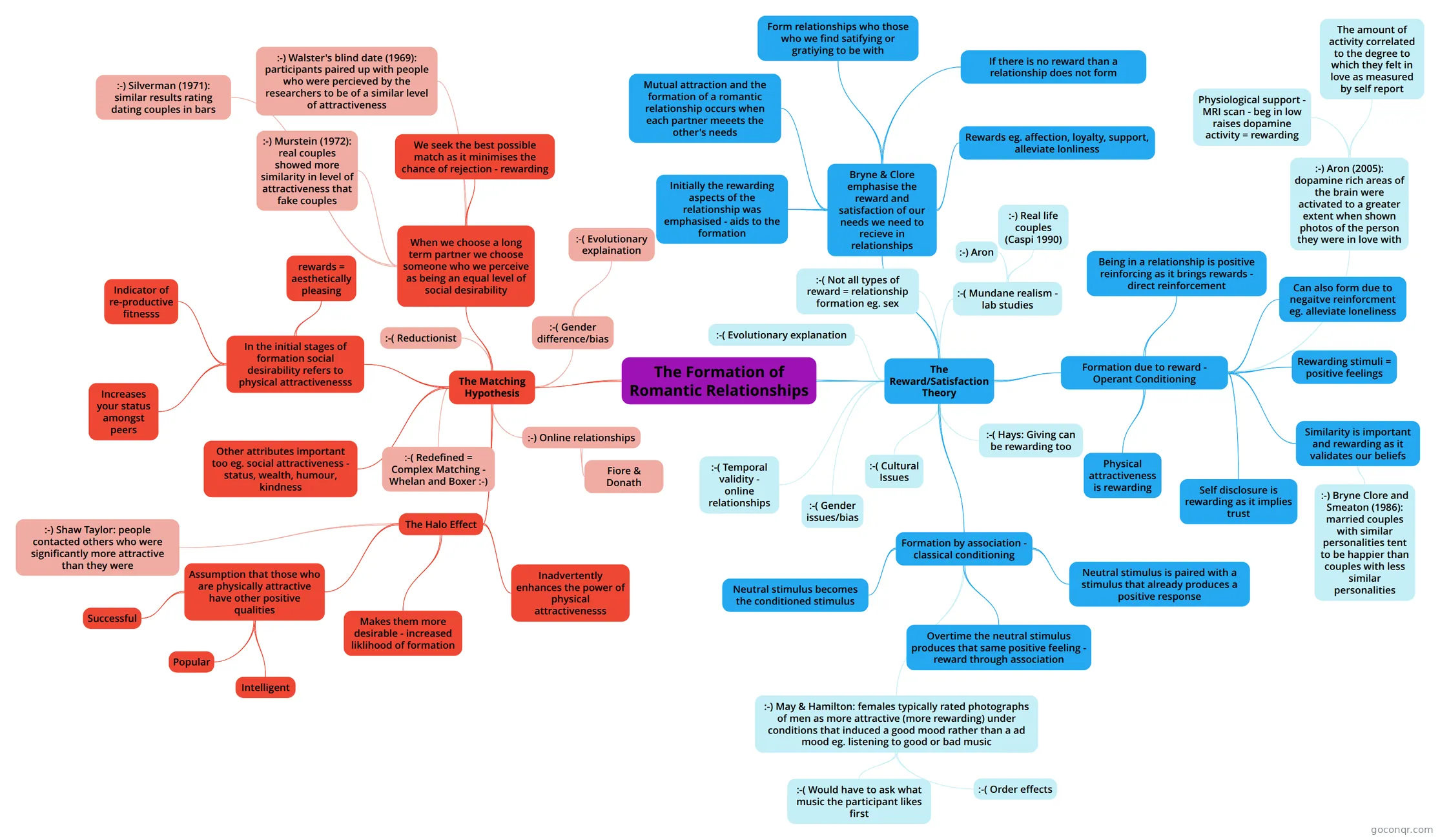
Mind map: formation of romantic relationships
Contenido del mapa
The Formation of Romantic Relationships
The Reward/Satisfaction Theory
- Bryne & Clore emphasise the reward and satisfaction of our needs we need to recieve in relationships
- Initially the rewarding aspects of the relationship was emphasised - aids to the formation
- Mutual attraction and the formation of a romantic relationship occurs when each partner meeets the other's needs
- Form relationships who those who we find satifying or gratiying to be with
- If there is no reward than a relationship does not form
- Rewards eg. affection, loyalty, support, alleviate lonliness
- Formation due to reward - Operant Conditioning
- Being in a relationship is positive reinforcing as it brings rewards - direct reinforcement
- Can also form due to negaitve reinforcment eg. alleviate loneliness
- Rewarding stimuli = positive feelings
- Similarity is important and rewarding as it validates our beliefs
- :-) Bryne Clore and Smeaton (1986): married couples with similar personalities tent to be happier than couples with less similar personalities
- Self disclosure is rewarding as it implies trust
- Physical attractiveness is rewarding
- :-) Aron (2005): dopamine rich areas of the brain were activated to a greater extent when shown photos of the person they were in love with
- The amount of activity correlated to the degree to which they felt in love as measured by self report
- Physiological support - MRI scan - beg in low raises dopamine activity = rewarding
- Formation by association - classical conditioning
- Neutral stimulus is paired with a stimulus that already produces a positive response
- Overtime the neutral stimulus produces that same positive feeling - reward through association
- Neutral stimulus becomes the conditioned stimulus
- :-) May & Hamilton: females typically rated photographs of men as more attractive (more rewarding) under conditions that induced a good mood rather than a ad mood eg. listening to good or bad music
- :-( Would have to ask what music the participant likes first
- :-( Order effects
- :-( Mundane realism - lab studies
- :-) Aron
- :-) Real life couples (Caspi 1990)
- :-( Not all types of reward = relationship formation eg. sex
- :-( Hays: Giving can be rewarding too
- :-( Cultural Issues
- :-( Gender issues/bias
- :-( Temporal validity - online relationships
- :-( Evolutionary explanation
- Bryne & Clore emphasise the reward and satisfaction of our needs we need to recieve in relationships
The Matching Hypothesis
- When we choose a long term partner we choose someone who we perceive as being an equal level of social desirability
- We seek the best possible match as it minimises the chance of rejection - rewarding
- :-) Walster's blind date (1969): participants paired up with people who were percieved by the researchers to be of a similar level of attractiveness
- :-) Murstein (1972): real couples showed more similarity in level of attractiveness that fake couples
- :-) Silverman (1971): similar results rating dating couples in bars
- In the initial stages of formation social desirability refers to physical attractivenesss
- rewards = aesthetically pleasing
- Indicator of re-productive fitnesss
- Increases your status amongst peers
- The Halo Effect
- Assumption that those who are physically attractive have other positive qualities
- Successful
- Popular
- Intelligent
- Makes them more desirable - increased liklihood of formation
- Inadvertently enhances the power of physical attractivenesss
- :-) Shaw Taylor: people contacted others who were significantly more attractive than they were
- Assumption that those who are physically attractive have other positive qualities
- Other attributes important too eg. social attractiveness - status, wealth, humour, kindness
- :-) Online relationships
- Fiore & Donath
- :-( Gender difference/bias
- :-( Evolutionary explaination
- :-( Redefined = Complex Matching - Whelan and Boxer :-)
- :-( Reductionist
- When we choose a long term partner we choose someone who we perceive as being an equal level of social desirability
Información
- Descripción
- A level (PSYA3 - Relationships) Psychology Mapa Mental sobre The Formation of Romantic Relationships, creado por Sandie Garland el 08/01/2015.
- Creado por
- Sandie Garland
- Visitas
- 154
- Etiquetas
- Valoración