
Mapa mental
Week 1: Evolving Life - Natural Selection and Speciation
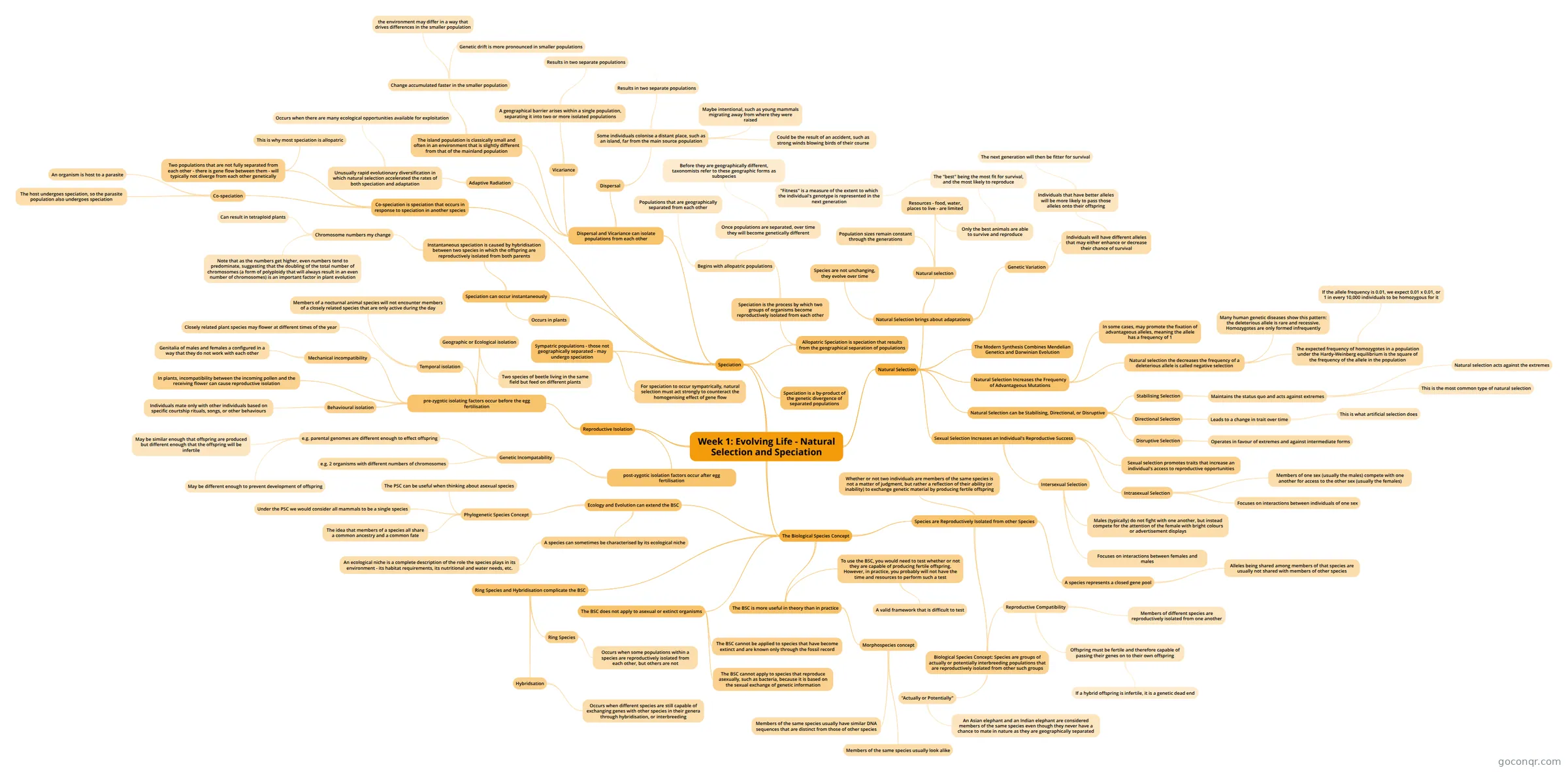
Mind map: natural selection and speciation
Contenido del mapa
Week 1: Evolving Life - Natural Selection and Speciation
Natural Selection
- Natural Selection brings about adaptations
- Species are not unchanging, they evolve over time
- Natural selection
- Population sizes remain constant through the generations
- Resources - food, water, places to live - are limited
- Only the best animals are able to survive and reproduce
- The "best" being the most fit for survival, and the most likely to reproduce
- "Fitness" is a measure of the extent to which the individual's genotype is represented in the next generation
- The "best" being the most fit for survival, and the most likely to reproduce
- Only the best animals are able to survive and reproduce
- Genetic Variation
- Individuals will have different alleles that may either enhance or decrease their chance of survival
- Individuals that have better alleles will be more likely to pass those alleles onto their offspring
- The next generation will then be fitter for survival
- Individuals that have better alleles will be more likely to pass those alleles onto their offspring
- Individuals will have different alleles that may either enhance or decrease their chance of survival
- The Modern Synthesis Combines Mendelian Genetics and Darwinian Evolution
- Natural Selection Increases the Frequency of Advantageous Mutations
- In some cases, may promote the fixation of advantageous alleles, meaning the allele has a frequency of 1
- Natural selection the decreases the frequency of a deleterious allele is called negative selection
- Many human genetic diseases show this pattern: the deleterious allele is rare and recessive. Homozygotes are only formed infrequently
- The expected frequency of homozygotes in a population under the Hardy-Weinberg equilibrium is the square of the frequency of the allele in the population
- If the allele frequency is 0.01, we expect 0.01 x 0.01, or 1 in every 10,000 individuals to be homozygous for it
- Natural Selection can be Stabilising, Directional, or Disruptive
- Stabilising Selection
- Maintains the status quo and acts against extremes
- Natural selection acts against the extremes
- This is the most common type of natural selection
- Maintains the status quo and acts against extremes
- Directional Selection
- Leads to a change in trait over time
- This is what artificial selection does
- Leads to a change in trait over time
- Disruptive Selection
- Operates in favour of extremes and against intermediate forms
- Stabilising Selection
- Sexual Selection Increases an Individual's Reproductive Success
- Sexual selection promotes traits that increase an individual's access to reproductive opportunities
- Intrasexual Selection
- Members of one sex (usually the males) compete with one another for access to the other sex (usually the females)
- Focuses on interactions between individuals of one sex
- Intersexual Selection
- Focuses on interactions between females and males
- Males (typically) do not fight with one another, but instead compete for the attention of the female with bright colours or advertisement displays
- Natural Selection brings about adaptations
The Biological Species Concept
- Species are Reproductively Isolated from other Species
- Whether or not two individuals are members of the same species is not a matter of judgment, but rather a reflection of their ability (or inability) to exchange genetic material by producing fertile offspring
- A species represents a closed gene pool
- Alleles being shared among members of that species are usually not shared with members of other species
- Biological Species Concept: Species are groups of actually or potentially interbreeding populations that are reproductively isolated from other such groups
- Reproductive Compatibility
- Members of different species are reproductively isolated from one another
- Offspring must be fertile and therefore capable of passing their genes on to their own offspring
- If a hybrid offspring is infertile, it is a genetic dead end
- "Actually or Potentially"
- An Asian elephant and an Indian elephant are considered members of the same species even though they never have a chance to mate in nature as they are geographically separated
- Reproductive Compatibility
- The BSC is more useful in theory than in practice
- To use the BSC, you would need to test whether or not they are capable of producing fertile offspring. However, in practice, you probably will not have the time and resources to perform such a test
- A valid framework that is difficult to test
- Morphospecies concept
- Members of the same species usually look alike
- Members of the same species usually have similar DNA sequences that are distinct from those of other species
- To use the BSC, you would need to test whether or not they are capable of producing fertile offspring. However, in practice, you probably will not have the time and resources to perform such a test
- The BSC does not apply to asexual or extinct organisms
- The BSC cannot apply to species that reproduce asexually, such as bacteria, because it is based on the sexual exchange of genetic information
- The BSC cannot be applied to species that have become extinct and are known only through the fossil record
- Ring Species and Hybridisation complicate the BSC
- Ring Species
- Occurs when some populations within a species are reproductively isolated from each other, but others are not
- Hybridsation
- Occurs when different species are still capable of exchanging genes with other species in their genera through hybridisation, or interbreeding
- Ring Species
- Ecology and Evolution can extend the BSC
- A species can sometimes be characterised by its ecological niche
- An ecological niche is a complete description of the role the species plays in its environment - its habitat requirements, its nutritional and water needs, etc.
- Phylogenetic Species Concept
- The idea that members of a species all share a common ancestry and a common fate
- Under the PSC we would consider all mammals to be a single species
- The PSC can be useful when thinking about asexual species
- A species can sometimes be characterised by its ecological niche
- Species are Reproductively Isolated from other Species
Reproductive Isolation
- post-zygotic isolation factors occur after egg fertilisation
- Genetic Incompatability
- e.g. 2 organisms with different numbers of chromosomes
- e.g. parental genomes are different enough to effect offspring
- May be different enough to prevent development of offspring
- May be similar enough that offspring are produced but different enough that the offspring will be infertile
- Genetic Incompatability
- pre-zygotic isolating factors occur before the egg fertilisation
- Behavioural isolation
- Individuals mate only with other individuals based on specific courtship rituals, songs, or other behaviours
- In plants, incompatibility between the incoming pollen and the receiving flower can cause reproductive isolation
- Mechanical incompatibility
- Genitalia of males and females a configured in a way that they do not work with each other
- Temporal isolation
- Closely related plant species may flower at different times of the year
- Members of a nocturnal animal species will not encounter members of a closely related species that are only active during the day
- Geographic or Ecological isolation
- Two species of beetle living in the same field but feed on different plants
- Behavioural isolation
- post-zygotic isolation factors occur after egg fertilisation
Speciation
- Speciation is a by-product of the genetic divergence of separated populations
- Allopatric Speciation is speciation that results from the geographical separation of populations
- Speciation is the process by which two groups of organisms become reproductively isolated from each other
- Begins with allopatric populations
- Populations that are geographically separated from each other
- Once populations are separated, over time they will become genetically different
- Before they are geographically different, taxonomists refer to these geographic forms as subspecies
- Begins with allopatric populations
- Speciation is the process by which two groups of organisms become reproductively isolated from each other
- Dispersal and Vicariance can isolate populations from each other
- Dispersal
- Some individuals colonise a distant place, such as an island, far from the main source population
- Results in two separate populations
- Maybe intentional, such as young mammals migrating away from where they were raised
- Could be the result of an accident, such as strong winds blowing birds of their course
- Some individuals colonise a distant place, such as an island, far from the main source population
- Vicariance
- A geographical barrier arises within a single population, separating it into two or more isolated populations
- Results in two separate populations
- A geographical barrier arises within a single population, separating it into two or more isolated populations
- The island population is classically small and often in an environment that is slightly different from that of the mainland population
- Change accumulated faster in the smaller population
- Genetic drift is more pronounced in smaller populations
- the environment may differ in a way that drives differences in the smaller population
- Change accumulated faster in the smaller population
- Adaptive Radiation
- Unusually rapid evolutionary diversification in which natural selection accelerated the rates of both speciation and adaptation
- Occurs when there are many ecological opportunities available for exploitation
- Unusually rapid evolutionary diversification in which natural selection accelerated the rates of both speciation and adaptation
- Dispersal
- Co-speciation is speciation that occurs in response to speciation in another species
- Two populations that are not fully separated from each other - there is gene flow between them - will typically not diverge from each other genetically
- This is why most speciation is allopatric
- Co-speciation
- An organism is host to a parasite
- The host undergoes speciation, so the parasite population also undergoes speciation
- Two populations that are not fully separated from each other - there is gene flow between them - will typically not diverge from each other genetically
- Sympatric populations - those not geographically separated - may undergo speciation
- For speciation to occur sympatrically, natural selection must act strongly to counteract the homogenising effect of gene flow
- Speciation can occur instantaneously
- Instantaneous speciation is caused by hybridisation between two species in which the offspring are reproductively isolated from both parents
- Chromosome numbers my change
- Can result in tetraploid plants
- Note that as the numbers get higher, even numbers tend to predominate, suggesting that the doubling of the total number of chromosomes (a form of polyploidy that will always result in an even number of chromosomes) is an important factor in plant evolution
- Chromosome numbers my change
- Occurs in plants
- Instantaneous speciation is caused by hybridisation between two species in which the offspring are reproductively isolated from both parents
Información
- Descripción
- Year 10 (YEAR 1 SEM 2) Biology Mapa Mental sobre Week 1: Evolving Life - Natural Selection and Speciation, creado por Ashleigh Hollins el 05/10/2019.
- Creado por
- Ashleigh Hollins
- Visitas
- 0
- Valoración