
Mapa mental
An Introduction to Language
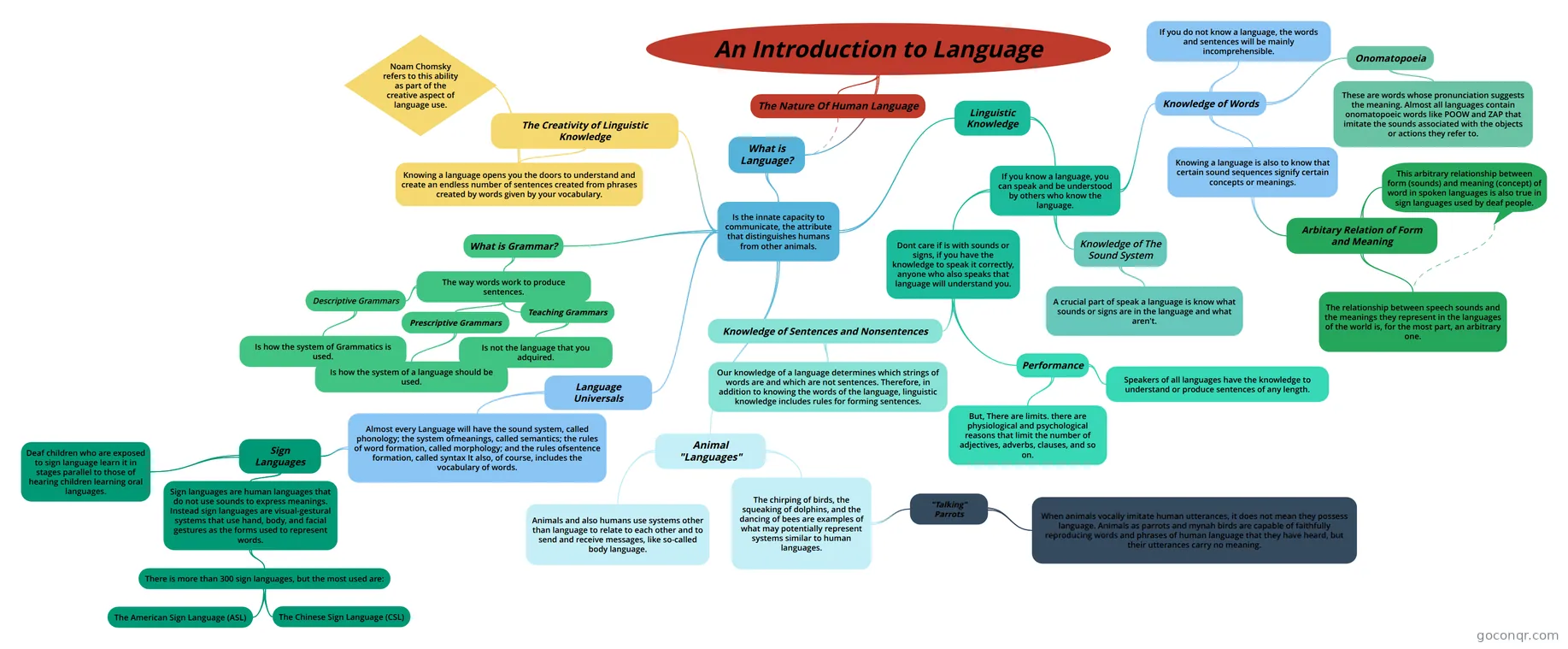
Mind map: Introduction to Language
Contenido del mapa
An Introduction to Language
What is Language?
- Is the innate capacity to communicate, the attribute that distinguishes humans from other animals.
- Linguistic Knowledge
- If you know a language, you can speak and be understood by others who know the language.
- Knowledge of The Sound System
- A crucial part of speak a language is know what sounds or signs are in the language and what aren't.
- Dont care if is with sounds or signs, if you have the knowledge to speak it correctly, anyone who also speaks that language will understand you.
- Knowledge of Sentences and Nonsentences
- Our knowledge of a language determines which strings of words are and which are not sentences. Therefore, in addition to knowing the words of the language, linguistic knowledge includes rules for forming sentences.
- Performance
- Speakers of all languages have the knowledge to understand or produce sentences of any length.
- But, There are limits. there are physiological and psychological reasons that limit the number of adjectives, adverbs, clauses, and so on.
- Knowledge of Sentences and Nonsentences
- Knowledge of Words
- Knowing a language is also to know that certain sound sequences signify certain concepts or meanings.
- Arbitary Relation of Form and Meaning
- The relationship between speech sounds and the meanings they represent in the languages of the world is, for the most part, an arbitrary one.
- This arbitrary relationship between form (sounds) and meaning (concept) of word in spoken languages is also true in sign languages used by deaf people.
- Arbitary Relation of Form and Meaning
- If you do not know a language, the words and sentences will be mainly incomprehensible.
- Onomatopoeia
- These are words whose pronunciation suggests the meaning. Almost all languages contain onomatopoeic words like POOW and ZAP that imitate the sounds associated with the objects or actions they refer to.
- Knowing a language is also to know that certain sound sequences signify certain concepts or meanings.
- Knowledge of The Sound System
- If you know a language, you can speak and be understood by others who know the language.
- The Creativity of Linguistic Knowledge
- Knowing a language opens you the doors to understand and create an endless number of sentences created from phrases created by words given by your vocabulary.
- Noam Chomsky refers to this ability as part of the creative aspect of language use.
- Knowing a language opens you the doors to understand and create an endless number of sentences created from phrases created by words given by your vocabulary.
- What is Grammar?
- The way words work to produce sentences.
- Descriptive Grammars
- Is how the system of Grammatics is used.
- Prescriptive Grammars
- Is how the system of a language should be used.
- Teaching Grammars
- Is not the language that you adquired.
- Descriptive Grammars
- The way words work to produce sentences.
- Language Universals
- Almost every Language will have the sound system, called phonology; the system ofmeanings, called semantics; the rules of word formation, called morphology; and the rules ofsentence formation, called syntax It also, of course, includes the vocabulary of words.
- Sign Languages
- Sign languages are human languages that do not use sounds to express meanings. Instead sign languages are visual-gestural systems that use hand, body, and facial gestures as the forms used to represent words.
- There is more than 300 sign languages, but the most used are:
- The American Sign Language (ASL)
- The Chinese Sign Language (CSL)
- There is more than 300 sign languages, but the most used are:
- Deaf children who are exposed to sign language learn it in stages parallel to those of hearing children learning oral languages.
- Sign languages are human languages that do not use sounds to express meanings. Instead sign languages are visual-gestural systems that use hand, body, and facial gestures as the forms used to represent words.
- Sign Languages
- Almost every Language will have the sound system, called phonology; the system ofmeanings, called semantics; the rules of word formation, called morphology; and the rules ofsentence formation, called syntax It also, of course, includes the vocabulary of words.
- Animal "Languages"
- Animals and also humans use systems other than language to relate to each other and to send and receive messages, like so-called body language.
- The chirping of birds, the squeaking of dolphins, and the dancing of bees are examples of what may potentially represent systems similar to human languages.
- "Talking" Parrots
- When animals vocally imitate human utterances, it does not mean they possess language. Animals as parrots and mynah birds are capable of faithfully reproducing words and phrases of human language that they have heard, but their utterances carry no meaning.
- "Talking" Parrots
- Linguistic Knowledge
- Is the innate capacity to communicate, the attribute that distinguishes humans from other animals.
The Nature Of Human Language
Información
- Descripción
- Mapa Mental sobre An Introduction to Language, creado por Nicolás Fierro el 06/02/2020.
- Creado por
- Nicolás Fierro
- Visitas
- 2
- Etiquetas
- Valoración